HelloCthulhu
- 150
- 3
I've been researching dielectric breakdown for a while and came across this interesting experiment:
https://tore.tuhh.de/bitstream/1142..._nano_to_millimeter_scale_TUB_Doc_version.pdf
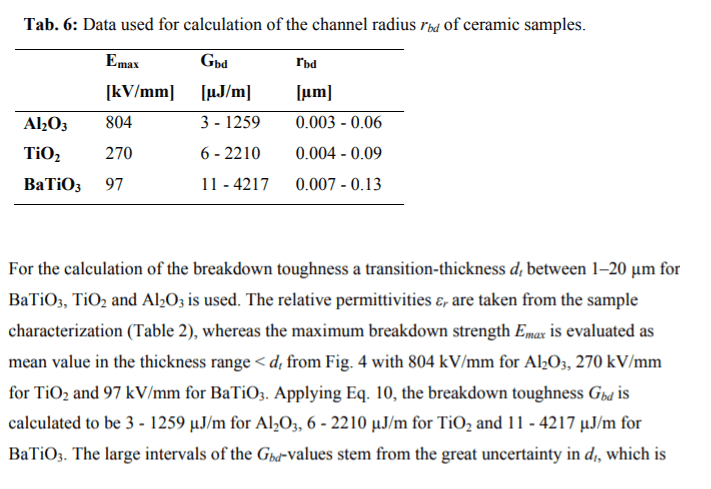
0.3mm of BaTiO3 was placed between two electrodes and reached its dielectric breakdown at 97kV/mm. At 0.3mm thickness this was probably around 29kV. I'm trying to understand what the current was, but so far I only know that a dc high voltage generator HCN 140-35000 with a current limit of 4 mA and a maximum voltage of 35 kV was used during the experiment. I'm not familiar with the relationship between μJ/m and current if there is one, but it's the only information on joules used I could see. Any assistance is greatly appreciated!
https://tore.tuhh.de/bitstream/1142..._nano_to_millimeter_scale_TUB_Doc_version.pdf
0.3mm of BaTiO3 was placed between two electrodes and reached its dielectric breakdown at 97kV/mm. At 0.3mm thickness this was probably around 29kV. I'm trying to understand what the current was, but so far I only know that a dc high voltage generator HCN 140-35000 with a current limit of 4 mA and a maximum voltage of 35 kV was used during the experiment. I'm not familiar with the relationship between μJ/m and current if there is one, but it's the only information on joules used I could see. Any assistance is greatly appreciated!