Engineering What is the Definition of Aspect Angle in 3D Motion?

  • Thread starter Thread starter jisbon
  • Start date Start date
  • Tags Tags
    3d Angle Plane
Click For Summary
SUMMARY

The aspect angle in 3D motion is defined as the angle between the observer's line of sight and the direction of the moving object, such as a ball. When the observer is directly facing the ball, the aspect angle is 0 degrees, while if the observer and the ball are aligned in the same direction, the aspect angle is 180 degrees. Height or elevation does not affect the aspect angle, as it is determined on the horizontal plane after projecting the object's position perpendicularly. The common definition of aspect angle also considers the orientation of the target, which is crucial for accurate calculations.

PREREQUISITES
  • Understanding of 3D motion dynamics
  • Familiarity with geometric projections
  • Knowledge of angles and their measurement in navigation
  • Basic principles of radar and line of sight (LOS) calculations
NEXT STEPS
  • Research the mathematical representation of aspect angles in 3D motion
  • Explore geometric projection techniques in physics
  • Learn about radar systems and their use of aspect angles
  • Investigate the implications of elevation angles in projectile motion analysis
USEFUL FOR

This discussion is beneficial for physicists, engineers, and students studying motion dynamics, as well as anyone involved in radar technology and projectile analysis.

jisbon
Messages
475
Reaction score
30
Homework Statement
What is exactly the aspect angle in the 2 figures below?
Relevant Equations
-
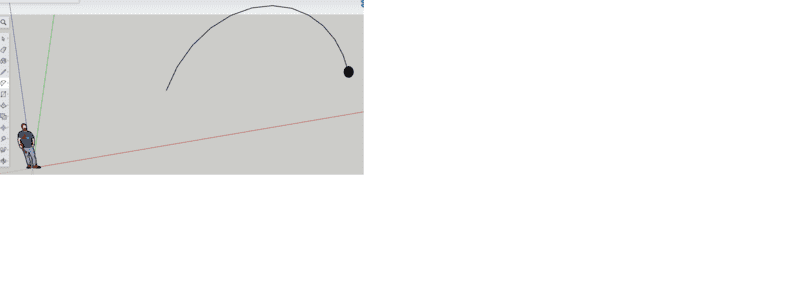
Hi all, a bit confused with regards to the whole term aspect angle. Most examples that I searched online involved either a 2D plane or a stationary object.

In this case:
1643256115946.png

Let's say the man is facing the ball. In this case, the ball is being thrown from the right to the left. Since the man is looking at the ball (same axis), from his POV, the aspect angle will always be 180 degrees (since aspect angle is defined as the angle between the person looking and the motion of the ball)? Do I need to account for the height? Will that be the depression angle instead of aspect angle?

Second case:
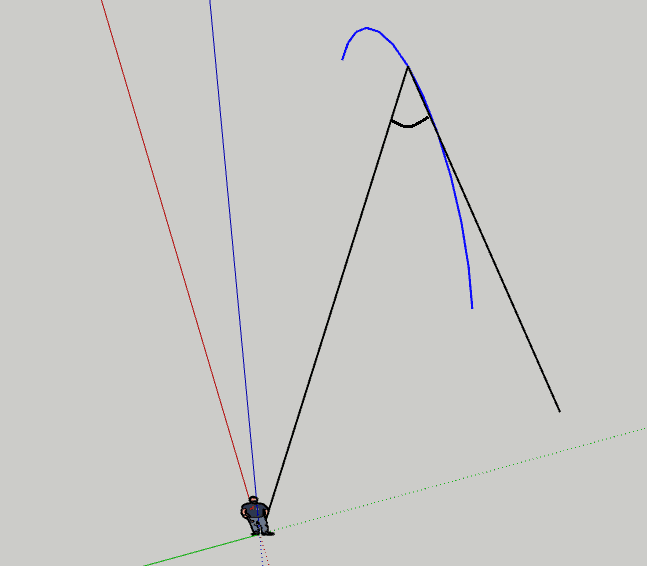
1643256286648.png

Viewing from the top, let say another ball is thrown nearer to him as depicted. In this case, if the ball is somewhere in the middle of the motion, will that be the aspect angle that I have drawn out? Do I need to account for any depression/elevation angle?

Thank you.
 
Physics news on Phys.org
CORRECTION: If he is always looking directly at the ball, the aspect angle of the ball in his head coordinate system is always zero. Aspect is the compass direction that a slope faces. The height can be ignored in most descriptions of aspect angle because the ball position is first projected perpendicularly onto the horizontal plane (that is the elevation angle). After the projection, the aspect angle is determined on the horizontal plane.
 
Last edited:
FactChecker said:
If he is always looking directly at the ball, the aspect angle of the ball in his head coordinate system is always zero. The height can be ignored in most descriptions of aspect angle because the ball position is first projected perpendicularly onto the horizontal plane (that is the elevation angle). After the projection, the aspect angle is determined on the horizontal plane.
Thanks for the reply. So from what I have read:

1) So what is the scenario when the aspect angle is 180 degrees? They are both facing the same direction? (Person and motion of projectile)

2) "After the projection, the aspect angle is determined on the horizontal plane." - May I know what does this implies? Does this means for the first projection picture, aspect angle remains constant at 0 degrees? Since it is going towards directly to the person, just going up and coming down. For the second case, that will be my angle I assume?
 
I have to correct my prior post. Aspect is the compass direction that a slope faces. I hope this clarifies the situation.
 
FactChecker said:
I have to correct my prior post. Aspect is the compass direction that a slope faces. I hope this clarifies the situation.
Hence my original assumption is correct? If the projectile is head on towards the person the aspect angle will be 180?
 
jisbon said:
Hence my original assumption is correct? If the projectile is head on towards the person the aspect angle will be 180?
The commoon definition of "aspect angle" is the angle off from North. It sounds like you are using a definition based on the direction that the man is looking. Is that correct? If so, are you assuming that the man changes where he is looking and turns to always face the ball? In that case, then the "aspect angle" of your definition is always 0. Height (elevation) does not matter when calculating the aspect angle..
 
FactChecker said:
The commoon definition of "aspect angle" is the angle off from North. It sounds like you are using a definition based on the direction that the man is looking. Is that correct? If so, are you assuming that the man changes where he is looking and turns to always face the ball? In that case, then the "aspect angle" of your definition is always 0. Height (elevation) does not matter when calculating the aspect angle..
Using this definition: The aspect angle θ is defined as the angle between the major axis of the target (heading direction) and the radar LOS
Assuming the man is the radar, then my aspect angle will always be 0?
When will aspect angle be 180? When the radar/man is facing the same direction as the projectile motion?
From the definition, I would have thought that aspect angle will always be 180 since the projectile motion and the LOS of the man is directly clashing with each other.
 
jisbon said:
Using this definition: The aspect angle θ is defined as the angle between the major axis of the target (heading direction) and the radar LOS
Ok. It looks like this definition is very different from the ones I was thinking of. The orientation of the target is important. It is measuring the direction that the target is pointing toward off of the direct line to the radar.
jisbon said:
Assuming the man is the radar, then my aspect angle will always be 0?
No. If the target is not pointing directly at the man, it will not be zero. Your example of a ball is not appropriate since a ball does not point in any particular direction. With that in mind, I don't know how to answer your question.
 
1643334130074.png

FactChecker said:
Ok. It looks like this definition is very different from the ones I was thinking of. The orientation of the target is important. It is measuring the direction that the target is pointing toward off of the direct line to the radar.

No. If the target is not pointing directly at the man, it will not be zero. Your example of a ball is not appropriate since a ball does not point in any particular direction. With that in mind, I don't know how to answer your question.
Assume the ball is going in the direction as indicated in the picture. From the man's POV, the ball will be directly heading towards him since they are in the same axis , just changing heights. Hence, I would have thought that aspect angle is 180 degrees.

As for orientation, do you mean which direction the ball is going?

EDIT: This picture may give a clearer view.
1643334528872.png

Both man and ball lie on the red axis. Ball is flying towards the man in a projectile motion. Hence from man's POV, ball is coming towards him straight on. In this case, A.A is still 0 degrees? or 180 degrees? Does orientation matter in this context?

Top View:
1643334648523.png

Man facing towards the ball as shown, ball going up and coming downwards towards him as shown from the top view. Hence I would have thought a.a is 180 degrees throughout the whole projectile motion.
 
Last edited:
  • #10
Usually, the "heading" refers to the direction that a plane is pointing (compass angle off of North), not necessarily the path that it is following. In a sidewind, the plane does not point in the direction that it is going. So the heading is not the same as the direction of the path it is traveling (flight path). I don't know how it is defined for your problem.
 

Similar threads

  • · Replies 2 ·
Replies
2
Views
4K
  • · Replies 1 ·
Replies
1
Views
3K
Replies
17
Views
2K
  • · Replies 18 ·
Replies
18
Views
4K
  • · Replies 4 ·
Replies
4
Views
2K
  • · Replies 157 ·
6
Replies
157
Views
12K
  • · Replies 19 ·
Replies
19
Views
3K
Replies
4
Views
2K
  • · Replies 25 ·
Replies
25
Views
877
  • · Replies 6 ·
Replies
6
Views
3K