SUMMARY
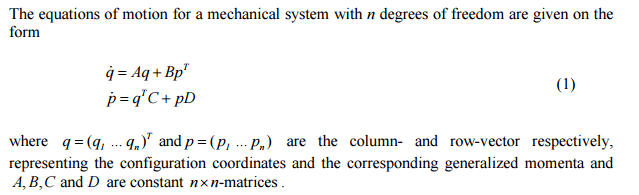
The derivative of a matrix transpose is not directly computed; instead, one takes the derivative of the functions that constitute the vector. In the context of the discussion, ##\dot{q}## represents the time derivative of the vector ##\vec{q}##, which is defined as ##\frac{d\vec{q}}{dt}##. The conversation emphasizes the importance of understanding that derivatives apply to the components of vectors rather than the matrices themselves. Additionally, the discussion clarifies that when taking partial derivatives, one should focus on the function H with respect to variables p and q.
PREREQUISITES
- Understanding of vector calculus
- Familiarity with matrix operations
- Knowledge of time derivatives in physics
- Basic concepts of partial derivatives
NEXT STEPS
- Study the properties of matrix derivatives in linear algebra
- Learn about vector calculus and its applications in physics
- Explore the concept of Jacobian matrices and their derivatives
- Investigate the relationship between matrix transposes and their derivatives
USEFUL FOR
Students and professionals in mathematics, physics, and engineering who are working with vector calculus and matrix operations, particularly those interested in understanding derivatives in the context of dynamic systems.