What is the difference in force between the first impact and water resistance?

  • Context: High School 
  • Thread starter Thread starter aosome23
  • Start date Start date
  • Tags Tags
    Force Impact Water
Click For Summary
SUMMARY

The discussion clarifies the differences between the force experienced during the initial impact with water and the force due to water resistance. The forces differ because the submerged object, such as a cube or sphere, interacts with more water upon impact, transferring greater momentum. The impact force is transient and governed by shock equations, while the resistance force becomes steady-state as the object decelerates. Additionally, the dynamics of water displacement and surface tension play crucial roles in understanding these forces.

PREREQUISITES
  • Understanding of basic physics concepts, particularly force and momentum.
  • Familiarity with fluid dynamics, including pressure and resistance forces.
  • Knowledge of shock wave equations, specifically Hugoniot equations.
  • Awareness of surface tension effects in fluids.
NEXT STEPS
  • Study the principles of fluid dynamics, focusing on pressure and resistance forces.
  • Learn about the Hugoniot equations and their applications in impact physics.
  • Research the effects of surface tension on objects entering water at high velocities.
  • Explore the dynamics of water displacement and its relation to object shape and velocity.
USEFUL FOR

This discussion is beneficial for physics students, engineers, and anyone interested in the mechanics of objects interacting with fluids, particularly in contexts like diving or water sports.
aosome23
Messages
16
Reaction score
0
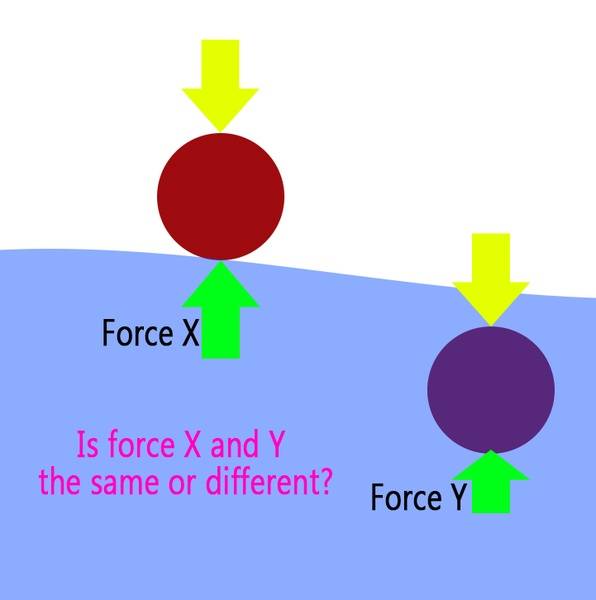
I really want to know if there is a difference between the force from the first impact of water and the force from water resistance. If it is different can someone tell me a explanation on why it is different?
Example:
tlcN0H1.jpg


I am not quite good at physics and would like some help
Thanks!
 
Physics news on Phys.org
The force at first contact, the way you drew it with just a tiny contact area, is tiny. The pressure (force / area) can be high though.

So yes, the forces are different, because the submerged ball interacts with more water, and therefore transfers more momentum to it. But when the submerged ball slows down the force goes down again.
 
A.T. said:
The force at first contact, the way you drew it with just a tiny contact area, is tiny. The pressure (force / area) can be high though.

So yes, the forces are different, because the submerged ball interacts with more water, and therefore transfers more momentum to it. But when the submerged ball slows down the force goes down again.

So if it is a cube instead of a sphere, will the resistance force be the same as the force at first contact if the velocity is exactly the same for the 2 objects?
 
aosome23 said:
So if it is a cube instead of a sphere, will the resistance force be the same as the force at first contact if the velocity is exactly the same for the 2 objects?

I'm not sure what you mean by resistance force, nor how you would judge different vs. the same.

One significant event during this time is the rapid, non-uniform, deceleration that the object experiences entering the water. While the part of the body under water is in highest deceleration, the rest of the body above the water is still in full acceleration. In your diagram, if case X is meant to show a cube that has already contacted the water and has begun deceleration, the internal stress forces on the object will be different than case Y. That's because in case X, the part under water is moving slower than top, and that's a big deal.
 
TumblingDice said:
I'm not sure what you mean by resistance force, nor how you would judge different vs. the same.

One significant event during this time is the rapid, non-uniform, deceleration that the object experiences entering the water. While the part of the body under water is in highest deceleration, the rest of the body above the water is still in full acceleration. In your diagram, if case X is meant to show a cube that has already contacted the water and has begun deceleration, the internal stress forces on the object will be different than case Y. That's because in case X, the part under water is moving slower than top, and that's a big deal.

Okay, and thank you. However, What do you mean by your last sentence, "That's because in case X, the part under water is moving slower than top, and that's a big deal."
 
aosome23 said:
Okay, and thank you. However, What do you mean by your last sentence, "That's because in case X, the part under water is moving slower than top, and that's a big deal."

The entire cube is accelerating until it begins entering the water. When the 'front' (bottom) contacts the water, everything above the water continues acceleration while the front part entering the water begins rapidly decelerating. The quickest that the rear end can 'learn' and react to what's happening at the front is limited to the speed of sound within whatever the cube is made of. The rear end continues to try to react albeit with this short delay until the cube is entirely submerged. It's because of this process that significant internal stress occurs due to compression while the object is partially submerged.
 
What about the splash? It would take a lot of energy to lift water high in the air, and a lot of force to break the surface tension. Unfortunately, simple linear F=ma is not enough. The effects are very nonlinear.
 
anorlunda said:
What about the splash? It would take a lot of energy to lift water high in the air
The backsplash that kicks into the air all happens behind the object. It's a result of surrounding water rushing to back-fill the void left behind the object when it submerges.

and a lot of force to break the surface tension.
It takes a lot of force to displace the volume of the water occupied by the object (not so much breaking the surface tension).
 
They are different because when the object impacts the surface it is finding out that there is something there and is governed by shock hugoniot equations with a pressure that looks like rho*soundspeed*velocity. For subsonic velocities, the pressure while in the fluid is going to look like rho*velocity^2. The impact pressure is a transient while in fluid is steady state.
 
  • #10
TumblingDice said:
The backsplash that kicks into the air all happens behind the object. It's a result of surrounding water rushing to back-fill the void left behind the object when it submerges.

True, but whether the splash occurs during or after, the energy in the splash comes from the falling object.

Regarding surface tension, I've fallen off water skis at 40 mph and it really hurts. The surface feels like a brick wall. Displacement of water is velocity independent, but the force of impact is not.


The original post asked about force, not energy, not velocity, and it did not mention time scale such as the first nanoseconds following impact, nor did it mention the density of the falling sphere. If it is a ping pong ball, it will just bob on the surface. If neutrally buoyant, it will stop and not sink further; zero net force.

It is hard to give a good answer to such an uncertain question.
 
  • #11
anorlunda said:
True, but whether the splash occurs during or after, the energy in the splash comes from the falling object.
Yes, if by energy you mean the momentum of water rising above the surface. This momentum originates from the mechanics of the water displacement before returning to level.

Regarding surface tension, I've fallen off water skis at 40 mph and it really hurts. The surface feels like a brick wall.
Yep, it can hurt.

Displacement of water is velocity independent, but the force of impact is not.
The force applied by the object when displacing the mass of the water is directly related to the object's mass and velocity. For a falling object (not a skipping stone, a water skier, a ping-pong ball, or a feather) overcoming surface tension is insignificant compared to accelerating the mass of the water out of the way.

The original post asked about force, not energy, not velocity, and it did not mention time scale such as the first nanoseconds following impact
True, it asked about difference of the two forces. I pointed out a significant difference due to rapid deceleration during entry as opposed to after entrance is complete. I think that's the largest dynamic difference. The World High Diving Federation (whdf.com) mentions this about high-diving discipline:
The body is exposed to enormous forces during a high dive, especially during entrance into the water. The moment of the highest risk is upon entry in the water: While the parts of the body under water are in highest deceleration, the rest of the body above the water is still in full acceleration.
 

Similar threads

  • · Replies 46 ·
2
Replies
46
Views
3K
  • · Replies 5 ·
Replies
5
Views
2K
  • · Replies 15 ·
Replies
15
Views
2K
  • · Replies 2 ·
Replies
2
Views
648
  • · Replies 16 ·
Replies
16
Views
6K
  • · Replies 8 ·
Replies
8
Views
2K
  • · Replies 11 ·
Replies
11
Views
4K
Replies
4
Views
1K
  • · Replies 5 ·
Replies
5
Views
12K
  • · Replies 48 ·
2
Replies
48
Views
3K