Discussion Overview
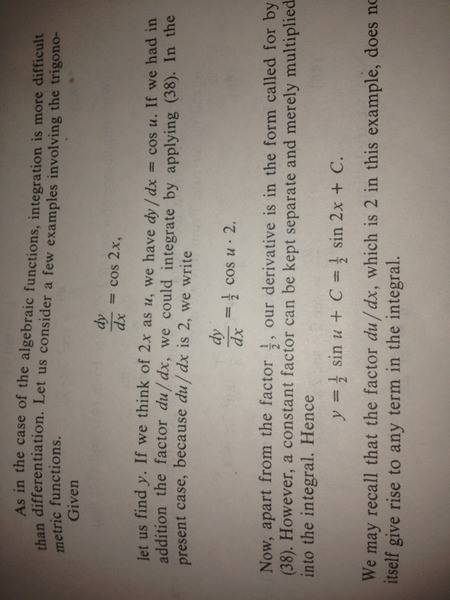
The discussion revolves around the anti-derivative of the function cos(2x), specifically addressing the appearance of the factor 1/2 in the result. Participants explore the method of integration by u-substitution, its application, and related concepts in calculus, including Simpson's rule and its significance in physics and engineering.
Discussion Character
- Exploratory
- Technical explanation
- Homework-related
- Debate/contested
Main Points Raised
- One participant expresses confusion about the factor of 1/2 in the anti-derivative of cos(2x) and seeks clarification.
- Another participant explains the u-substitution method, detailing how to set u=2x and derive du, leading to the integration process that results in 1/2*sin(2x) + C.
- Some participants discuss the importance of integration techniques like u-substitution and Simpson's rule in calculus.
- There is mention of the challenges in applying these techniques to more complex equations, such as dy/dx=tan(2x)sec^2(2x), and confusion about the derivation of du.
- Participants share their experiences and struggles with calculus, including the application of integration in physics and engineering contexts.
- Clarifications are made regarding the chain rule and its role in determining the factor of 2 in the derivative of tan(2x).
Areas of Agreement / Disagreement
Participants generally agree on the method of u-substitution and its application, but there are varying levels of understanding and confusion regarding specific steps in the process. Some participants express uncertainty about the chain rule and its implications, indicating that the discussion remains unresolved in certain areas.
Contextual Notes
Some participants struggle with the foundational concepts of calculus, such as the chain rule and integration techniques, which may limit their understanding of more advanced applications. The discussion also highlights the varying degrees of familiarity with mathematical concepts among participants.
Who May Find This Useful
This discussion may be useful for high school students preparing for calculus, individuals interested in integration techniques, and those exploring the applications of calculus in physics and engineering.