What is the final angular velocity of each cylinder

Click For Summary
SUMMARY

The final angular velocities of two identical cylinders, A and B, are determined through the analysis of their motion under friction. Cylinder A, initially rotating at 50 rad/s, executes three revolutions before reaching a constant angular velocity, while cylinder B, starting from rest, completes one revolution. The final angular velocities are equal in magnitude but opposite in direction, and the coefficient of kinetic friction (uk) plays a crucial role in the interaction between the cylinders. The solution involves applying the equation T1 + U = T2 to derive the necessary values.

PREREQUISITES
  • Understanding of angular motion and angular velocity
  • Familiarity with the concepts of friction and kinetic friction coefficients
  • Knowledge of rotational dynamics and energy conservation principles
  • Ability to apply relevant equations in mechanics
NEXT STEPS
  • Calculate the final angular velocity using the conservation of angular momentum
  • Determine the coefficient of kinetic friction using the relationship between torque and friction
  • Explore the dynamics of rolling motion versus slipping motion
  • Investigate the effects of varying friction coefficients on angular velocity outcomes
USEFUL FOR

Mechanical engineers, physics students, and anyone studying rotational dynamics and friction in mechanical systems will benefit from this discussion.

samm12345
Messages
1
Reaction score
0
Homework Statement
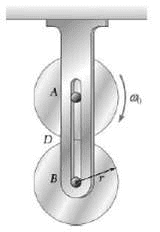
The uniform 4-kg cylinder A, of radius r = 150 mm, has an angular velocity w = 50 rad/s when it is brought into contact with an identical cylinder B which is at rest. The coefficient of kinetic friction at the contact point D is uk. After a period of slipping, the cylinders attain constant angular velocities of equal magnitude and opposite direction at the same time. Knowing that cylinder A executes three revolutions before it attains a constant angular velocity and cylinder B executes one revolution before it attains a constant angular velocity, determine
(a) The final angular velocity of each cylinder,
(b) The coefficient of kinetic friction uk.
Relevant Equations
T1 + U =T2
Problem Statement: The uniform 4-kg cylinder A, of radius r = 150 mm, has an angular velocity w = 50 rad/s when it is brought into contact with an identical cylinder B which is at rest. The coefficient of kinetic friction at the contact point D is uk. After a period of slipping, the cylinders attain constant angular velocities of equal magnitude and opposite direction at the same time. Knowing that cylinder A executes three revolutions before it attains a constant angular velocity and cylinder B executes one revolution before it attains a constant angular velocity, determine
(a) The final angular velocity of each cylinder,
(b) The coefficient of kinetic friction uk.
Relevant Equations: T1 + U =T2
246719
 
Physics news on Phys.org
Welcome to the PF. :smile:

We require that you show your work toward the solution before we can offer tutorial help. Please show us how you are approaching the problem...
 
  • Like
Likes   Reactions: samm12345

Similar threads

Replies
2
Views
3K
  • · Replies 12 ·
Replies
12
Views
2K
Replies
12
Views
3K
  • · Replies 2 ·
Replies
2
Views
4K
Replies
19
Views
3K
  • · Replies 4 ·
Replies
4
Views
4K
Replies
18
Views
2K
Replies
8
Views
2K
  • · Replies 16 ·
Replies
16
Views
5K
  • · Replies 3 ·
Replies
3
Views
2K