What is the Final Potential Across the First Capacitor After Switch Closure?

Click For Summary

Homework Help Overview

The discussion revolves around a problem involving capacitors, specifically focusing on the final potential across a capacitor after it is disconnected from a voltage source and connected to another capacitor. The subject area is electrical circuits and capacitor behavior.

Discussion Character

  • Exploratory, Conceptual clarification, Mathematical reasoning

Approaches and Questions Raised

  • Participants explore the effects of closing a switch on the charges and potentials of the capacitors involved. Questions arise regarding the conservation of charge and the relationships between the charges on the capacitors.

Discussion Status

Participants have engaged in a productive dialogue, with some offering guidance on applying conservation principles and equations related to capacitance and potential. There is an acknowledgment of the relationship between the charges on the capacitors and their potentials.

Contextual Notes

Participants are working under the assumption that the initial conditions involve one charged capacitor and one uncharged capacitor, and they are considering the implications of connecting these two capacitors together.

phantom85
Messages
4
Reaction score
0
A first capacitor is initially connected to potential source ?. The charged capacitor is then removed
from the source and connected to a second initially uncharged capacitor. Determine the final potential
across the first capacitor long after the switch is closed.
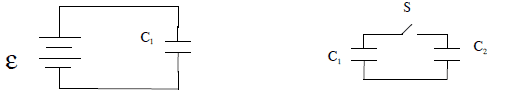
media%2Fc03%2Fc033c36f-9c11-489c-acaa-b30d25a43852%2FphpG6QhHA.png


Homework Statement


Q1 charged by capacitor C1

Homework Equations


Q=Cε

The Attempt at a Solution

 
Physics news on Phys.org
You're going to have to give some effort to the problem. What do you think is going to happen once the the switch is closed, in terms of changes in charges and potentials, since those are the only quantities that can vary?
 
So if it let charges at C1 when connected to voltage source to be Q' then after let charges at C1 and C2 to be Q1 and Q2. It should be Q1+Q2=Q' ?
 
Yes, from conservation of charge. If you use the equation you listed, you can substitute capacitance times potential for each charge, and then that should open up the potential on C1
 
So V(C1+C2)=C1ε , and solving for V=(C1ε)/(C1+C2) is this correct?
 
Yes, that's right. V is the same across both capacitors because they become equipotential surfaces.
 
  • Like
Likes   Reactions: 1 person
Alright Thank you.
 

Similar threads

Replies
2
Views
1K
  • · Replies 15 ·
Replies
15
Views
1K
Replies
3
Views
2K
  • · Replies 3 ·
Replies
3
Views
3K
Replies
23
Views
13K
Replies
26
Views
3K
  • · Replies 4 ·
Replies
4
Views
3K
  • · Replies 11 ·
Replies
11
Views
2K
Replies
6
Views
3K