What is the formula for determining small angles in spherical diopters?

  • Thread starter Thread starter duchuy
  • Start date Start date
  • Tags Tags
    Formula Spherical
Click For Summary

Homework Help Overview

The discussion revolves around understanding the determination of small angles in spherical diopters, specifically focusing on the values of alpha, alpha', and omega. The original poster expresses confusion regarding the formula alpha = SP / AS and the application of trigonometric principles in this context.

Discussion Character

  • Exploratory, Conceptual clarification, Mathematical reasoning

Approaches and Questions Raised

  • Participants explore the definition of angles in radians and question the relationship between the angles and the lengths SP and AS. There are attempts to clarify the meaning of these terms and their relevance to the angles being discussed.

Discussion Status

Some participants have offered guidance on asking specific questions to facilitate understanding. There is an ongoing exploration of whether the angle alpha can be approximated using trigonometric identities due to its small size, but no consensus has been reached on the definitions or relationships involved.

Contextual Notes

There are indications of confusion regarding the definitions of SP and AS, particularly whether SP refers to the length of a straight line or the curvature. The role of point A in the context of angle definitions is also questioned, suggesting a potential ambiguity in the problem setup.

duchuy
Messages
79
Reaction score
3
Homework Statement
I can't seem to understand the relation
Relevant Equations
angle = length / length
Hi,
I don't understand how the professor managed to determine the values of alpha, alpha' and omega. What is the formula tha´t is applied to determine alpha = SP / AS and so on... knowing that alpha is a really small angle. Cheers
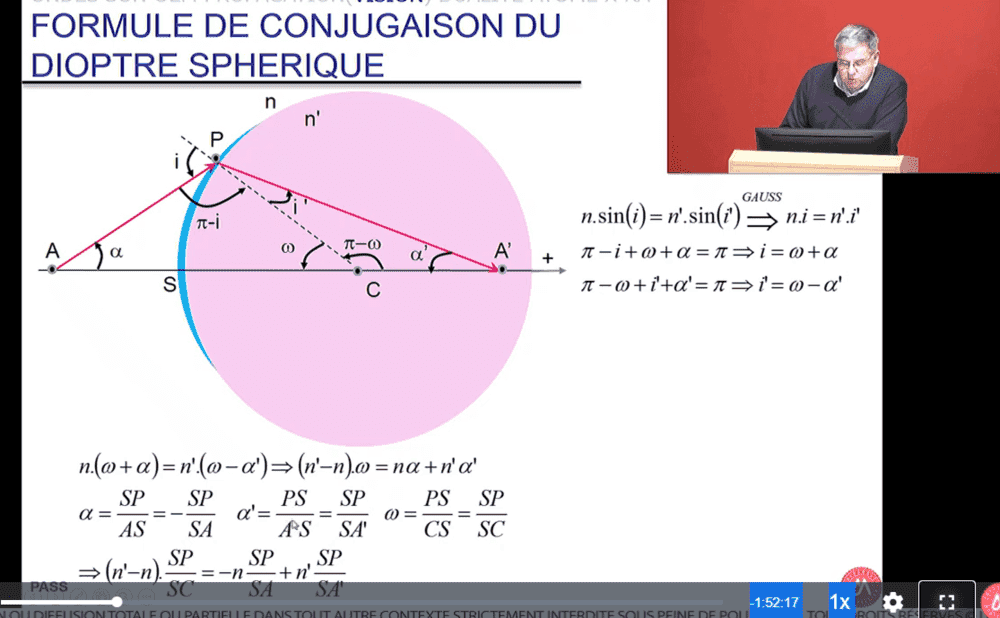
Capture.PNG
 
Physics news on Phys.org
You need to ask specific questions one at a time as you try to work through this. You could start by saying in specific detail what you wish to know when we are finished here.
The typical way to define an angle (in radians) is ?
 
hutchphd said:
You need to ask specific questions one at a time as you try to work through this. You could start by saying in specific detail what you wish to know when we are finished here.
Thanks for your reply, would you then mind explaining me how the professor managed to determine that alpha = SP / AS? I did try to use trigonometric formulas for this but the results were nowhere near SP / AS. Thanks a lot.
 
hutchphd said:
I don't really understand... PAC which is the alpha angle doesn't have A as the center of the circle and SP is the length of the the straight line SP not the curvature SP. Or in this case is SP referring to the length of the curvature? That would make sense for the omega angle but still not for alpha no?
Thanks
 
I see. Does he specify pt A in some way or is it arbitrary? This may be an approximation.
 
So when you say that this may be an approximation, are you saying that since alpha is a really small angle, therefore you could write tan alpha = alpha then use the tan = o/a to write these expressions right? This makes a lot of sense thanks a lot!
 

Similar threads

Replies
46
Views
7K
  • · Replies 3 ·
Replies
3
Views
457
  • · Replies 12 ·
Replies
12
Views
2K
Replies
2
Views
2K
  • · Replies 1 ·
Replies
1
Views
2K
  • · Replies 4 ·
Replies
4
Views
1K
  • · Replies 9 ·
Replies
9
Views
2K
  • · Replies 29 ·
Replies
29
Views
4K
Replies
12
Views
2K
  • · Replies 21 ·
Replies
21
Views
3K