What is the formula for the norm of a vector cross product?

Click For Summary

Homework Help Overview

The discussion revolves around the formula for the norm of a vector cross product, specifically focusing on the scalar product of the cross product of two vectors. The original poster expresses confusion regarding their calculations and the application of relevant identities in tensor calculus.

Discussion Character

  • Conceptual clarification, Mathematical reasoning, Assumption checking

Approaches and Questions Raised

  • Participants explore the calculation of the scalar product of the cross product and question the application of the Levi-Civita symbol identity. Some suggest starting with the definitions provided and re-evaluating the steps taken in the calculations.

Discussion Status

Several participants have offered guidance and pointed out potential mistakes in the original poster's reasoning. There is an ongoing exploration of different approaches, including index-free calculus and tensor notation, but no consensus has been reached on the correct path forward.

Contextual Notes

The original poster acknowledges a mistake in their calculations but is unsure how to correct it. There is a reference to specific rules and commandments related to tensor calculus that may be relevant to the discussion.

Lambda96
Messages
233
Reaction score
77
Homework Statement
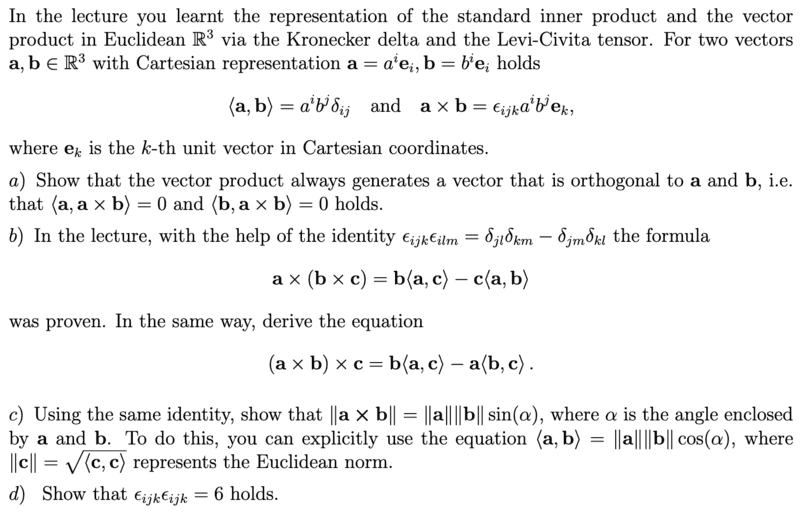
Use the identity ##\epsilon_{ijk} \epsilon_{ilm} = \delta_{jl} \delta_{km} - \delta_{jm} \delta_{kj}## to proof ##||\vec{a} \times \vec{b}||=||\vec{a}|| \cdot ||\vec{b}|| \sin{\alpha}##
Relevant Equations
##\epsilon_{ijk} \epsilon_{ilm} = \delta_{jl} \delta_{km} - \delta_{jm} \delta_{kj}##
Hi everyone,

I'm having problems with task c
Bildschirmfoto 2023-11-16 um 11.04.05.png

In the task, the norm has already been defined, i.e. ##||\vec{c}||=\sqrt{\langle \vec{c}, \vec{c} \rangle }## I therefore first wanted to calculate the scalar product of the cross product, i.e. ##\langle \vec{a} \times \vec{b} , \vec{a} \times \vec{b} \rangle## first

$$\langle \vec{a} \times \vec{b} , \vec{a} \times \vec{b} \rangle = \epsilon_{ijk}a^{i}b^{j} \vec{e}_k \cdot \epsilon_{ijk}a^{i}b^{j} \vec{e}_k$$
$$\langle \vec{a} \times \vec{b} , \vec{a} \times \vec{b} \rangle = \epsilon_{ijk}a^{i}b^{j} \cdot \epsilon_{ijk}a^{i}b^{j}$$
$$\langle \vec{a} \times \vec{b} , \vec{a} \times \vec{b} \rangle = \epsilon_{ijk} \epsilon_{ijk} ||a^{i}||^2 ||b^{j}||^2 $$

If I look at my calculation now, I've definitely made a mistake, but I don't know how else to arrive at the desired result.
I know I didn't use the identity ##\epsilon_{ijk} \epsilon_{ilm} = \delta_{jl} \delta_{km} - \delta_{jm} \delta_{kj}##, but if I take the scalar product with itself, the epsilon would be ##\epsilon_{ijk} \epsilon_{ijk}## and not ##\epsilon_{ijk} \epsilon_{ilm}##, or not?
 
Physics news on Phys.org
How about starting with what is given?
\begin{align*}
\langle \mathrm{a}\times \mathrm{b}\ ,\ \mathrm{a}\times \mathrm{b} \rangle&=\epsilon_{ijk}\,a^i\,b^j\, \epsilon_{lmn}\,a^l\,b^m \,\langle \mathrm{e}_k\ ,\ \mathrm{e}_n \rangle\\
&=\epsilon_{ijk}\,a^i\,b^j\, \epsilon_{lmk}\,a^l\,b^m= \epsilon_{kij}\,\epsilon_{klm}\,a^i\,b^j\,a^l\,b^m\\
&=(\delta_{il}\delta_{jm} - \delta_{jk} \delta_{km})\,a^i\,b^j\,a^l\,b^m \\
&=a^i\,b^j\,a^i\,b^j \,-\, a^i\,b^k\,a^l\,b^k
&=\ldots
\end{align*}
... if I made no mistakes. I think your mistake was in the formula under "relevant equations". It should have been $$\epsilon_{ijk}\epsilon_{ilm}=\delta_{jl} \delta_{km}- \delta_{jm} \delta_{kl} $$ like in ##\delta_{22} \delta_{33}- \delta_{23} \delta_{32}.##
 
  • Like
Likes   Reactions: Lambda96
fresh_42 said:
How about starting with what is given?
\begin{align*}
\langle \mathrm{a}\times \mathrm{b}\ ,\ \mathrm{a}\times \mathrm{b} \rangle&=\epsilon_{ijk}\,a^i\,b^j\, \epsilon_{lmn}\,a^l\,b^m \,\langle \mathrm{e}_k\ ,\ \mathrm{e}_n \rangle\\
&=\epsilon_{ijk}\,a^i\,b^j\, \epsilon_{lmk}\,a^l\,b^m= \epsilon_{kij}\,\epsilon_{klm}\,a^i\,b^j\,a^l\,b^m\\
&=(\delta_{il}\delta_{jm} - \delta_{jk} \delta_{km})\,a^i\,b^j\,a^l\,b^m \\
&=a^i\,b^j\,a^i\,b^j \,-\, a^i\,b^k\,a^l\,b^k
&=\ldots
\end{align*}
... if I made no mistakes.
Typo, but the final expression violates the third commandment.
fresh_42 said:
I think your mistake was in the formula under "relevant equations".
That is a typo, yes, but there are worse mistakes as well.
 
Last edited by a moderator:
  • Like
Likes   Reactions: Lambda96
Thank you Orodruin and fresh_42 for your help 👍👍

Thanks also Orodruin for the link, it helped me a lot 👍

I have now proceeded as follows:

$$\langle \vec{a} \times \vec{b} , \vec{a} \times \vec{b} \rangle = \bigl( \vec{a} \times \vec{b} \bigr)_i \cdot \bigl( \vec{a} \times \vec{b} \bigr)_i$$

$$\langle \vec{a} \times \vec{b} , \vec{a} \times \vec{b} \rangle = \epsilon_{ijk} a^{j}b^{k} \epsilon_{ilm} a^{l} b^{m}$$

$$\langle \vec{a} \times \vec{b} , \vec{a} \times \vec{b} \rangle = \epsilon_{ijk} \epsilon_{ilm} a^{j}b^{k} a^{l} b^{m}$$$$\langle \vec{a} \times \vec{b} , \vec{a} \times \vec{b} \rangle = \bigl( \delta_{jl} \delta_{km} -\delta_{jm} \delta_{kl} \bigr) a^{j}b^{k} a^{l} b^{m}$$

$$\langle \vec{a} \times \vec{b} , \vec{a} \times \vec{b} \rangle = \delta_{jl} \delta_{km} a^{j}b^{k} a^{l} b^{m} -\delta_{jm} \delta_{kl} a^{j}b^{k} a^{l} b^{m} $$

$$\langle \vec{a} \times \vec{b} , \vec{a} \times \vec{b} \rangle = a^{l}b^{m} a^{l} b^{m} - a^{m}b^{l} a^{l} b^{m}$$

$$\langle \vec{a} \times \vec{b} , \vec{a} \times \vec{b} \rangle =\bigl( \vec{a} \cdot \vec{a} \bigr) \bigl( \vec{b} \cdot \vec{b} \bigr) - \bigl( \vec{a} \cdot \vec{b} \bigr) \cdot \bigl( \vec{a} \cdot \vec{b} \bigr) $$$$\langle \vec{a} \times \vec{b} , \vec{a} \times \vec{b} \rangle = ||\vec{a}||^2 \cdot ||\vec{b}||^2 - ||\vec{a}||^2 \cdot ||\vec{b}||^2 \cos^2{\alpha}$$

$$\langle \vec{a} \times \vec{b} , \vec{a} \times \vec{b} \rangle = ||\vec{a}||^2 \cdot ||\vec{b}||^2 \bigl( 1 - \cos^2{\alpha} \bigr) $$

$$\langle \vec{a} \times \vec{b} , \vec{a} \times \vec{b} \rangle = ||\vec{a}||^2 \cdot ||\vec{b}||^2 \sin^2{\alpha}$$

$$|| \vec{a} \times \vec{b}|| = ||\vec{a}|| \cdot ||\vec{b}|| \sin{\alpha}$$
 
  • Like
Likes   Reactions: Orodruin
It's a bit simpler to use the index-free calculus in this case and use the additional rule
$$\vec{u} \cdot (\vec{v} \times \vec{w})=(\vec{u} \times \vec{v}) \cdot \vec{w}.$$
Setting ##\vec{u}=\vec{a} \times \vec{b}## and ##\vec{v}=\vec{a}## and ##\vec{w}=\vec{b}## this gives
$$(\vec{a} \times \vec{b}) \cdot (\vec{a} \times \vec{b}) =[ (\vec{a} \times \vec{b})\times \vec{a}] \cdot \vec{b}.$$
Now you use the formula for the triple vector product (which is equivalent to the given formula for the Levi-Civita symbols),
$$(\vec{a} \times \vec{b}) \cdot (\vec{a} \times \vec{b}) = [\vec{b} (\vec{a} \cdot \vec{a}) - \vec{a} (\vec{a} \cdot \vec{b}] \cdot \vec{b} = \|vec{a} \|^2 \|\vec{b}|^2 [1-\cos^2 \angle (\vec{a},\vec{b})]=\|\vec{a}|^2 \|\vec{b} \|^2 \sin^2 \angle (\vec{a},\vec{b}).$$
Since by definite ##\angle(\vec{a},\vec{b}) \in [0,\pi]## the sine is ##\geq 0## and thus
$$\|\vec{a} \times \vec{b} \| = \|\vec{a} \| \|\vec{b} \| \sin \angle(\vec{a},\vec{b}).$$
 
Last edited by a moderator:

Similar threads

  • · Replies 3 ·
Replies
3
Views
2K
  • · Replies 1 ·
Replies
1
Views
2K
  • · Replies 3 ·
Replies
3
Views
3K
  • · Replies 10 ·
Replies
10
Views
6K
  • · Replies 9 ·
Replies
9
Views
2K
  • · Replies 9 ·
Replies
9
Views
2K
  • · Replies 3 ·
Replies
3
Views
2K
Replies
5
Views
2K
  • · Replies 20 ·
Replies
20
Views
4K
  • · Replies 6 ·
Replies
6
Views
3K