Discussion Overview
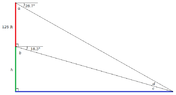
The discussion revolves around a geometry problem involving a tower on a cliff and the angles of depression to a point on the opposite shore of a river. Participants are attempting to determine the height of the cliff based on given angles and the height of the tower. The scope includes mathematical reasoning and problem-solving strategies.
Discussion Character
- Mathematical reasoning
- Homework-related
- Exploratory
Main Points Raised
- One participant presents the problem, asking for help to find the height of the cliff based on the angles of depression.
- Several participants emphasize the importance of drawing a diagram to visualize the problem and identify relevant triangles.
- A diagram is provided by one participant, prompting further calculations of angles related to the triangles formed.
- Another participant suggests a calculation method using the law of sines, leading to a proposed height of the cliff at approximately 206.4 feet.
- One participant questions whether a previously stated height of 190.71 feet is correct.
Areas of Agreement / Disagreement
There is no consensus on the height of the cliff, as different calculations have been proposed, and participants have not agreed on a definitive answer.
Contextual Notes
Participants have not fully resolved the mathematical steps involved in their calculations, and there may be dependencies on the accuracy of the angles and assumptions made about the geometry of the situation.