What is the Length of a Compound Microscope?

Click For Summary

Discussion Overview

The discussion revolves around the definition of the "length of a compound microscope," specifically whether it refers to the tube length (the distance between the focal points of the objective and eyepiece lenses) or the distance between the objective and eyepiece lenses. Participants explore the implications of these definitions and their relevance to the practical use of microscopes.

Discussion Character

  • Debate/contested
  • Conceptual clarification

Main Points Raised

  • Some participants question what is meant by "length of microscope," suggesting it could refer to either the tube length or the distance between the lenses.
  • There is a suggestion that there is no universally accepted definition of the microscope's length, with one participant noting that the dimension marked on a ray diagram might be relevant.
  • One participant mentions the length of the cutout in the carrying case, which is longer than the distance between the lens centers but shorter than the distance between the object and the eye.
  • Another participant argues that the term "length" is not officially defined and can vary with adjustments in focusing, emphasizing the importance of precise descriptions in context.
  • Some participants express confusion over the definitions provided by teachers and the terminology encountered online.

Areas of Agreement / Disagreement

Participants do not reach a consensus on the definition of the "length of a compound microscope," with multiple competing views and uncertainties remaining regarding the terminology and its implications.

Contextual Notes

Participants highlight the potential for varying definitions based on context, focusing adjustments, and the practical aspects of microscope design, which may not align with theoretical definitions.

songoku
Messages
2,512
Reaction score
394
TL;DR
Compound microscope uses two convex lenses, one as objective lens and one as eye piece lens. What is the length of compound microscope?
If we say "length of microscope", which distance does it refer to? Is it:

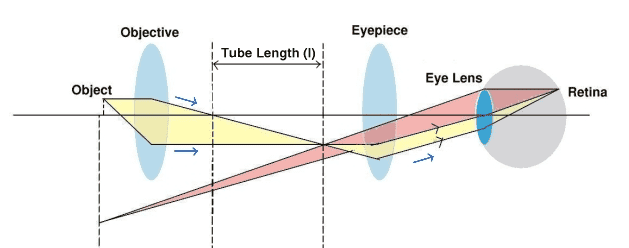
a) the tube length (L), which is the distance between the focal point of objective and focal point of eye piece lens
1612231160533.png


OR

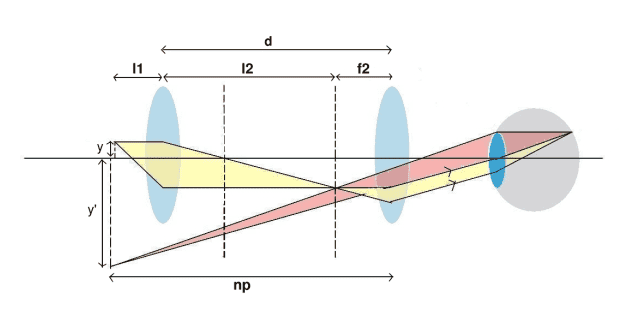
b) the distance (d) between objective and eye piece lens
1612231194874.png

Thanks
 
Science news on Phys.org
songoku said:
Summary:: Compound microscope uses two convex lenses, one as objective lens and one as eye piece lens. What is the length of compound microscope?

If we say "length of microscope", which distance does it refer to?
I think there is no accepted answer. The dimension that's marked on the ray diagram would be the length to consider if there is some discussion that refers to it(?). One important 'length' would be the length of the cutout in the carrying case, which would be longer than the distance between the centres of the lenses and shorter than the distance between object and eye.
Not something to worry about too much, perhaps and not part of the theory.
 
  • Like
Likes   Reactions: songoku
sophiecentaur said:
I think there is no accepted answer. The dimension that's marked on the ray diagram would be the length to consider if there is some discussion that refers to it(?).
There is no specific discussion that refers to it. My teacher said length of microscope is distance between two lenses and I came across the term tube length while googling about microscope so I am confused which one is the length of microscope

One important 'length' would be the length of the cutout in the carrying case, which would be longer than the distance between the centres of the lenses and shorter than the distance between object and eye.
Not something to worry about too much, perhaps and not part of the theory.
What do you mean by length of cutout?

Thanks
 
Most optical stuff lays in a cutout hole in the carry case to stop it moving about. The width and depth of the hole are also relevant but not to the optics.
I do not think there’s an official term “length”. That can change as the focusing is adjusted .
Edit: You have already said that your teacher gave you a definition for the purpose of the lesson. Tube length will depend on all sorts of things and is of no 'optical' significance. You should stop worrying about using the correct word and concentrate on using and demanding precise descriptions to suit the context. Classifying can be a real waste of time.
 
Last edited:
  • Like
Likes   Reactions: songoku
sophiecentaur said:
Most optical stuff lays in a cutout hole in the carry case to stop it moving about. The width and depth of the hole are also relevant but not to the optics.
I do not think there’s an official term “length”. That can change as the focusing is adjusted .
Edit: You have already said that your teacher gave you a definition for the purpose of the lesson. Tube length will depend on all sorts of things and is of no 'optical' significance. You should stop worrying about using the correct word and concentrate on using and demanding precise descriptions to suit the context. Classifying can be a real waste of time.
Thank you very much sophiecentaur
 
  • Like
Likes   Reactions: sophiecentaur

Similar threads

  • · Replies 7 ·
Replies
7
Views
3K
  • · Replies 2 ·
Replies
2
Views
2K
  • · Replies 10 ·
Replies
10
Views
3K
  • · Replies 12 ·
Replies
12
Views
2K
  • · Replies 7 ·
Replies
7
Views
2K
  • · Replies 7 ·
Replies
7
Views
2K
  • · Replies 3 ·
Replies
3
Views
2K
  • · Replies 8 ·
Replies
8
Views
3K
  • · Replies 2 ·
Replies
2
Views
4K
  • · Replies 2 ·
Replies
2
Views
3K