goody1
- 16
- 0
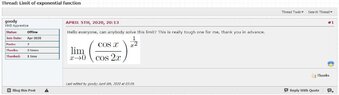
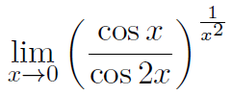
Hello everyone, can anybody solve this limit? This is really tough one for me, thank you in advance.
View attachment 9653
Attachments
Last edited:

goody said:Hello everyone, can anybody solve this limit without using L'Hospital's rule? This is really tough one for me, I know I'd use that x = e^lnx.
goody said:I understand that you used Maclaurin series expansion and then the first step behind first equal sign but may I ask how did we get another steps?
goody said:Oh of course, I got it. And in the last step you just divided 3/2 by n because n is infinite number of terms behind dots or why is it like that? Why did you not divide 1 by n as well?
goody said:Hello everyone, can anybody solve this limit? This is really tough one for me, thank you in advance.
Klaas van Aarsen said:It's like this:
$$\Big(1-\frac 12 x^2 + \ldots\Big)\Big(1+\frac 12 (2x)^2 - \ldots\Big)\\
=1\cdot 1 -\frac 12 x^2 \cdot 1+1\cdot \frac 12 (2x)^2 - \frac 12 x^2 \cdot \frac 12 (2x)^2 + \text{ other terms with }x^4\text{ and higher order}\\
=1 + \Big(-\frac 12 + \frac 12(2^2)\Big)x^2 + \ldots \\
= 1+\frac 32 x^2 + \ldots
$$
goody said:Still, now I'm wondering how we got this .
Is it correct? Because I think it should be like that or did I miss something?
Prove It said:So much unneccessary analysis when L'Hospital's Rule is so concise...
Klaas van Aarsen said:The original OP asked explicitly to do it without L'Hospital's Rule.
Prove It said:Oh really?
Klaas van Aarsen said:Ah well, I was kind of happy to see that the OP showed interest in power series expansions.
They are kind of... well... powerful.