What Is the Maximum Acceleration of a Crate Up an Incline Before Tipping Over?

Click For Summary

Homework Help Overview

The discussion revolves around determining the maximum acceleration of a crate on an incline before it tips over. The problem involves concepts from mechanics, specifically relating to forces, torques, and friction on an inclined plane.

Discussion Character

  • Mixed

Approaches and Questions Raised

  • Participants explore the conditions for tipping over versus slipping, questioning the relationship between normal force, friction, and torque. There are attempts to derive equations related to forces and moments acting on the crate.

Discussion Status

Multiple interpretations of the problem are being explored, particularly the conditions under which the crate will tip versus when it will slip. Some participants have provided calculations for maximum acceleration, while others emphasize the need to clarify the conditions for tipping.

Contextual Notes

There is an ongoing discussion about the assumptions made regarding the point of action for forces and the relevance of torque in determining tipping conditions. Some participants express uncertainty about the definitions of slipping and tipping, indicating a need for further exploration of these concepts.
Vladimir_Kitanov
Messages
44
Reaction score
14
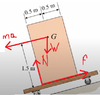
Homework Statement
Picture
Relevant Equations
Nothing special
1.PNG

Correct answer is (b) 0,620 ms2

My attempt:
FBD
2.PNG

Equation 1. ∑Fx=0=−ma−Wsin⁡(15)+f
N=Wcos⁡15
f=Nμs=379,03N

Equation 1. ma=f−Wsin⁡15
15a=379,03−203,1
a=2,20ms2

Equation 2. ∑MG=0=−Nx+f1,5
x=0,75m
 
Physics news on Phys.org
What is the condition for tipping over to occur?
 
Lnewqban said:
What is the condition for tipping over to occur?
x need to be more then 0,5
 
And what is x?
 
Why did you draw the point of action for the normal force they way you did?
 
For the crate to tip, a non-zero net torque is needed. I don't see a torque equation. Your value for the acceleration of 2.20 m/s2 is the value at which the crate will start sliding assuming that it does not tip. If the crate tips before it starts sliding, the 2.20 m/s2 cannot be the answer. You need to find another value for the acceleration at which the crate will tip assuming that it does not slip and pick the smaller of the two values as the answer. As @Lnewqban asked,
Lnewqban said:
What is the condition for tipping over to occur?
That's a key issue to address.

On edit:
Your answer
Vladimir_Kitanov said:
x need to be more then 0,5
is a non-answer because x cannot be greater than 0.5 m.
 
Last edited:
  • Like
Likes   Reactions: Lnewqban
I don't seem to understand well slipping and tipping.
I will learn more about that and then i will be back here.
:)
 
Vladimir_Kitanov said:
I don't seem to understand well slipping and tipping.
I will learn more about that and then i will be back here.
:)
In order for the block to tip over, two things need to happen: a moment about the edge, and enough static friction, so the block does not slide rather than tip over.
Determining both things is the core of this problem.
You now that friction depends on normal force and coefficient of friction.
You also know that any force that has a lever or distance respect to the pivoting edge, induces a moment.
 
Ok i did it.
To solve this we need to find acceleration when slipping will occur and acceleration when tipping occur.
And choose smaller so it will not tip or slip.
 
  • Like
Likes   Reactions: Lnewqban
  • #10
Vladimir_Kitanov said:
Ok i did it.
To solve this we need to find acceleration when slipping will occur and acceleration when tipping occur.
And choose smaller so it will not tip or slip.
Yes, that's what I suggested. Please post your work for finding the maximum acceleration before tipping occurs.
 
  • Like
Likes   Reactions: Lnewqban and Vladimir_Kitanov
  • #11
kuruman said:
Yes, that's what I suggested. Please post your work for finding the maximum acceleration before tipping occurs.

2.PNG


W - weight = ##W = m*9,81 = 784,8##
N - normal force On left edge because it will tip over that edge and all weight will be there.
##N = W\cos15 = 758,1##
f - friction

Equation 1##\sum F_x = 0 = ma - f + W\sin15##
##\sum M_G = 0 = -N0,5 + f1,5## --> ##f = 252,69##

From equation 1 we now find a.
##a = 0,62##
 

Attachments

  • 2.PNG
    2.PNG
    19.1 KB · Views: 152
  • Like
Likes   Reactions: Lnewqban
  • #12
Why will the block tip if there is no unbalanced torque acting on it? Do you understand torques? What do they do?
 
  • #13
kuruman said:
Why will the block tip if there is no unbalanced torque acting on it? Do you understand torques? What do they do?
Sum of all torques is 0. And it will not tip.
When we set normal force to be on edge we find maximum acceleration at at witch crate will not tip.
If acceleration is bigger then 0,62 it will tip.
 
  • #14
Vladimir_Kitanov said:
View attachment 305589

W - weight = ##W = m*9,81 = 784,8##
N - normal force On left edge because it will tip over that edge and all weight will be there.
##N = W\cos15 = 758,1##
f - friction

Equation 1##\sum F_x = 0 = ma - f + W\sin15##
##\sum M_G = 0 = -N0,5 + f1,5## --> ##f = 252,69##

From equation 1 we now find a.
##a = 0,62##
You still seem to be tangling up the two cases.

In post #1, you successfully found the max acceleration assuming that it will slip rather than tip.
But then you wrote
Vladimir_Kitanov said:
Equation 2. ∑MG=0=−Nx+f1,5
where I assume you used the f calculated from the first case, but you should now be assuming that it will tip rather than slip, so that f value is irrelevant. Take moments about the tipping point instead.

In post #11, you made the converse error: found f assuming tip but applied that value to the slip case.
 
  • #15
haruspex said:
In post #11, you made the converse error: found f assuming tip but applied that value to the slip case.
That all is just tip case.I did not post solution for slip case.
For slip case i get different value for friction.
 
  • #16
Vladimir_Kitanov said:
That all is just tip case.I did not post solution for slip case.
For slip case i get different value for friction.
Sorry, you are right. I agree with your answer.
 

Similar threads

  • · Replies 6 ·
Replies
6
Views
2K
Replies
19
Views
4K
  • · Replies 11 ·
Replies
11
Views
5K
  • · Replies 5 ·
Replies
5
Views
3K
  • · Replies 27 ·
Replies
27
Views
4K
Replies
3
Views
1K
Replies
6
Views
3K
  • · Replies 4 ·
Replies
4
Views
4K
  • · Replies 4 ·
Replies
4
Views
2K
  • · Replies 1 ·
Replies
1
Views
2K