What is the meaning of the \sum signal in this direct current circuit problem?

Click For Summary

Homework Help Overview

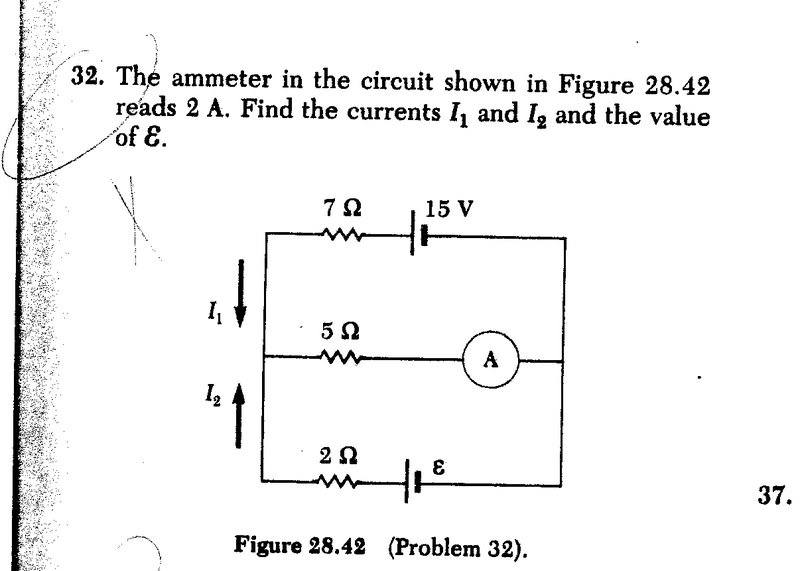
The discussion revolves around a direct current circuit problem involving an ammeter reading and the interpretation of the summation symbol (\sum). Participants are exploring the relationships between currents in different loops of the circuit.

Discussion Character

  • Exploratory, Assumption checking, Problem interpretation

Approaches and Questions Raised

  • The original poster questions the meaning of the \sum symbol and its relevance to the total current in the circuit. They propose using Kirchhoff's laws to relate the currents I, I1, and I2 across different loops. Other participants suggest defining potentials and using Kirchhoff's loop law to derive relationships between the currents.

Discussion Status

Participants are actively engaging with the problem, offering hints and guidance without providing direct answers. There is a clear emphasis on exploring the circuit's behavior and the implications of the given readings, with multiple interpretations being considered.

Contextual Notes

There is a mention of a missing image that is intended to clarify the problem setup. Additionally, participants are reminded of the forum's rules regarding providing complete solutions.

zvee_y
Messages
31
Reaction score
0
I've attached the problem in this post, so that's way yall can see the problem and picture easily.

The Attempt at a Solution


what is this signal [tex]\sum[/tex] means in the problem?
THe problem said they find the ammeter in the cirucuit read 2A, I just wonder is it the total current?
If i set up I = I1 + I2, then in loop 1 (top loop) I can use I and I1 to; and in loop 2(bottom loop) I can use I and I2 in order to find the currents. Is it correct? Please give me a hint. Thank you!
scan0006.jpg
 
Last edited:
Physics news on Phys.org
The symbol is a capital Sigma, it generally means sum of ( ie add them all up )
ps - You don't seem to have attached the picture properly
 
Thanks. I did fixed the picture. Can anyone please help me out?
 
define the potential to the point to the right of the ammeter to be 0.
call the potential to the left of th 5 ohm resistance U.
What must U be to make the current through the ammeter equal to 2A?
Once you have U you can calculate I_1 and the use kirchhof's current law to get I_2
 
Go around the bottom loop and go around the top loop using Kirchoff's loop law, then find I3 through the ammeter in terms of I1 and I2. 3 equations and 3 unknowns.
 
I want answer for questions, wuold you help mme?
 
Unfortunately no one can give you the answer, per PF rules. Show your work and we'll help you if you have problems.
 

Similar threads

  • · Replies 9 ·
Replies
9
Views
2K
Replies
22
Views
4K
  • · Replies 1 ·
Replies
1
Views
1K
Replies
1
Views
1K
  • · Replies 48 ·
2
Replies
48
Views
3K
  • · Replies 4 ·
Replies
4
Views
4K
  • · Replies 13 ·
Replies
13
Views
2K
  • · Replies 4 ·
Replies
4
Views
4K
Replies
16
Views
2K
  • · Replies 6 ·
Replies
6
Views
2K