What is the most accurate way to represent the heavy nucleus of an element?

John37309
Messages
102
Reaction score
0
I'm sure everyone here will be familiar with the usual graphic or image used to show what an atomic nucleus might look like. Here are two typical images used today;
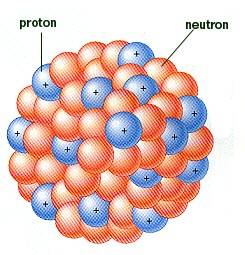
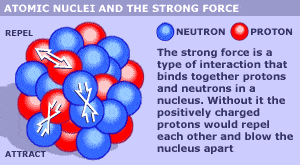
nucleus3.jpg


_643791_nucleus2_inf300.gif


---------

Everybody has seen those images. But in reality, we have no picture of an atomic nucleus, we can only draw the picture based on the properties of the elements in the periodic table.

But, if the protons themselves stayed together as little particles on their own inside the nucleus, the positive charge in the protons would prevent the nucleus from ever forming in the first place. Same thing would happen with the neutrons because we know from neutron decay, the neutron is almost identical to the proton except its slightly heavier and has no charge, and it can decay into a proton. As a result of this, there can't be lots of little proton balls and lots of little neutron balls. They must be one ball that just gets slightly bigger and slightly heavier as we go through the periodic table up to the heavy elements.

My question;
So if you were drawing pictures of the nucleus of the heavier elements, as the elements get heavier going from Hydrogen all the way up to uranium, what are they most likely to look like. Or do you think the image with the little balls is a good representation of what a heavy nucleus would look like? Could we draw a heavy nucleus in a better way to better represent the properties of a heavy nucleus?

What I'm really getting at is that a uranium nucleus would look exactly like a deuterium, 1 proton and 1 neutron, but the uranium nucleus would just be bigger and heavier. But the uranium nucleus would be much closer to being two balls of energy, the proton ball and the neutron ball. It would not look like 92 proton balls and 92 neutron balls as shown in the above images.

John.
 
Last edited by a moderator:
Physics news on Phys.org
It appears that you have completely neglected the role of the strong force and the Standard Model of elementary particles, and then made up your own hypothesis of the nucleus without it. Is there a reason for this, or do you just simply not accept the presence of the strong force? We have given the Nobel Prize for it!

Zz.
 
No, don't get me wrong. I think the standard model is great. I'm just suggesting that the visual representation of heavy nucleus's could be drawn in a way to better represent the properties we observe in experiments.

Critically, in heavy elements, using Iron as an example, we don't observe anything to suggests that Iron-52, with 26 protons and 26 neutrons, has 52 little individual bits stuck together by the strong force. What we do observe is a heavy nucleus, that physically gets bigger roughly by the cube of its mass. And with all the various fission, fusion, isotopes, and decay modes, we observe a nucleus that displays properties much closer to two bundles stuck together by the strong force. That's a bundle of protons and a bundle of neutrons, separate, but stuck together by the strong force.

I drew this image as a better representation of the properties we observe;

nucleus173.jpg


That image shows a Carbon, Iron and a Uranium nucleus. Below each image is an Isotope of each element with more neutrons than protons. So i displayed the neutrons in the isotope as being just a bit larger than the proton bundle. This image is physically a better representation of the properties we observe in heavy elements than the image with the single bundle of dots suggesting Iron-52 has 52 separate little bits stuck together.

John.
 
Last edited:
John37309 said:
No, don't get me wrong. I think the standard model is great. I'm just suggesting that the visual representation of heavy nucleus's could be drawn in a way to better represent the properties we observe in experiments.

Critically, in heavy elements, using Iron as an example, we don't observe anything to suggests that Iron-52, with 26 protons and 26 neutrons, has 52 little individual bits stuck together by the strong force. What we do observe is a heavy nucleus, that physically gets bigger roughly by the cube of its mass. And with all the various fission, fusion, isotopes, and decay modes, we observe a nucleus that displays properties much closer to two bundles stuck together by the strong force. That's a bundle of protons and a bundle of neutrons, separate, but stuck together by the strong force.

I drew this image as a better representation of the properties we observe;

nucleus173.jpg


That image shows a Carbon, Iron and a Uranium nucleus. Below each image is an Isotope of each element with more neutrons than protons. So i displayed the neutrons in the isotope as being just a bit larger than the proton bundle. This image is physically a better representation of the properties we observe in heavy elements than the image with the single bundle of dots suggesting Iron-52 has 52 separate little bits stuck together.

John.

This "picture" is not better. You clumped all the protons together, and all the neutrons together. This isn't the case. We know that such a configuration (a nuclear with all protons or all neutrons) are extremely unstable and don't exist. So it makes no sense to make such a picture. There's also nothing to indicate, based on all our experiments, that such a picture is more accurate. In fact, there are indications (based on what I mentioned earlier), that such a picture is not accurate at all.

This is almost like insisting on using the Rutherford model for the atom. It may be "easier" to visualize than the actual QM description, but just because it is easier to draw and picture, it doesn't make it accurate.

Zz.
 
Last edited:
Let me try to explain this better. I'm sure you are familiar with the image of the single proton. From particle collisions, we know the proton has 3 quarks. 2 up quarks and one down quark. When we discuss sub-atomic particles, we might draw the proton with the 3 quarks inside the proton like this;

250px-Quark_structure_proton.svg.png


But you will never see a chemical engineer drawing that image because the 3 quarks all act as one bundle, and we call it a proton. And we draw it as one circle because in the vast majority of experiments, protons display the properties of being one bundle of energy. And its extremely difficult to split that proton into smaller components. The proton never displays the properties of having 3 bits inside it. We only know it has 3 quarks inside it because we smash them in accelerators. But this is rare and we only do it for experimental purposes.

So the same thing applies to heavier Nuclei. They do not display any properties to suggest they have tonnes of little bits inside them. They act like two bundles, a bundle of protons and a bundle of neutrons, stuck together by the strong force as i drew in my image.

John.
 
Last edited:
John37309 said:
So the same thing applies to heavier Nuclei. They do not display any properties to suggest they have tonnes of little bits inside them. They act like two bundles, a bundle of protons and a bundle of neutrons, stuck together by the strong force as i drew in my image.

John.

Nope .. I don't agree with that at all. It doesn't account for known properties like fission, alpha and beta decay, nuclear shell structure, neutron emission, Mossbauer spectroscopy, nuclear angular momentum, etc. etc.

The usual model of a nucleus as being an inhomogeneous mixed mass of protons and neutrons was developed to explain these properties. Just pick up a book on nuclear physics and you will begin to understand why your model makes much less sense. It is incredibly difficult (if not impossible) to find a diproton (i.e. a He-2 nucleus), let alone a big mass of positive charge all smashed together, and holding a ball of pure neutrons together requires a massive external force like the gravitational field of a neutron star.
 
Last edited:
John37309 said:
So the same thing applies to heavier Nuclei. They do not display any properties to suggest they have tonnes of little bits inside them. They act like two bundles, a bundle of protons and a bundle of neutrons, stuck together by the strong force as i drew in my image.

John.

How do you know that same thing applies to heavy nuclei? How do you know they do not display such properties? You have not been following the results from RHIC and ALICE? Nothing of what you said here is consistent with nuclear theory AND experiment. Thus, it makes your picture a fiction toy model.

Zz.
 
Yea, ok. Just wanted to see if anyone agreed with the theory.

In my mind, it still make more sense to think about it the way i just described. But maybe its just me. Thanks for the input guys!

John.
 
John37309 said:
Yea, ok. Just wanted to see if anyone agreed with the theory.

In my mind, it still make more sense to think about it the way i just described. But maybe its just me. Thanks for the input guys!

John.

Are you viewing the particles as classical "balls" or as quantum particles involving wave functions and such?
So the same thing applies to heavier Nuclei. They do not display any properties to suggest they have tonnes of little bits inside them. They act like two bundles, a bundle of protons and a bundle of neutrons, stuck together by the strong force as i drew in my image.

Actually the fusing and fissioning of nuclei is an example of the nucleus acting like many little bits. The quarks inside a nucleon don't act like such, as they are never emitted during a decay process. There are a few different models for the nucleus, none of which fully explain everything observed. (Wikipedia states that there are 37 models stated in N.D. Cook (2010). Models of the Atomic Nucleus (2nd ed.))
 
Last edited:
  • #10
Perhaps the gist of John's thread is that he sees no evidence that the protons and neutrons in the nucleus have an experimentally verifiable position within the nucleus. (i.e. that some are, say, at the top outside, whereas others are at the equator near the core).

Since this does not seem to be a correct way of modeling the nucleus, perhaps it should not be illustrated this way.

Any illustration is going to be inaccurate, his submission is simply inaccurate in a different way. His argument is that his might be less conceptually misrepresentative.

... or so it seems to me...
 
  • #11
DaveC426913 said:
Perhaps the gist of John's thread is that he sees no evidence that the protons and neutrons in the nucleus have an experimentally verifiable position within the nucleus. (i.e. that some are, say, at the top outside, whereas others are at the equator near the core).

Since this does not seem to be a correct way of modeling the nucleus, perhaps it should not be illustrated this way.

Any illustration is going to be inaccurate, his submission is simply inaccurate in a different way. His argument is that his might be less conceptually misrepresentative.

... or so it seems to me...

Don't nucleons occupy particular spots or orbits or something in the nucleus? After all they are fermions and obey the Pauli Exclusion Principle, which is why nuclei differ in size as you add more nucleons, similar to adding more electrons. It seems like it is similar to electrons in that they occupy different orbitals and those orbitals define the likelihood of finding the particle at particular spots.
 
  • #12
Drakkith said:
Are you viewing the particles as classical "balls" or as quantum particles involving wave functions and such?
Yes, i do imagine the nucleus as being a classical little ball. But i see it as a little ball of wavy energy, not solid, just wavy energy.

Its the mass of the ball and the charge of the ball that tells us what that element is. With Iron-52, if i fire neutrons at the nucleus, i can create a heavier isotope like Iron-56. But the neutrons will only stick to the "neutron" ball inside the nucleus. I can't create cobalt by firing neutrons at the nucleus hoping the neutrons will stick to the proton ball. In other words, i can't create a heavier element by firing neutrons at the nucleus. So in many situations, in my mind anyway, the nucleus of heavy elements just acts like two balls stuck together by the strong force.

But i do agree with you guys too. There are pro's and con's to drawing the nucleus in different ways depending on what someone is explaining. There is good and bad in my method.

John.
 
  • #13
Its the mass of the ball and the charge of the ball that tells us what that element is. With Iron-52, if i fire neutrons at the nucleus, i can create a heavier isotope like Iron-56. But the neutrons will only stick to the "neutron" ball inside the nucleus. I can't create cobalt by firing neutrons at the nucleus hoping the neutrons will stick to the proton ball. In other words, i can't create a heavier element by firing neutrons at the nucleus.

Sure you can. That's how they create Plutonium and such. A neutron is absorbed by the nucleus, which then decays to a proton. And neutrons do not stick ONLY to other neutrons. They stick to both neutrons and protons. If it weren't for the fact that individual neutrons stick to individual protons, nuclei would be much much more unstable.
 
  • #14
Drakkith said:
Sure you can. That's how they create Plutonium and such. A neutron is absorbed by the nucleus, which then decays to a proton. And neutrons do not stick ONLY to other neutrons. They stick to both neutrons and protons. If it weren't for the fact that individual neutrons stick to individual protons, nuclei would be much much more unstable.
You make a very valid point.

John.
 
  • #15
It's the shifting from fairly precise descriptions and images to an expression like 'little ball of wavy energy' that throws me. I cannot relate the expression with the images.

In any event, for all the models of a nucleus that are out there, putting all the protons together (if that's what we are 'actually' doing) seems the least likely candidate. Protons can only stand so much same-charge association for long. "Two's company, three's a crowd."

And I can't see any analogy of quark bag-containment with a nucleus model.

A deeper problem for any model is the nature of 'space' and 'location' at the quantum scale of a nucleus, and the wave-function of a nucleon: it only has a probability of being here or there in the nucleus, if we have any meaning for 'here' or 'there'.

"There is no 'there' there." --Gertrude Stein
 
  • #16
danR said:
It's the shifting from fairly precise descriptions and images to an expression like 'little ball of wavy energy' that throws me. I cannot relate the expression with the images.
Hi Dan,
If i could have drawn the nucleus's in my image as kind of wavy, i would have. So i drew them as perfect circles only because its a limitation of my image software. With my image software, i would have made a hash of the drawing if i tried to make the circles wavy.

Do you see any logic in what I'm suggesting Dan?

John.
 
  • #17
Unfortunately, the nucleus is tricky to model, which is why there are so many models on the nucleus.
What we do know is that the nucleus is roughly spherical (not two spheres joined together).
Also, the strong force does not depend on isospin, therefore the proton and neutron inside the nucleus can be viewed as two quantum states of the same particle. This gave rise to the term nucleon (neutron or proton), because we can't point at a nucleon inside the nucleus and say "its a proton" or "its a neutron".
So although you can say "there are 5 protons and 4 neutrons inside that nucleus", you can't say which are the protons and which are the neutrons.
 
  • #18
John37309 said:
Hi Dan,
If i could have drawn the nucleus's in my image as kind of wavy, i would have. So i drew them as perfect circles only because its a limitation of my image software. With my image software, i would have made a hash of the drawing if i tried to make the circles wavy.

Do you see any logic in what I'm suggesting Dan?

John.

You should understand that my field is linguistics, and the way people map words and phrases to meaning and reality. That sort of thing. Physics is very interesting in the way it uses words, and physicists are very careful to define their terms, and re-define terms to apply to microscopic worlds in special way. When we draw circles (or spheres), or make them look 'wavy' and say the represent a nucleus, we are throwing around an incredible amount of terminology and conceptualization that may not apply at very small scales, or may have no meaning whatever.

If I teach adult Koreans English, I know they have no internalized mapping of preposition-phrases to concrete objects and relationships whatsoever. Because they have no 'prepositions' to speak of. 'In the car' is grammatical/syntactic object that they may have a very good formalist grasp, but in saying 'in the car', I bring up no image in their minds that would immediately be formed in an American's mind.

Likewise, my 'realist' knowledge of the strange world of microscopic scales is approximately zero, and I have to map your own use of terms to my own understanding of those terms to my non-understanding of the alien world of nuclei.

And then someone says there are umpteen theories about the architecture of nuclei, all devised by postgraduate students and professors of physics who have spent x hundred person-years thinking very deeply about the subject. So, as a layman in the jury box, I'm inclined to give a great deal of weight to those theories, and less weight to a theory that 'appears' to leave protons all together for certain length of time. I suppose there are times that the wave functions of protons may temporarily (quantum-speaking) be all on one 'side' (whatever that means), and yes, those may be the times when atom-bombs are more likely to be effective.

For most atoms, most of the time, I would be more agreeable to some averaged (time-wise or shell-wise) distribution of nucleons.
 
  • #19
danR said:
You should understand that my field is linguistics, and the way people map words and phrases to meaning and reality. That sort of thing...
Interesting Dan.

I'm a bit like you Dan. I myself have a keen interest in how scientists map there mathematics and words into images. You talk about teaching a foreign student a different language and how best the words and ideas can be communicated between two languages. Well I'm a bit like that. I read the scientific text and mathematics and then translate that to images. The funny thing about science is that when people get used to seeing a particular representation of something, its very difficult to change their mind. Even though the image might be a very poor representation of what someone is explaining, people just get used to the image and don't want to change it.

Hence very few people in this thread saw any merit at all in the case i presented here. Even though the images i drew here are an almost perfect copy of an image created by a very eminent scientist. Nobody even made the connection. I found this very interesting.

John.
 
  • #20
John37309 said:
The funny thing about science is that when people get used to seeing a particular representation of something, its very difficult to change their mind. Even though the image might be a very poor representation of what someone is explaining, people just get used to the image and don't want to change it.

Hence very few people in this thread saw any merit at all in the case i presented here.

You assumed that people saw no merit because they don't want to change their ideas, and you ignored the possibility that people saw no merit because, say, the idea had no merit.


John37309 said:
Even though the images i drew here are an almost perfect copy of an image created by a very eminent scientist. Nobody even made the connection. I found this very interesting.
So what? Eminent scientists propose ideas all the time. That doesn't make them right. Additionally, without context, there is no indication that those images apply here at all.
 
  • #21
John37309 said:
Hence very few people in this thread saw any merit at all in the case i presented here.

There's no merit to it because the images are WRONG! You have been given several explanations on why they are wrong. Do you think your images trump over the physics? Since when?

Even though the images i drew here are an almost perfect copy of an image created by a very eminent scientist.

What "eminent scientist"? Please provide exact references. If you want to do science, then you have to know how to cite references, rather than present unverified statements.

The puzzling thing about this whole thread is that you asked for our opinions! When you got what you did not expect, you now think that we are the ones at fault for not accepting your picture. If you can't accept what you asked for, you shouldn't have asked in the first place.

Zz.
 
  • #22
I'm curious to see said source as well.
 
  • #23
John, also remember that the images created vary with the target audience. Just because an image is created by a great scientist doesn't mean it was supposed to be as accurate as possible.

Also, you asked:

My question;
So if you were drawing pictures of the nucleus of the heavier elements, as the elements get heavier going from Hydrogen all the way up to uranium, what are they most likely to look like. Or do you think the image with the little balls is a good representation of what a heavy nucleus would look like? Could we draw a heavy nucleus in a better way to better represent the properties of a heavy nucleus?

So you asked us what it would most likely look like, and we gave you our best answer. I'm sorry you didn't like it.
 
  • #24
Yep, i just wanted to see what you guys thought of the idea. And as you guys said, ye didn't like the idea. So that's fine. If you prefer the nucleus with lots of bits inside the nucleus, then that's what you want to see.

Unfortunately i can't quote my source in this particular case. But i drew the images myself, its my personal art work.

John.
 
  • #25
John37309 said:
Yep, i just wanted to see what you guys thought of the idea. And as you guys said, ye didn't like the idea. So that's fine. If you prefer the nucleus with lots of bits inside the nucleus, then that's what you want to see.

And take note, we not only told you why we didn't like it, we gave you physics reasons why! You never gave any physical basis why your picture is better. All you cared about was that it is easier to visualize or conceptualize, regardless on whether it matches the physics of what we know about the nucleus. This is putting the cart before the horse, and forcing nature to conform to what you want it to look like. As scientists, this is the worst thing in the world to do. Yet, you think we do not accept your picture because we simply do not want to give up a picture that we are "familiar" with. That is the criticism that I will not let slide by without challenge.

Zz.
 
  • #26
ZapperZ said:
... That is the criticism that I will not let slide by without challenge.

Zz.
Master Zapper,
Ok, i suggest pistols at dawn. Time square, New York would be a suitable venue. Attire should be formal top coats and hats. Fight till the death :frown:

Its just a discussion, don't take it so seriously my friend.

John.
 
  • #27
John37309 said:
Its just a discussion, don't take it so seriously my friend.

This is a website whose aim is teaching and to do so only allows mainstream published science.

As such, it is important to take baseless claims that don't conform to the mainstream very seriously.

As per the rules, if you want to claim your image is correct you must support it with relevant sources. You cannot just assert it is correct because you find it easier.
 
  • #28
JaredJames said:
This is a website whose aim is teaching and to do so only allows mainstream published science.

As such, it is important to take baseless claims that don't conform to the mainstream very seriously.

As per the rules, if you want to claim your image is correct you must support it with relevant sources. You cannot just assert it is correct because you find it easier.
Jarid,
Its just a public forum. Don't treat it like a science journal. Yes, its very good to beat out any scientific argument to come to a proper conclusion about something, or to resolve a problem. But PF is whatever the people using the forum make it. What's discussed in a public forum is not going to change the world, its just discussion of scientific topics. Lots of people with different backgrounds and levels of education.

John.
 
  • #29
John37309 said:
Jarid

Jared - as per the username.
Its just a public forum. Don't treat it like a science journal. Yes, its very good to beat out any scientific argument to come to a proper conclusion about something, or to resolve a problem. But PF is whatever the people using the forum make it. What's discussed in a public forum is not going to change the world, its just discussion of scientific topics. Lots of people with different backgrounds and levels of education.

John.

Correction, it's a private forum, under the rules the owners dictate.

Whether you like it or not, this website is designed around discussion of mainstream science only and teaching people about it. This is all well outlined in the rules you agreed to on signup.

You are not allowed to push your own theories and ideas unless you can support them with published science.
 
  • #30
JaredJames said:
Jared - as per the username.


Correction, it's a private forum, under the rules the owners dictate.

Whether you like it or not, this website is designed around discussion of mainstream science only and teaching people about it. This is all well outlined in the rules you agreed to on signup.

You are not allowed to push your own theories and ideas unless you can support them with published science.

Well now Jarid, i had no idea this forum was such a serious place. Thats really good to know!

John.
 

Similar threads

  • · Replies 5 ·
Replies
5
Views
2K
  • · Replies 12 ·
Replies
12
Views
5K
  • · Replies 15 ·
Replies
15
Views
4K
  • · Replies 14 ·
Replies
14
Views
2K
  • · Replies 10 ·
Replies
10
Views
2K
Replies
10
Views
5K
  • · Replies 9 ·
Replies
9
Views
2K
  • · Replies 5 ·
Replies
5
Views
3K
  • · Replies 8 ·
Replies
8
Views
3K
  • · Replies 1 ·
Replies
1
Views
2K