What is the net charge on the hollow conducting sphere?

Click For Summary
SUMMARY

The net charge on the hollow conducting sphere can be determined by applying Gauss's Law. Given the electric field values at 13.7 cm and 47.0 cm from the center, the charge on the insulating sphere is calculated as -7.18 x 10^-9 C, while the surface charge on the inside of the hollow sphere is 7.18 x 10^-9 C. To find the net charge on the hollow conducting sphere, one must first calculate the total charge within a Gaussian surface that includes both the insulator and the conductor, then subtract the charge of the insulator. This approach leads to a clear understanding of the charge distribution in this electrostatic configuration.

PREREQUISITES
  • Understanding of Gauss's Law
  • Familiarity with electric fields and charge distributions
  • Knowledge of spherical conductors and insulators
  • Ability to perform calculations involving electric fields (E = k * q / r^2)
NEXT STEPS
  • Study Gauss's Law applications in electrostatics
  • Learn about electric field calculations for spherical charge distributions
  • Explore the concept of Gaussian surfaces in electrostatics
  • Review problems involving charge distribution in conductors and insulators
USEFUL FOR

Students preparing for physics exams, particularly those focusing on electrostatics, as well as educators seeking to enhance their understanding of charge distributions in conductive materials.

mitleid
Messages
56
Reaction score
1
For the configuration shown in the figure below, suppose that a = 5.60 cm, b = 19.8 cm, and c = 27.9 cm. Furthermore, suppose that the electric field at a point 13.7 cm from the center is 3.44 x 10^3 N/C radially inward, while the electric field at a point 47.0 cm from the center is 1.03 x 10^2 N/C radially outward.
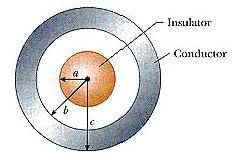
diagram-2.jpg


I've already answered half of this question, which is to find the charge on the insulating sphere as well as the surface charge on the inside of the hollow sphere (-7.18 x 10^-9 C and 7.18 x 10^-9 C respectively).

I'm having trouble with these :
find (b) the net charge on the hollow conducting sphere. and

(d) the total charge on the outer surfaces of the hollow conducting sphere.

What I did to try and get the net charge was basically the same as what I did for the insulating sphere...

(Field * R^2)/Ke = q

Any help is much appreciated! Pretty interesting problem...
 
Physics news on Phys.org
Hint: First find the net charge within a gaussian sphere containing both the insulator and the hollow conductor...

Then subtract away the charge on the insulator to give the charge on the conductor... use the field at 47.0cm that they've given...
 
Last edited:
yes!

I think I've got it now, thanks for connecting the dots for me... I'm actually a fairly visual learner, so until the picture makes sense in my mind it's difficult to realize the necessary calculations.

I should be doing well on the exam next week! Thanks again.

~Mitleid
 

Similar threads

Replies
23
Views
5K
Replies
12
Views
2K
  • · Replies 2 ·
Replies
2
Views
2K
  • · Replies 2 ·
Replies
2
Views
1K
  • · Replies 9 ·
Replies
9
Views
3K
  • · Replies 5 ·
Replies
5
Views
5K
Replies
20
Views
3K
Replies
12
Views
2K
Replies
1
Views
2K
  • · Replies 5 ·
Replies
5
Views
3K