Discussion Overview
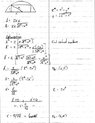
The discussion revolves around finding the dimensions and area of the rectangle of largest area that can be inscribed in a semicircle of radius R, with one side of the rectangle lying on the diameter. The focus includes optimization techniques and mathematical reasoning related to this geometric problem.
Discussion Character
- Mathematical reasoning
- Homework-related
- Exploratory
Main Points Raised
- One participant expresses confusion about how to optimize the rectangle's area and seeks clarification on the requirements, including the need for a diagram.
- Another participant provides a critical value for the rectangle's dimensions, specifically stating that the base of the rectangle is \(2x\) and asking for the height \(y\) at \(x=\frac{R}{\sqrt{2}}\).
- A participant calculates the area \(A\) as \(2x \cdot \sqrt{R^2 - x^2}\) and seeks confirmation on whether they have correctly identified the length and width.
- Further calculations are presented, with one participant attempting to express the area in terms of \(l\) and \(w\), leading to a more complex expression involving square roots.
- Another participant confirms the base and height of the rectangle, ultimately calculating the area as \(R^2\) based on their derived dimensions.
Areas of Agreement / Disagreement
Participants present various calculations and approaches, but there is no consensus on the final area or the correctness of the derived expressions. The discussion remains unresolved regarding the optimal dimensions and area of the rectangle.
Contextual Notes
There are unresolved mathematical steps and assumptions regarding the optimization process, particularly in how the area is derived and expressed. The dependence on the critical value and the implications of the rectangle's dimensions are also not fully clarified.