What is the period of the loaded tuning fork?

Click For Summary
SUMMARY

The discussion centers on the effect of loading a tuning fork with wax on its frequency and period. Two identical tuning forks vibrate at 256 Hz, and when one is loaded, it produces 6 beats per second, indicating a frequency difference of 6 Hz. The loaded tuning fork's frequency decreases due to the added mass, which affects the restoring force and results in a slower vibration. This phenomenon is explained by the relationship between mass and frequency in oscillators, where increased mass leads to a lower frequency.

PREREQUISITES
  • Understanding of basic physics concepts related to oscillation and frequency
  • Familiarity with tuning fork mechanics and sound wave production
  • Knowledge of the relationship between mass and frequency in oscillatory systems
  • Basic grasp of the concept of beats in wave interference
NEXT STEPS
  • Study the principles of harmonic oscillators and their frequency equations
  • Learn about the physics of sound waves and their properties
  • Explore the concept of beats and how they relate to frequency differences
  • Investigate the effects of mass loading on various types of oscillators
USEFUL FOR

Physics students, educators, and anyone interested in the mechanics of sound and oscillation, particularly in understanding the effects of mass on frequency in tuning forks.

blue.flake
Messages
11
Reaction score
1
Member advised to use the homework template for posts in the homework sections of PF.
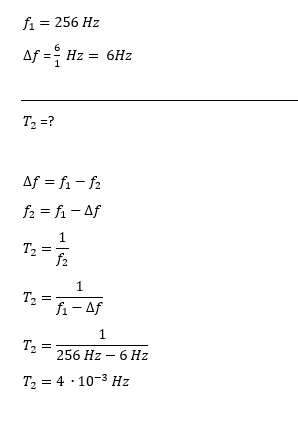
Two identical tuning forks vibrate at 256 Hz. One of them is then loaded with a drop of wax, after which 6 beats/s are heard. The period of the loaded tuning fork is?

So, as the uploaded pictures shows, I did solve the problem, but I'm not sure why the f1 frequency is bigger than f2. I mean how can I be sure which one should I subtract from the other?
1.PNG


edit: yeah i just noticed i messed up the unit for the period, I'm sorry..
 
Physics news on Phys.org
A tuning fork will vibrate at a lower frequency when loaded.
 
thank you, but can you explain to me why exactly?
 
In simple terms, the fork's material has a solid material shape which if deformed, e.g. if a tine is struck, it will tend to "bounce back" to its original shape. This occurs with a restoring force due to the structure and shape of the fork. Each tine of the fork has weight. The relationship between the restoring force and the weight determines the frequency. Adding the wax does not change the way the fork's restoring energy works, it only adds mass to the system. From general knowledge of oscillators mass loaded vibrators such as spring systems or just by thinking about F=M*a (recall M increases but F stays the same) you can generalize that the extra mass will make the tine vibrate slower.
 
thank you so much ^_^
 

Similar threads

  • · Replies 5 ·
Replies
5
Views
2K
  • · Replies 6 ·
Replies
6
Views
5K
  • · Replies 4 ·
Replies
4
Views
2K
Replies
22
Views
5K
  • · Replies 15 ·
Replies
15
Views
9K
Replies
3
Views
2K
  • · Replies 1 ·
Replies
1
Views
2K
  • · Replies 4 ·
Replies
4
Views
3K
  • · Replies 7 ·
Replies
7
Views
8K
  • · Replies 5 ·
Replies
5
Views
2K