What is the potential difference Vad-Vac?

  • Thread starter Thread starter dwstrait
  • Start date Start date
  • Tags Tags
    Capacitors Switch
Click For Summary
SUMMARY

The discussion focuses on calculating the potential difference Vad-Vac in a circuit involving capacitors. The initial potential difference applied is Vab = +210 V. The equivalent capacitance of the series configuration is determined to be 4 x 10⁻⁶ F. The charge on the capacitors is calculated using Q = CV, resulting in a total charge of 8.4 x 10⁻⁴ C. Ultimately, the potential differences are found to be Vad = 140 V and Vac = 70 V, leading to the conclusion that Vad - Vac = 70 V.

PREREQUISITES
  • Understanding of capacitor configurations (series and parallel)
  • Familiarity with capacitance calculations (C = Q/V)
  • Knowledge of equivalent capacitance formulas (1/C = 1/c1 + 1/c2 for series)
  • Basic principles of electric potential difference
NEXT STEPS
  • Study the principles of capacitor charging and discharging
  • Learn about complex capacitor networks and their analysis
  • Explore the impact of dielectric materials on capacitance
  • Investigate the applications of capacitors in AC circuits
USEFUL FOR

Students in electrical engineering, physics enthusiasts, and anyone seeking to deepen their understanding of capacitor behavior in circuits.

dwstrait
Messages
4
Reaction score
0
1. The problem statement
The capacitors in the figure are initially uncharged and are connected, as in the diagram, with switch S open. The applied potential difference is Vab = + 210 V.

What is the potential difference Vcd?
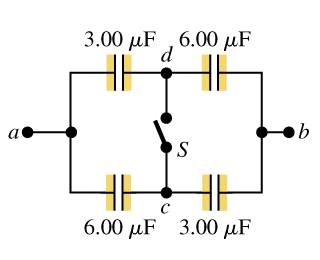
YF-24-60.jpg


Homework Equations


(series) 1/C = 1/c1 + 1/c2 + ...
(parallel) C = c1 + c2 + ...
C=Q/V

The Attempt at a Solution


Trying to find Vcd:
I first found the equivalent capacitance of the series, which is 4*10-6 F. I calculated the charge on the capacitors using Q = CV, which was 8.4*10-4. Then, I tried to find Vad and Vac by using V=Q/C. I don't think this is the right way to do this problem though.
 
Last edited:
Physics news on Phys.org
That looks like the way to do it as far as you went.
 
Ah, I figured it out. The upper and lower series each have half the value of the charge that I calculated. Then using V=QC, Vad=140V and Vac=70V, so Vad-Vac=70V.
 

Similar threads

Replies
2
Views
1K
  • · Replies 15 ·
Replies
15
Views
1K
  • · Replies 7 ·
Replies
7
Views
2K
  • · Replies 9 ·
Replies
9
Views
2K
  • · Replies 2 ·
Replies
2
Views
14K
  • · Replies 11 ·
Replies
11
Views
4K
  • · Replies 4 ·
Replies
4
Views
4K
Replies
23
Views
13K
  • · Replies 5 ·
Replies
5
Views
2K
Replies
5
Views
1K