What is the probability of a customer only insuring one non-sports car?

Click For Summary
SUMMARY

The probability that a randomly selected customer insures exactly one non-sports car is 0.205 or 20.5%. Analyzing a pool of 1,000 customers, 300 insure one car, while 700 insure more than one car. Among these, 20% insure a sports car, leading to 95 customers with one sports car. Consequently, 205 customers insure one car that is not a sports car, confirming the calculated probability of 0.205.

PREREQUISITES
  • Understanding of basic probability concepts
  • Familiarity with Venn diagrams for probability visualization
  • Knowledge of conditional probability formulas
  • Ability to interpret statistical data
NEXT STEPS
  • Study conditional probability and its applications
  • Learn how to construct and interpret Venn diagrams in probability
  • Explore real-world applications of probability in insurance
  • Investigate the impact of customer demographics on insurance probabilities
USEFUL FOR

Statisticians, data analysts, insurance professionals, and students studying probability theory will benefit from this discussion.

Jason123
Messages
3
Reaction score
0
Need help with a probability problem. I have the answer from the answer key, I just don't know how to figure it out.An insurance company examines its pool of auto insurance customers and gathers the following information:1) All customers insure at least one car.

2) 70% of the customers insure more than one car.

3) 20% of customers insure a sports car.

4) Of those customers who insure more than one car, 15% insure a sports car.
Calculate the probability that a randomly selected customer insures exactly one car and that car is not a sports car.
 
Physics news on Phys.org
Hello Jason123 and welcome to MHB! :D

Any thoughts on where to begin?

Also, we ask that users do not post duplicate topics, thanks. I've deleted your other thread.
 
I know I need to use the formula, pr(AnB)/Pr(B). For this problem I believe that pr(AnB) = the probability that someone has only one car and the car is not a sports car. And then divide that by the probability that someone has only one car. but I can't seem to get those numbers. Answer key says its .205.
 
Here's how I would do this problem (I'm not big on memorizing formulas):
"An insurance company examines its pool of auto insurance customers and gathers the following information:"
Imagine 1000 customers.

"1) All customers insure at least one car.

2) 70% of the customers insure more than one car."
So 700 insure more than one car, 300 insure one car.

"3) 20% of customers insure a sports car."
So 200 insure a sports car.

"4) Of those customers who insure more than one car, 15% insure a sports car."
Of the 700 customers who insure more than one car, .15(700)= 105 insure a sports car. Since 200 customers insured a sports car, that means there are 200- 105= 95 customers who insure only one car and that is a sports car. Since 300 customers insure one car, 300- 95= 205 customers insure one car and that car is not a sports car.

"Calculate the probability that a randomly selected customer insures exactly one car and that car is not a sports car."
That's easy now. Out of 1000 customers, 205 of them insure one car which is not a sports car. The probability is 205/1000= 0.205 or 20.5%.
 
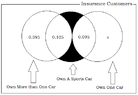
Consider the following Venn diagram:

View attachment 6082

We must have:

$$x+0.7+0.095=1$$

$$x=0.205$$
 

Attachments

  • insurancevenn.png
    insurancevenn.png
    4.5 KB · Views: 150

Similar threads

  • · Replies 4 ·
Replies
4
Views
2K
  • · Replies 1 ·
Replies
1
Views
2K
Replies
4
Views
3K
Replies
9
Views
3K
  • · Replies 1 ·
Replies
1
Views
3K
  • · Replies 108 ·
4
Replies
108
Views
19K
  • · Replies 22 ·
Replies
22
Views
6K
Replies
127
Views
22K
  • · Replies 4 ·
Replies
4
Views
3K
  • · Replies 116 ·
4
Replies
116
Views
17K