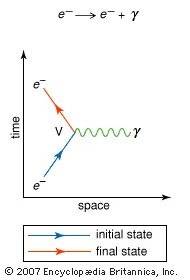
What is the probability of an electron emitting a photon?

Click For Summary
SUMMARY

The probability of an electron emitting a photon can be calculated using Feynman diagrams, which represent interactions in quantum field theory. The final numerical probability, such as 0.000000 for a specific interaction, requires careful consideration of various factors, including conservation laws and coupling constants. Key resources for understanding these calculations include "Quarks and Leptons: An Introductory Course in Modern Particle Physics" by Francis Halzen and Alan D. Martin, as well as the Particle Data Group (PDG) website for precise values of constants. The fine structure constant, α = 1/137, plays a crucial role in these calculations.

PREREQUISITES
  • Understanding of Feynman diagrams and their algebraic representation
  • Knowledge of quantum field theory and particle interactions
  • Familiarity with the fine structure constant (α = 1/137)
  • Basic grasp of conservation laws in physics
NEXT STEPS
  • Study the process of calculating decay widths and cross sections in particle physics
  • Learn how to interpret Feynman diagrams in the context of quantum electrodynamics (QED)
  • Explore the significance of the Particle Data Group (PDG) constants in particle physics calculations
  • Investigate the relationship between energy, momentum, and interaction rates in particle collisions
USEFUL FOR

Physicists, students of quantum mechanics, and anyone interested in the mathematical foundations of particle interactions and their probabilities.

James1238765
Messages
120
Reaction score
8
TL;DR
How to calculate numerical probabilities using Feynman diagram?
I have seen many tutorials that provide steps how to transcribe a Feynman diagram into algebra, for instance [here]:

ezgif.com-gif-maker.jpg


However, I have never seen the final line of the calculation converted into a real number. What are the steps to get from the algebra equations transcribed using the Feynman diagram, into a final concrete (eg 0.1726341) probability number for this interaction to happen?
 
Physics news on Phys.org
Since you don't seem like someone who would read a whole textbook, see e.g. http://nicadd.niu.edu/~dhiman/courses/phys684_10/lectures/process_rates.pdf
It tells you how to compute decay widths and cross sections, which are probability-related quantities that we actually measure. But you will not find a lot of numbers, even in detailed textbooks on particle physics the computation of actual numbers is usually left to exercises.
 
Last edited:
  • Like
  • Informative
Likes   Reactions: James1238765, Vanadium 50, topsquark and 2 others
  • Like
Likes   Reactions: James1238765, topsquark, vanhees71 and 1 other person
The probability of the diagram you have written down is calculable. The answer is 0.000000.

Momentum and energy are not conserved.

This may sound like a quibble, but it highlights @Demystifier's comment about texts. There is a lot that needs to be considered when making these calculations, and that's why we have textbooks.
 
  • Like
Likes   Reactions: topsquark, vanhees71, apostolosdt and 1 other person
James1238765 said:
TL;DR Summary: How to calculate numerical probabilities using Feynman diagram?

I have seen many tutorials that provide steps how to transcribe a Feynman diagram into algebra, for instance [here]:

View attachment 319296

However, I have never seen the final line of the calculation converted into a real number. What are the steps to get from the algebra equations transcribed using the Feynman diagram, into a final concrete (eg 0.1726341) probability number for this interaction to happen?
Such a diagram is not a process at all. It's the leading term in an infinite series which represents the process. As such the mathematical representation/value of that diagram does not give what you want.

Interpreting Feynman diagrams as processes is something which only happens in popular science. Or at least: that ought to be.
 
  • Like
Likes   Reactions: topsquark, vanhees71, apostolosdt and 1 other person
Thank you. I realize many factors must be taken into account to get the final probability. It's just easier usually for me to work backward to understand the answer for the first time. From @Spinnor [here],

qed1273654.jpg

where s and alpha have been previously defined as:

qed1.jpg
qed2.jpg

and

qed3.jpg


which are jointly used to derive the final numerical result:

qed82765342.jpg

I'm unclear how the 1/137 and 398 values above were obtained?

1. Is g_e some constant value that is readable from a table, giving us the 1/137?

2. How does hc equals to 398/1?
 
It may be easier for you, but it is much, much harder for us. @Demystifier is right - you are asking us essentially to write a textbook for you, only out of order. Further, I don't think it's even true: thinking you understand is not the same as actually understanding.

To the specific question, the equation in slide 35 is the same as the one on slide 33, only with some numbers plugged in. You can't understand Slide 35 without understanding Slide 33, and this goes all the way back.
 
  • Like
Likes   Reactions: topsquark and vanhees71
PS Please use LaTeX instead of pasting images.
 
  • Like
Likes   Reactions: topsquark, vanhees71 and berkeman
1. ##\alpha = 1/137##is the famous fine structure constant.

2. ##(\hbar c)^2 = (197.3)^2 = 3.89## MeV. I presume 398 is a typo and involves decimal places conversion from the ##\mu b## units.

The result states that the probability of muon pair production from electron annihilation depends only on the momentum/energy E of the incoming electrons, proportional to a universally applicable coupling constant.
 
Last edited by a moderator:
  • #10
ad 1. ##\alpha=1/137## is the usual back-of-the-envelope approximation of the fine structure constant. It's much more precisely known today. See, e.g., the pdg webpage for precise values of the constants:

https://pdg.lbl.gov/

ad 2. It is utmost important in physics to use correct units; ##\hbar c \simeq 197.3 \; \text{MeV} \, \text{fm}##. Indeed ##\hbar## as the dimension of an action, i.e., of ##\text{energy} \times \text{time}## and ##c## the dimension of a velocity, i.e., ##\text{length}/\text{time}## and thus ##\hbar c## has dimensions ##\text{energy} \times \text{length}## and convenient units in particle and nuclear physics are ##\text{MeV}## and ##\text{fm}##. So a correct statement is ##(\hbar c)^2 \simeq 38927.29 \text{MeV}^2 \text{fm}^2##.
 
  • Like
  • Informative
Likes   Reactions: topsquark, James1238765 and PeroK
  • #11
James1238765 said:
The result states that the probability of muon pair production from electron annihilation depends only on the momentum/energy E of the incoming electrons,

That's because you integrated all the other variables out.
 
  • Like
Likes   Reactions: topsquark and James1238765
  • #12
@Vanadium 50 Can sigma for other types of interactions depend on other factors than E?
 
  • #13
I don't understand the question, "Sigma" usually represents the cross-section in some fiducial region, so it is just a number, not a function. You can talk about its derivative with respect to some variable, but sigma by itself is just a number.
 
  • Like
Likes   Reactions: topsquark
  • #14
@Vanadium 50 Sigma the "scattering cross section" means the rate at which this particle interaction will occur, is that right? If we increase the momentum of collision, it makes sense that the rate of interaction should go up. I was wondering if anything else can affect this rate of interaction, other than the momentum with which we pump the incoming particles?
 
  • #15
First, relying on intuition is a bad idea if anyone is just starting out. Intuition takes time to develop.

Second, it is especially bad if one adopts the "start in the middle and don't bother with the prereqs" strategy. Apart from being inefficient for you, it adds to the burden of people who are trying to teach you - never a good idea, but particularly bad for volunteers.

The road you are trying to take doesn't really go where you want to go.

Now, your intuition is wrong: e^+e^- \rightarrow \mu^+\mu^- goes down with energy. You just calculated it, or at least looked at a calculation and nodded your head. That doesn't mean e^+e^- \rightarrow \mu^+\mu^- + {\rm anything} goes down. It in fact goes up. But that's not what you calculated (well, watched being calculated) is it?
 
Last edited by a moderator:
  • Like
Likes   Reactions: vanhees71, topsquark and PeroK

Similar threads

  • · Replies 6 ·
Replies
6
Views
2K
  • · Replies 5 ·
Replies
5
Views
3K
  • · Replies 8 ·
Replies
8
Views
2K
  • · Replies 2 ·
Replies
2
Views
2K
  • · Replies 1 ·
Replies
1
Views
2K
  • · Replies 4 ·
Replies
4
Views
3K
  • · Replies 1 ·
Replies
1
Views
2K
  • · Replies 1 ·
Replies
1
Views
2K
  • · Replies 7 ·
Replies
7
Views
2K
  • · Replies 13 ·
Replies
13
Views
2K