Calculating a particular amplitude with Feynman diagrams

Click For Summary
SUMMARY

The discussion focuses on calculating the probability amplitude for an electron and positron annihilating into photons using Feynman diagrams. Participants emphasize the importance of using LaTeX for clear communication of equations and suggest consulting Quantum Field Theory (QFT) textbooks, particularly "An Introduction to Quantum Field Theory" by Peskin & Schroeder, for detailed guidance. The need for step-by-step explanations with minimal assumptions is highlighted, along with the recommendation to reference specific pages and equations from the textbooks for effective clarification.

PREREQUISITES
  • Understanding of Feynman diagrams in Quantum Field Theory (QFT)
  • Proficiency in LaTeX for typesetting equations
  • Familiarity with the concepts of probability amplitudes and particle interactions
  • Knowledge of QFT textbooks, specifically "An Introduction to Quantum Field Theory" by Peskin & Schroeder
NEXT STEPS
  • Learn to use LaTeX for formatting equations and enhancing clarity in discussions
  • Study the first and second order expansions in QFT as outlined in Peskin & Schroeder
  • Practice calculating probability amplitudes using Feynman diagrams
  • Engage with online forums or study groups for collaborative learning and problem-solving
USEFUL FOR

Students and self-taught individuals in Quantum Field Theory, physicists interested in particle interactions, and anyone looking to improve their skills in calculating probability amplitudes using Feynman diagrams.

Ringo Hendrix
Messages
9
Reaction score
3
TL;DR
This isn’t homework, I’m self taught. Pardon me for using pictures instead of typing out equations, I have no clue how to do that. So please don’t downvote this for that :-) I’m just really desperate to learn this.
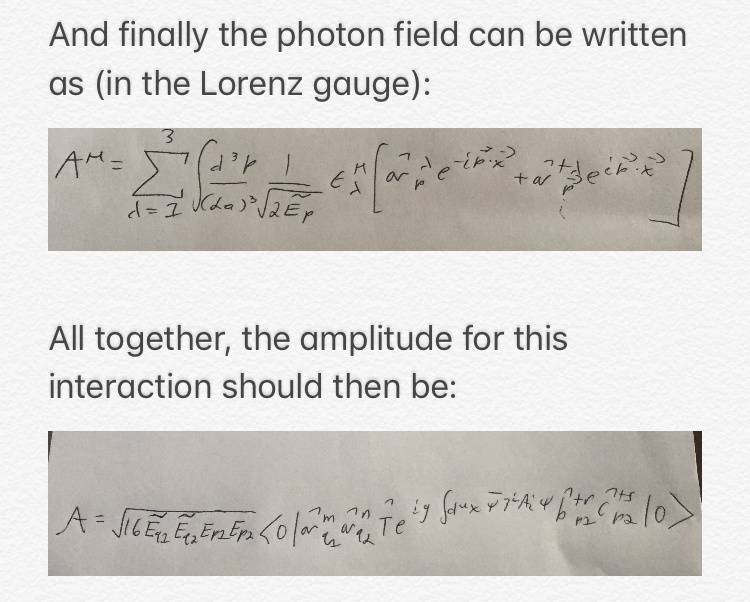
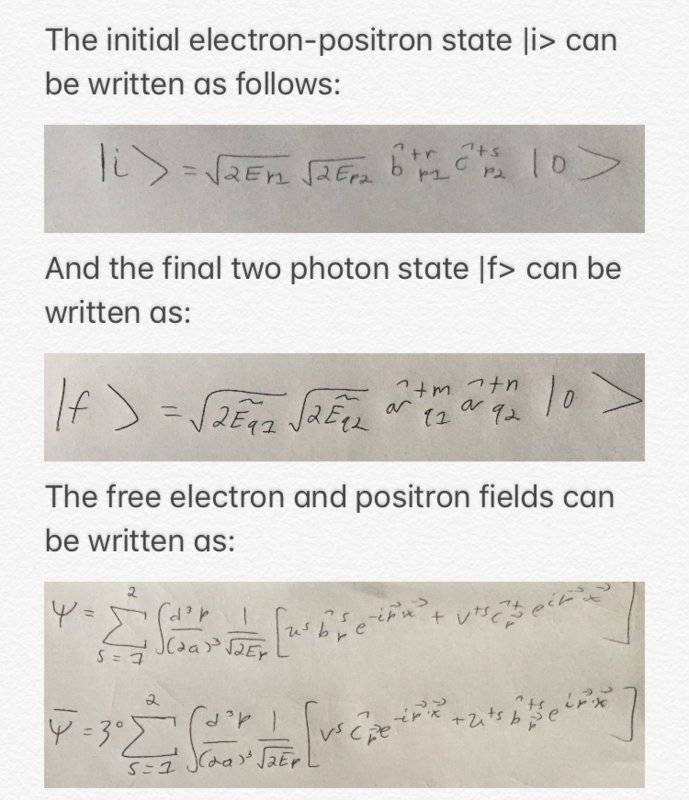
So I’m trying to compute the probability amplitude of an electron with momentum p1 and a positron with momentum p2 annihilating into a photons with momenta q1 and q2.

My question is how do you use Feynman diagrams to calculate the first and second order expansions (seen in the third image)? I wouldn’t mind a step-by-step with minimal assumption similar to the pictures I posted. Any help would be greatly appreciated. Again I’m sorry about the pictures, but I really am unsure how to type out the equations but I hope and assume my writing is legible enough.

What I have so far
59624B62-B3ED-462E-BAA2-1AA4FEB87D5E.jpeg

59BCDEC6-11B1-4A49-AF19-CC4439537269.jpeg

9FDB9BCD-411B-468A-BE14-C9DB0CDC6794.jpeg
 

Attachments

  • 7B979D15-FFE5-4414-B78A-CC9B5C69FACC.jpeg
    7B979D15-FFE5-4414-B78A-CC9B5C69FACC.jpeg
    47.2 KB · Views: 332
Physics news on Phys.org
Ringo Hendrix said:
I really am unsure how to type out the equations

You do it using LaTeX:

https://www.physicsforums.com/help/latexhelp/
Please take the time to learn it and use it to type your equations. The issue is not just legibility but being able to quote parts of your post in responses; we can't do that if all the equations are in images. That makes it much harder for people to help you.
 
  • Like
Likes   Reactions: Ringo Hendrix
Ringo Hendrix said:
This isn’t homework, I’m self taught. [...] I’m just really desperate to learn this.
But,... presumably you are learning from QFT textbook(s), yes? If so, which one(s)? If not, go get a copy of (e.g.,) Peskin & Schroeder.

My question is how do you use Feynman diagrams to calculate the first and second order expansions (seen in the third image)? [...] I wouldn’t mind a step-by-step with minimal assumption [...]
Any respectable QFT textbook should do that. Best to try and learn from the textbook first, then come back here to clarify any details or steps that you don't follow, or can't figure out (but if you do this, be sure to cite page+eqn numbers in the book).
 

Similar threads

  • · Replies 14 ·
Replies
14
Views
2K
  • · Replies 4 ·
Replies
4
Views
3K
  • · Replies 6 ·
Replies
6
Views
2K
  • · Replies 134 ·
5
Replies
134
Views
12K
  • · Replies 2 ·
Replies
2
Views
2K
  • · Replies 15 ·
Replies
15
Views
3K
  • · Replies 4 ·
Replies
4
Views
3K
  • · Replies 7 ·
Replies
7
Views
2K
Replies
2
Views
1K
  • · Replies 2 ·
Replies
2
Views
3K