Discussion Overview
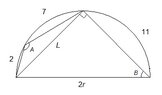
The discussion revolves around finding the radius of the circle inscribing a hexagon with specific side lengths (2, 2, 7, 7, 11, 11). Participants explore various mathematical approaches and reasoning related to this geometry problem.
Discussion Character
- Exploratory
- Mathematical reasoning
- Debate/contested
Main Points Raised
- One participant suggests using the equation involving arcsine functions to find the radius, questioning whether this approach counts as a solution.
- Another participant proposes a method involving a triangle formed by two sides of length 11, applying the Pythagorean theorem to derive the radius, but expresses uncertainty about their reasoning.
- A later reply challenges the assumption of a 45-45-90 triangle, prompting a reconsideration of the initial approach.
- One participant presents a solution using the law of cosines, arriving at a radius of 7, while another participant seeks clarification on the reasoning behind using this law.
- Another participant discusses the relationship between angles in a cyclic quadrilateral and how it aids in applying the law of cosines, leading to a cubic equation that also results in a radius of 7.
Areas of Agreement / Disagreement
There is no consensus on the method to find the radius, as multiple approaches are presented, and participants express uncertainty and challenge each other's reasoning.
Contextual Notes
Some mathematical steps and assumptions remain unresolved, particularly regarding the validity of the triangle assumptions and the application of the law of cosines in this context.

 I'm still pretty new to doing this. I've got a lot of polishing to do!(Blush)
 It might be obvious to you but it isn't to me...