What is the radius of the circle inscribing a hexagon?

  • Topic:
  • Thread starter Thread starter anemone
  • Start date Start date
  • Tags Tags
    Radius
Join the discussion
Registration is free. Start your own thread to ask a follow-up.
9 replies · 3K views
anemone
Gold Member
MHB
POTW Director
Messages
3,851
Reaction score
115
A hexagon with consecutive sides of lengths 2, 2, 7, 7, 11 and 11 is inscribed in a circle.

View attachment 946

Find the radius of the circle.
 
Attachments
  • Find radius.JPG
    Find radius.JPG
    11.4 KB · Views: 148
Mathematics news on Phys.org
I may be incorrect on this, so please correct me if I am. I have been trying to do a lot of math problems this summer to become better, and I have recently learned since coming back here that I am definitely not as good as I thought I was!:D

Anyway, so I see that two sides of the hexagon are each 11 in length, so if I draw a line from where each of these points connect to the circle, then I have a triangle. And since each side is length 11 each, I can assume it's a 45-45-90 triangle. So then I can use pythagorean's theorem to find the hypotenuse of that triangle, then divide it by two to find the radius:

$$a^2 + b^2 = c^2$$

$$11^2 + 11^2 = c^2$$

$$121+ 121= c^2$$

$$242= c^2$$

$$\sqrt{242}$$ =c

$$\frac{\sqrt{242}}{2} =$$ radius

$$7.778174593052$$ =approximate decimal notation solution of radius

Am I on the right track?
 
Farmtalk said:
...I can assume it's a 45-45-90 triangle...

Can you? ;)
 
M R said:
Can you? ;)

Good point, I probably could NOT. Thanks for that! :cool: I'm still pretty new to doing this. I've got a lot of polishing to do!(Blush)
 
M R said:
solve asin(1/r)+asin(7/(2r))+asin(11/(2r))=pi/2 - Wolfram|Alpha

Does that count as a solution? (Tongueout)

Is Wolframalpha making us lazy?

Hi M R,:)

If you don't mind me asking, could you please tell me more about how exactly did you come up with that brilliant formula?:o It might be obvious to you but it isn't to me...:mad:

Thanks!

And I'm really sorry, your solution isn't complete but the answer is correct though! Good job, Wolfram|Alpha!:cool:
 
Applying the law of cosines You arrive to the equation...

$$\cos ^{-1} (1-\frac{2}{r^{2}}) + \cos^{-1} (1-\frac{49}{2\ r^{2}}) + \cos^{-1} (1-\frac{121}{2\ r^{2}}) = \pi\ (1)$$

... and its solution is $r=7$...

Kind regards

$\chi$ $\sigma$
,
 
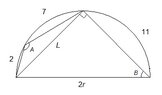
I began the same way chisigma did, and I noticed this allows the construction:

View attachment 947

The law of cosines gives us:

$$L^2=53-28\cos(A)=4r^2+121-44r\cos(B)$$

Because $A$ and $B$ are opposite angles in a cyclic quadrilateral, we know they are supplementary, and using the identity $$\cos(\pi-x)=-\cos(x)$$, we may write:

$$L^2=53-28\cos(A)=4r^2+121+44r\cos(A)$$

This gives us:

$$\cos(A)=\frac{53-L^2}{28}=\frac{L^2-4r^2-121}{44r}$$

Now, by Pythagoras, we have:

$$L^2=4r^2-121$$

Hence, we may state (after some simplification):

$$\frac{2r^2-87}{7}=\frac{11}{r}$$

Cross-multiplying, we get the cubic:

$$2r^3-87r-77=0$$

This may be factored as:

$$(r-7)\left(2r^2+14r+11 \right)=0$$

Discarding the negative roots, we are left with:

$$r=7$$
 
Attachments
  • anemoneradius.jpg
    anemoneradius.jpg
    7.3 KB · Views: 136
So what exactly lead you to use the law of cosines for this problem?
 
Farmtalk said:
So what exactly lead you to use the law of cosines for this problem?

The law of cosines gives us a convenient way to relate the three sides and one of the interior angles of any triangle.

Also, knowing that $A$ and $B$ are supplementary, and the fact that we also have a right triangle in there helps too. :D