What is the shear stress in a lap joint with a double lap configuration?

Join the discussion
Registration is free. Start your own thread to ask a follow-up.
2 replies · 5K views
Bolter
Messages
262
Reaction score
31
Homework Statement
See image below
Relevant Equations
Stress = force/area
Here is a MCQ which I'm struggling to answer
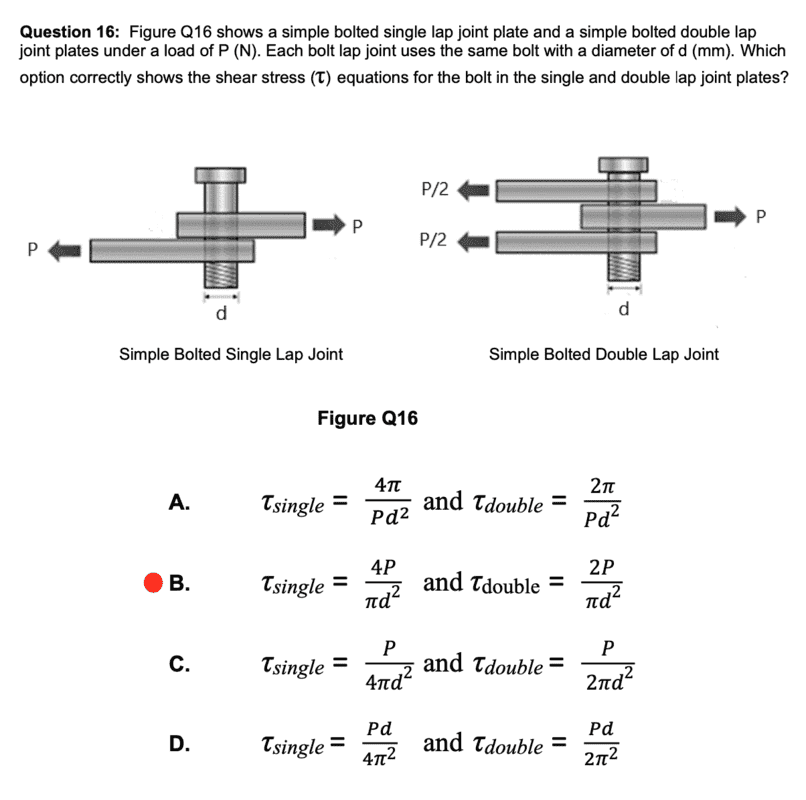
Screenshot 2020-06-04 at 20.58.22.png

The option with a red dot is the answer I chosen and think is right

I know that stress is equal to force/area

Area i.e. the cross sectional area of a circle is (pi*d2)/4

Looking at the simple lap joint, force is simple P netwons
hence stress is P/(pi*d2)/4 giving 4P/(pi*d2)

Not so sure about the double lap joint, but I think force must be P/2 Newtons, hence stress is (P/2)/((pi*d2)/4 = 2P/pi*d2

Thus giving me option b as the answer. Is this the way you work it out?

Thanks in advance!
 
Physics news on Phys.org
Bolter said:
Homework Statement:: See image below
Relevant Equations:: Stress = force/area

Here is a MCQ which I'm struggling to answer

View attachment 264160
The option with a red dot is the answer I chosen and think is right

I know that stress is equal to force/area

Area i.e. the cross sectional area of a circle is (pi*d2)/4

Looking at the simple lap joint, force is simple P netwons
hence stress is P/(pi*d2)/4 giving 4P/(pi*d2)

Not so sure about the double lap joint, but I think force must be P/2 Newtons, hence stress is (P/2)/((pi*d2)/4 = 2P/pi*d2

Thus giving me option b as the answer. Is this the way you work it out?

Thanks in advance!
I agree with your answer. You can think of the double joint as two singles, each with force P/2.
 
  • Like
Likes   Reactions: Bolter
I must admit I found it hard to interpret the diagrams. This link made it much clearer to me to me what was going on, and so I realize we are looking for the shear stress in the horizontal cross section in the plane between any two plates. Then you can consider drawing a FBD of the bolt, and then making a "slice" to the bolt in one of those planes and inserting internal constraint forces (which here are shear forces). That then allows you to calculate the shear stress.

Hope that makes things slightly more intuitive! I often find lots of these engineering-type problems can be fairly esoteric :wink:.
 
  • Like
Likes   Reactions: Bolter