What is the structure of DNA polymerase III?

Click For Summary
SUMMARY

The structure of DNA polymerase III is debated, with Snustard and Simmons presenting a diagram that features the clamp loader (γ-δ complex) on one side, while Lehninger depicts it as centrally located. Both diagrams have limitations due to the challenges of imaging large multiprotein complexes, which often rely on cryo-electron microscopy studies for accurate representation. The Snustard and Simmons diagram is considered to provide a minimal and potentially more accurate depiction, while the Lehninger version requires more interpretative imagination. For comprehensive understanding, consulting cryo-EM studies is recommended.

PREREQUISITES
  • Understanding of DNA polymerase III structure and function
  • Familiarity with cryo-electron microscopy techniques
  • Knowledge of protein complex architecture
  • Ability to interpret scientific diagrams and models
NEXT STEPS
  • Research cryo-electron microscopy studies related to DNA polymerase III
  • Examine the differences between the Snustard and Simmons and Lehninger diagrams
  • Explore literature on multiprotein complex imaging techniques
  • Contact authors of relevant studies for additional insights and references
USEFUL FOR

Biochemists, molecular biologists, and students studying DNA replication mechanisms will benefit from this discussion, particularly those interested in the structural biology of DNA polymerase III.
Tyto alba
Messages
60
Reaction score
0
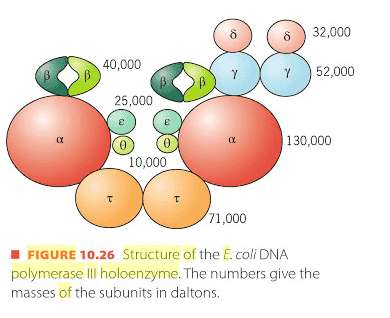
According to Snustard and Simmons the structure of DNA polymerase III is the following, where the clamp loader( γ -δ complex ) is present on one side:

LNAQ4.png


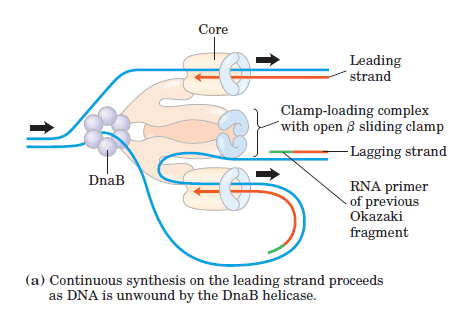
But according to Lehninger the clamp loader is centrally located:

CIEeJ.png


Which one is right? Besides where can I find a correct diagrammatic representation of DNA polymerase III?
 
Biology news on Phys.org
I'm not sure if either diagram can be called "right." Most of these diagrams are based on only limited information (e.g. which parts are directly touching each other), but very often, it is difficult to directly image large multiprotein complexes such as DNA pol III. Information about the architecture of large complexes often comes from cryo-electron microscopy studies. A quick google search shows cryo-EM studies of parts of the complex (e.g. https://elifesciences.org/content/4/e11134) but I didn't find any of the entire complex.

The Snustard and Simmons is probably right in that it present a minimal set of information about the complex without adding in unknown details (here the relative arrangement of the subunits is not meaningful, only the relative sizes and which subunits are directly contacting). The Lehninger diagram, however, involves a bit more imagination in thinking about how all of the pieces might fit together. This is definitely the one I've most often seen, though I'm not sure the extent to which it is based on actual evidence. Perhaps you could email the authors to see if they can provide any helpful references.
 
Last edited:
  • Like
Likes   Reactions: Tyto alba
Thank you for your advice, I really appreciate it.
 

Similar threads

  • · Replies 15 ·
Replies
15
Views
3K
Replies
4
Views
2K
  • · Replies 1 ·
Replies
1
Views
3K
  • · Replies 4 ·
Replies
4
Views
6K
  • · Replies 1 ·
Replies
1
Views
6K
  • · Replies 10 ·
Replies
10
Views
3K
  • · Replies 1 ·
Replies
1
Views
5K
  • · Replies 1 ·
Replies
1
Views
4K
  • · Replies 1 ·
Replies
1
Views
4K
Replies
1
Views
2K