What is the variable theta of omega in a series RL cct?

Click For Summary
SUMMARY

The variable θ(ω) in a series RL circuit represents the phase angle between voltage and current, defined by the equation tan θ(ω) = ωL/R. This relationship indicates how the phase angle varies with frequency, where ω is the angular frequency, L is the inductance, and R is the resistance. The discussion also confirms that tan [-θ(ω) + 90°] = R/Lω, validating the cosine form of the answer provided by the user. A review of the phasor section in "Electric Circuits 9ed" by Nilsson is recommended for further understanding.

PREREQUISITES
  • Understanding of series RL circuits
  • Familiarity with trigonometric identities
  • Knowledge of phase angles in electrical engineering
  • Basic concepts of angular frequency (ω)
NEXT STEPS
  • Review the phasor section in "Electric Circuits 9ed" by Nilsson
  • Study the relationship between voltage and current in AC circuits
  • Learn about the implications of phase angles in circuit analysis
  • Explore the derivation of tan θ(ω) = ωL/R in detail
USEFUL FOR

Electrical engineering students, circuit designers, and anyone studying AC circuit analysis will benefit from this discussion.

kl055
Messages
26
Reaction score
0
What is the variable "theta of omega" in a series RL cct?

Homework Statement


Hi

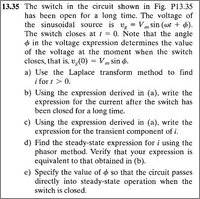
I'm not looking for a complete solution to this problem. My question concerns just one specific part of the solution to part A:
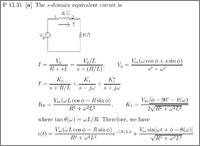
why is tan θ(ω) = ωL/R?

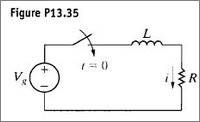
and what θ(ω) represent? how does it relate to the current? I took the introductory EC course almost two years ago so I need a refresher. Which section should I review? (I am using Electric Circuits 9ed by Nilsson)

I was able to complete the entirety of part A except for that part.

Also, is it true that tan [-θ(ω)+90°] = R/Lω? If so, then my answer is correct because I got that answer, but in cosine form. So the +90 would validate my answer.

Homework Equations


PROBLEM
13_35.jpg


13_35_2.jpg

SOLUTION
13_35_S.jpg


The Attempt at a Solution

 
Last edited:
Physics news on Phys.org
welcome to pf!

hi kl055! welcome to pf! :smile:
kl055 said:
why is tan θ(ω) = ωL/R?

and what θ(ω) represent? how does it relate to the current?

Also, is it true that tan [-θ(ω)+90°] = R/Lω?]

it's simple trig …

Acosφ + Bsinφ = A(cosφ + (B/A)sinφ)

and cos(φ+θ) = cosφcosθ - sinφsinθ = cosθ(cosφ - tanθsinφ)

so if we define θ so that tanθ = -B/A,

then Acosφ + Bsinφ = (A/cosθ)cos(φ+θ) :wink:

(and tan(90°- θ) = cotθ = 1/tanθ)
 
Show us your computation of K1.

That way I can show you why θ(ω) = tan-1(ωL/R).
θ(ω) is part of the phase angle between voltage and current. It's the part that's a function of frequency wheras phi and -90 deg. are constant angles, independent of frequency.
 
IMG_20130520_225200.jpg


IMG_20130520_225235.jpg


IMG_20130520_225433.jpg


IMG_20130520_225510.jpg
I did a partial fraction expansion, solved the system of equations, then rewrote K1 using trig laws.
 
kl055 said:
IMG_20130520_225200.jpg


IMG_20130520_225235.jpg


IMG_20130520_225433.jpg


IMG_20130520_225510.jpg


I did a partial fraction expansion, solved the system of equations, then rewrote K1 using trig laws.

So you're happy with what you did, no more questions?
 
Yes. I don't have a problem with the math but I was wondering how to conceptually interpret the theta angle. You mentioned the "phase angle between voltage and current" which indicates that I need to review the phasor section of the textbook. Thanks for the help.
I've got quite a bit of reading to do =/
I'll post here again if I have trouble with the textbook's explanation.
 

Similar threads

  • · Replies 6 ·
Replies
6
Views
4K
  • · Replies 3 ·
Replies
3
Views
2K
  • · Replies 10 ·
Replies
10
Views
5K
  • · Replies 2 ·
Replies
2
Views
2K
  • · Replies 8 ·
Replies
8
Views
5K
  • · Replies 4 ·
Replies
4
Views
3K
  • · Replies 1 ·
Replies
1
Views
2K
Replies
5
Views
5K
  • · Replies 10 ·
Replies
10
Views
2K
  • · Replies 8 ·
Replies
8
Views
4K