What is the weight that will balance the object Q?

  • Thread starter Thread starter Kile
  • Start date Start date
  • Tags Tags
    Balance Weight
Click For Summary
SUMMARY

The discussion focuses on calculating the weight Q required to balance a tower crane with a rack weight P of 700 kN and a maximum load capacity W of 200 kN. The crane's beam lengths are 12 meters for the long beam and 6 meters for the short beam. Two scenarios are analyzed: one with a full load (W=200 kN) leading to the minimum weight requirement for Q, denoted as Q_min, and another with no load (W=0 kN) leading to the maximum weight requirement for Q, denoted as Q_max. The equations derived from the moments around the pivot points provide the necessary calculations for both scenarios.

PREREQUISITES
  • Understanding of static equilibrium principles in mechanics
  • Familiarity with moment calculations and lever arms
  • Knowledge of tower crane specifications and load capacities
  • Basic algebra for solving equations
NEXT STEPS
  • Study the principles of static equilibrium in mechanical systems
  • Learn about moment calculations and their applications in engineering
  • Explore tower crane design and safety regulations
  • Investigate load distribution and its effects on crane stability
USEFUL FOR

Engineers, crane operators, and construction project managers involved in crane operations and load management will benefit from this discussion.

Kile
Messages
12
Reaction score
0
Poster has been reminded that the use of the HH Template and showing work is not optional
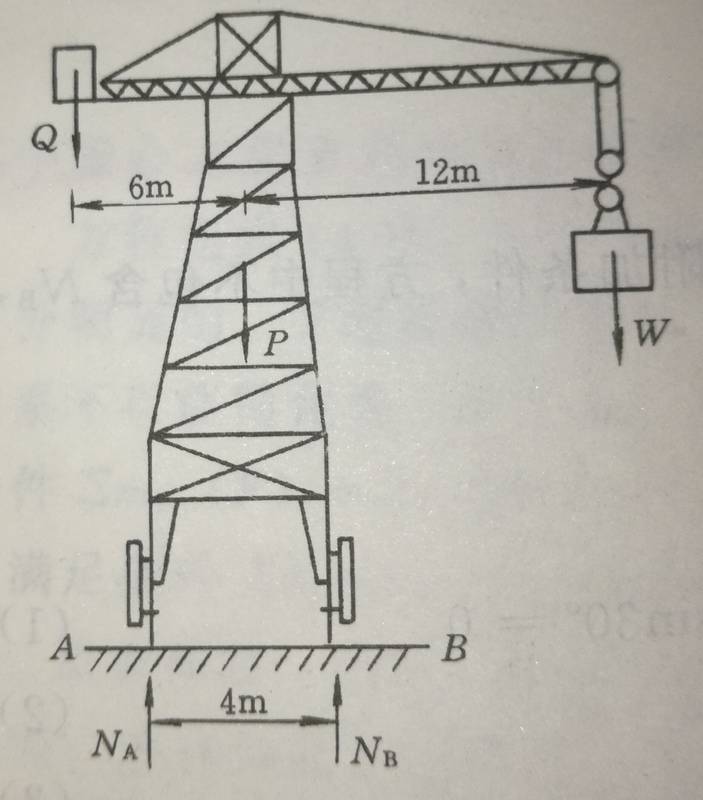
Here is diagram for Tower Crane.
BlSChqD.jpg

The Rack weight P=700kN, and the maximum load capacity for this crane is W=200kN. The long beam length is 12 metres, and the balance object weighs Q. The short beam length is 6 metres. What is the weight of Q to keep the crane's balance at all situation?
 

Attachments

  • BlSChqD.jpg
    BlSChqD.jpg
    41.4 KB · Views: 577
Physics news on Phys.org
Why should it be like that?
There are 2 situations
Full load, W=200 kN. let ##Q_{min}## stands for the minimum weight requirement of Q.

$$\sum m_B(F)=0, (6+2)Q_{min} + 2P - (12-2) W=0, N_A=0$$

No load, W=0 kN. let ##Q_{max}## stands for the maximum weight requirement of Q

$$\sum m_A(F)=0, (6-2)Q_{max} - 2P =0, N_B=0$$
 

Similar threads

Replies
1
Views
2K
  • · Replies 3 ·
Replies
3
Views
5K
Replies
1
Views
1K
  • · Replies 8 ·
Replies
8
Views
3K
  • · Replies 8 ·
Replies
8
Views
12K
  • · Replies 5 ·
Replies
5
Views
3K
  • · Replies 2 ·
Replies
2
Views
4K
  • · Replies 1 ·
Replies
1
Views
2K
  • · Replies 9 ·
Replies
9
Views
2K
Replies
33
Views
5K