What Is the Physics Behind Particle Traveling Over Voltage?

  • Context: Undergrad 
  • Thread starter Thread starter TBert
  • Start date Start date
  • Tags Tags
    E&m Quantum
Click For Summary
SUMMARY

The discussion centers on the physics of charged particles traveling over voltage and the concept of potential barriers. Participants clarify that while quantum tunneling involves barriers, the scenario described relates to a potential barrier where a particle can jump if it possesses sufficient energy. The conversation also references Schrödinger's equation and the particle in a box model as relevant frameworks for understanding these phenomena. The importance of accurately interpreting diagrams in quantum mechanics is emphasized, particularly regarding the representation of physical quantities.

PREREQUISITES
  • Understanding of quantum mechanics principles
  • Familiarity with Schrödinger's equation
  • Knowledge of potential barriers in physics
  • Ability to interpret quantum mechanical diagrams
NEXT STEPS
  • Study Schrödinger's equation for one-dimensional potentials
  • Explore the particle in a box model in quantum mechanics
  • Research the concept of potential barriers and their implications
  • Examine quantum tunneling and its applications in modern physics
USEFUL FOR

Physics students, educators, and anyone interested in the principles of quantum mechanics and the behavior of charged particles in electric fields.

TBert
Messages
7
Reaction score
0
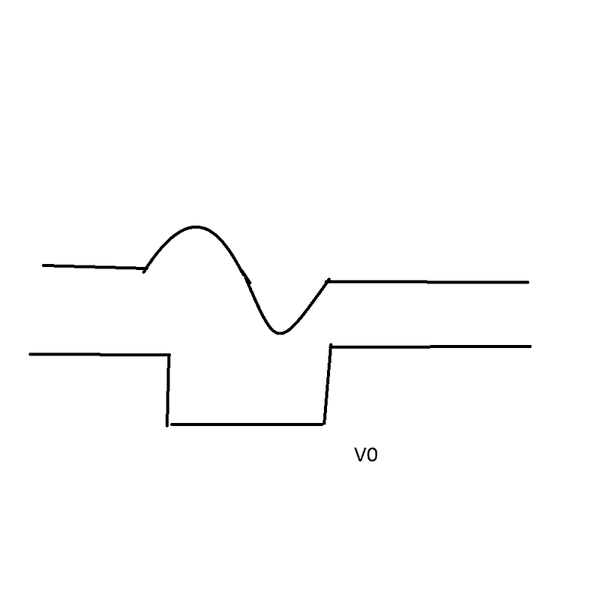
A friend of mine showed me a diagram like this:
aWp6wGv.png


I think they said it was describing the probability of finding a charged particle in a certain place when traveling over a voltage. They said that if the particle doesn't have enough energy to make it across then it gets stuck at the beginning of the voltage. I'm wondering if anyone can identify what effect/physics law this is a give me a better description of how it works
 
Physics news on Phys.org
Look up quantum tunneling.

Thanks
Bill
 
bhobba said:
Look up quantum tunneling.

Thanks
Bill
They said it was different from quantum tunneling though because there wasn't a barrier the was being passed
 
TBert said:
They said it was different from quantum tunneling though because there wasn't a barrier the was being passed

Its a potential barrier. If it has enough energy it can jump the barrier. That's the funny thing about QM because it doesn't have an energy until actually measured it can be found outside a barrier that doesn't require an infinite energy to jump.

The QM particle in a box might be slightly more instructive for you. Have a look at the infinite barrier box first then the case of a finite wall:
http://hyperphysics.phy-astr.gsu.edu/hbase/quantum/pbox.html

Thanks
Bill
 
bhobba said:
Its a potential barrier. If it has enough energy it can jump the barrier. That's the funny thing about QM because it doesn't have an energy until actually measured it can be found outside a barrier that doesn't require an infinite energy to jump.

The QM particle in a box might be slightly more instructive for you. Have a look at the infinite barrier box first then the case of a finite wall:
http://hyperphysics.phy-astr.gsu.edu/hbase/quantum/pbox.html

Thanks
Bill
Are you sure it is a potential barrier? They seemed very sure about the fact that it wasn't a barrier or quantum tunneling. They made it seem like it was a force to the electricity.
 
TBert said:
They made it seem like it was a force to the electricity.
That's what a potential barrier is.
People use the word "tunnelling" more or less narrowly to describe the phenomena that are observed when an incident wave encounters a change in potential, but the physics you're looking for is Schrödinger's equation for a one-dimensional potential... But I don't think your diagram corresponds to any correct solution of that equation.
 
TBert said:
A friend of mine showed me a diagram like this

Did he tell you what the horizontal and vertical axes of the diagram represent? If not, it's really hard to know what the diagram is supposed to be telling you.
 
Looks like someone took a sloppy representation of the first excited state of a particle in a well and elevated it above the well. I certainly wouldn't put any stock in this image.
 
PeterDonis said:
Did he tell you what the horizontal and vertical axes of the diagram represent? If not, it's really hard to know what the diagram is supposed to be telling you.
For the curvy line on top the vertical axes is the amount of particle in the position and the horizontal axes is the position (like in one dimension). For the bottom line the vertical and horizontal axes show where the charge is.
 
  • #10
TBert said:
the amount of particle

What does this mean? "Amount of particle" is not a physical quantity.

TBert said:
For the bottom line the vertical and horizontal axes show where the charge is.

Are you sure?
 
  • Like
Likes   Reactions: bhobba

Similar threads

  • · Replies 0 ·
Replies
0
Views
1K
  • · Replies 36 ·
2
Replies
36
Views
8K
  • · Replies 3 ·
Replies
3
Views
1K
  • · Replies 5 ·
Replies
5
Views
3K
  • · Replies 46 ·
2
Replies
46
Views
5K
  • · Replies 12 ·
Replies
12
Views
2K
  • · Replies 86 ·
3
Replies
86
Views
12K
  • · Replies 17 ·
Replies
17
Views
3K
  • · Replies 43 ·
2
Replies
43
Views
5K
  • · Replies 54 ·
2
Replies
54
Views
11K