What is wrong with our assumptions?

  • Thread starter Thread starter cubby208
  • Start date Start date
  • Tags Tags
    Assumptions
Click For Summary
SUMMARY

The forum discussion revolves around an experiment using an Atwood machine to estimate the mass of an unknown object. The setup involves two 200-gram masses and measuring the time it takes for the unknown mass to fall one meter. The participants initially miscalculated the acceleration due to neglecting a factor of 2 in their formula, leading to an incorrect estimation of the unknown mass, which was actually 12 grams. The correct approach involves using the formula m_u = (2 * m1 * a) / (g - a) to accurately derive the unknown mass.

PREREQUISITES
  • Understanding of Newton's laws of motion
  • Familiarity with Atwood machine dynamics
  • Basic knowledge of kinematic equations
  • Ability to convert units (grams to kilograms)
NEXT STEPS
  • Learn how to derive kinematic equations for falling objects
  • Study the principles of force diagrams in mechanics
  • Explore the concept of acceleration in systems with multiple masses
  • Practice solving problems involving Atwood machines and mass calculations
USEFUL FOR

Students in physics, educators teaching mechanics, and anyone interested in experimental physics and mass estimation techniques.

cubby208
Messages
6
Reaction score
0
[Moderator note: Thread moved from technical forum so no template shown]

I am trying to do a simple experiment that estimates the mass of an object based on how an Atwood machine reacts when it is added to one side.

For this experiment we have a pulley with 200-gram masses on either side of the rope. We then set it up so that the right mass was exactly one meter from the floor. Then we would attach the unknown mass to the other time, and measure the time in seconds it took for it to hit the floor.

From this data we calculated that the acceleration was (1 meter / (seconds to fall)^2). We then put it into the following formula.
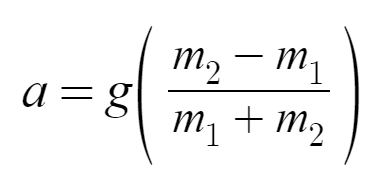
usVFbxt.png

I really don't know where we got this formula from. I also don't know wether the a on one side is expressing acceleration of the system, or just one of the masses.

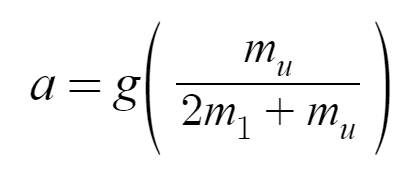
Since m1 and m2 are both 200 grams we were able to simplify the formula. While simplifying we considered that m2 would be (m1 + mu) (mu being the unknown mass). We then got this formula:
um0Sxp9.png


We tried out our first mass and it took it 3.3 seconds to travel one meter.
We plugged everyhing into the formula and got

Unfortunately this did not work out for us. We converted grams to kilograms and substituted everything in. We got a calculated mass that was way too low, the objects actual weight is 12 grams. What did we mess up?
 
Physics news on Phys.org
cubby208 said:
I am trying to do a simple experiment that estimates the mass of an object based on how an Atwood machine reacts when it is added to one side.

For this experiment we have a pulley with 200-gram masses on either side of the rope. We then set it up so that the right mass was exactly one meter from the floor. Then we would attach the unknown mass to the other time, and measure the time in seconds it took for it to hit the floor.

From this data we calculated that the acceleration was (1 meter / (seconds to fall)^2). We then put it into the following formula.
usVFbxt.png

I really don't know where we got this formula from. I also don't know wether the a on one side is expressing acceleration of the system, or just one of the masses.

Since m1 and m2 are both 200 grams we were able to simplify the formula. While simplifying we considered that m2 would be (m1 + mu) (mu being the unknown mass). We then got this formula:
um0Sxp9.png


We tried out our first mass and it took it 3.3 seconds to travel one meter.
We plugged everyhing into the formula and got

Unfortunately this did not work out for us. We converted grams to kilograms and substituted everything in. We got a calculated mass that was way too low, the objects actual weight is 12 grams. What did we mess up?

First, if you don't know where a formula comes from you should see if you can derive it.

Why don't you draw a force diagram for the masses and try to come up with it, it'll clear up what it's actually trying to say.

Edit: Okay I reread it, and think you're saying that the .2kg mass is still there. in which case, your simplification is okay.

What did you get for acceleration? And the unknown mass?

I'm going to report this post, as I think it would be more appropriately placed in homework.
 
Last edited:
cubby208 said:
From this data we calculated that the acceleration was (1 meter / (seconds to fall)^2).
You're missing a factor of 2 there. If the distance to fall is ##h##, the time taken is ##t## and the acceleration is ##a##, then ##h=\frac{1}{2} at^2##, which gives ##a=2h/t^2##.

We then put it into the following formula.
usVFbxt.png

I really don't know where we got this formula from. I also don't know wether the a on one side is expressing acceleration of the system, or just one of the masses.
The two masses are connected by a string that doesn't stretch, so a is the magnitude of the acceleration of either one of the masses. One accelerates downwards while the other accelerates upwards at the same rate.

Since m1 and m2 are both 200 grams we were able to simplify the formula. While simplifying we considered that m2 would be (m1 + mu) (mu being the unknown mass). We then got this formula:
um0Sxp9.png
Fine.

We tried out our first mass and it took it 3.3 seconds to travel one meter.
We plugged everyhing into the formula and got ...
Got what? Is something missing there?

Unfortunately this did not work out for us. We converted grams to kilograms and substituted everything in. We got a calculated mass that was way too low, the objects actual weight is 12 grams. What did we mess up?
Are you trying to solve for ##m_u##, then, using the measured value of ##a##? Re-arranging your second equation gives $$m_u = \frac{2 m_1 a}{g-a}$$. Does that help?
 

Similar threads

  • · Replies 20 ·
Replies
20
Views
2K
  • · Replies 6 ·
Replies
6
Views
4K
  • · Replies 47 ·
2
Replies
47
Views
3K
Replies
2
Views
2K
  • · Replies 3 ·
Replies
3
Views
2K
Replies
3
Views
2K
Replies
8
Views
4K
  • · Replies 3 ·
Replies
3
Views
2K
  • · Replies 6 ·
Replies
6
Views
2K
Replies
2
Views
1K