D O
- 13
- 3
Hi everyone,
I have created a simulation of the major bodies in the Solar System, using the exact positions, velocities, and masses etc. at midnight on Jan 10 (as provided by the NASA HORIZONS project). Using Newtonian gravity I numerically simulate the forces between all the bodies (with a very small time interval; about 0.1 seconds) and can focus the centre of the images produced (in a stop-time sort of way) on any planet I want.
So far I have been very successful; behaviour is as expected - I get the 1:2:4 resonance of the Galilean moons etc.
However, the Saturn system seems to have strange behaviour; Rhea is significantly affected by Titan (the only other moon I simulated in the Saturn system), and is perturbed to a higher and higher orbit, eventually passing right around Titan in a gravity assist. Rhea then shoots out of the Saturn system like a rocket and orbits the Sun.
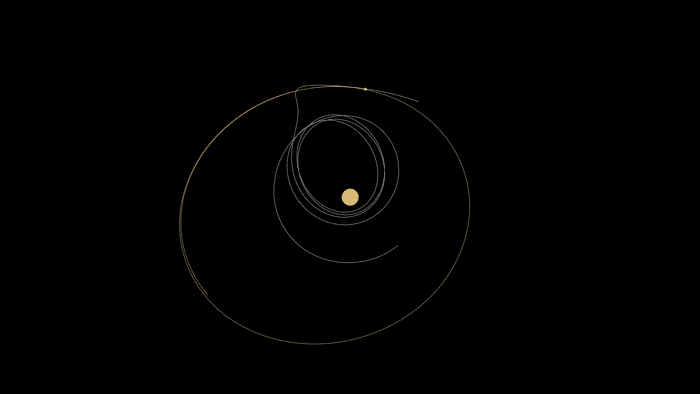
The image shows Rhea (grey), having passed Titan (yellow), on its way out of Saturn (the big yellow ball). The time after the epoch (Jan 10 00:00) is t=1381376 seconds. This would put the picture on the 25th January 2017. I think I would have been aware of such an event if it had happened in real life!
An animation of the event is available at https://www.outpig.com/files/saturn.mp4
The bodies I have simulated are:
Sun, Mercury, Venus, Earth (Moon), Mars, Jupiter (Io, Europa, Ganymede, Callisto), Saturn (Titan, Rhea), Uranus (Titania, Oberon), Neptune (Triton), and Pluto (Charon) for old times' sake ;).
My reasoning behing these choices was to try to select the bodies I think have the greatest effect on those already picked; I used a list of Solar System major bodies by mass (from Wikipedia) and left out Eris etc. in lieu of Pluto and Charon. For moons, I'm happy with the Jupiter system, but I think the moons in the Saturn system are much closer in mass at the top end.
My initial thoughts are: Is the behaviour caused by leaving out some important stabilising moon/s? Iapetus, Dione, Tethys, and Enceladus all seem to have mass significant enough to have some influence.
Rhea is not too close to Saturn so I would not have thought the rings (which I have not modeled) would have anything to do with it, but then I am not familiar with the effects the rings have on the moons and vice versa.
Just to clarify: I have modeled all the planets as point masses; there is no rotation, atmospheres, tidal forces etc. in the simulation. The sizes of the moons on the images produced have been magnified by 4x so they are visible; this has no effect on the physics (there is no collision detection etc.)
The images produced are viewed looking top-down on the Solar System (projection onto plane of Earth's orbit, I believe), and are snapshotted at time intervals of 1024 seconds. If the lines look a bit segmented, that is to do with this time interval and does not reflect the accuracy of the underlying simulation.
I can provide further details upon request. Any ideas?
Thanks,
Dan O
I have created a simulation of the major bodies in the Solar System, using the exact positions, velocities, and masses etc. at midnight on Jan 10 (as provided by the NASA HORIZONS project). Using Newtonian gravity I numerically simulate the forces between all the bodies (with a very small time interval; about 0.1 seconds) and can focus the centre of the images produced (in a stop-time sort of way) on any planet I want.
So far I have been very successful; behaviour is as expected - I get the 1:2:4 resonance of the Galilean moons etc.
However, the Saturn system seems to have strange behaviour; Rhea is significantly affected by Titan (the only other moon I simulated in the Saturn system), and is perturbed to a higher and higher orbit, eventually passing right around Titan in a gravity assist. Rhea then shoots out of the Saturn system like a rocket and orbits the Sun.
The image shows Rhea (grey), having passed Titan (yellow), on its way out of Saturn (the big yellow ball). The time after the epoch (Jan 10 00:00) is t=1381376 seconds. This would put the picture on the 25th January 2017. I think I would have been aware of such an event if it had happened in real life!
An animation of the event is available at https://www.outpig.com/files/saturn.mp4
The bodies I have simulated are:
Sun, Mercury, Venus, Earth (Moon), Mars, Jupiter (Io, Europa, Ganymede, Callisto), Saturn (Titan, Rhea), Uranus (Titania, Oberon), Neptune (Triton), and Pluto (Charon) for old times' sake ;).
My reasoning behing these choices was to try to select the bodies I think have the greatest effect on those already picked; I used a list of Solar System major bodies by mass (from Wikipedia) and left out Eris etc. in lieu of Pluto and Charon. For moons, I'm happy with the Jupiter system, but I think the moons in the Saturn system are much closer in mass at the top end.
My initial thoughts are: Is the behaviour caused by leaving out some important stabilising moon/s? Iapetus, Dione, Tethys, and Enceladus all seem to have mass significant enough to have some influence.
Rhea is not too close to Saturn so I would not have thought the rings (which I have not modeled) would have anything to do with it, but then I am not familiar with the effects the rings have on the moons and vice versa.
Just to clarify: I have modeled all the planets as point masses; there is no rotation, atmospheres, tidal forces etc. in the simulation. The sizes of the moons on the images produced have been magnified by 4x so they are visible; this has no effect on the physics (there is no collision detection etc.)
The images produced are viewed looking top-down on the Solar System (projection onto plane of Earth's orbit, I believe), and are snapshotted at time intervals of 1024 seconds. If the lines look a bit segmented, that is to do with this time interval and does not reflect the accuracy of the underlying simulation.
I can provide further details upon request. Any ideas?
Thanks,
Dan O