What Medium Does Light Travel Through in Space?

  • Context: High School 
  • Thread starter Thread starter rekha1804
  • Start date Start date
  • Tags Tags
    Light Medium Travel
Join the discussion
Registration is free. Ask a follow-up in this thread, or start your own.
61 replies · 3K views
I just visited the NIST website and found the diagram below.
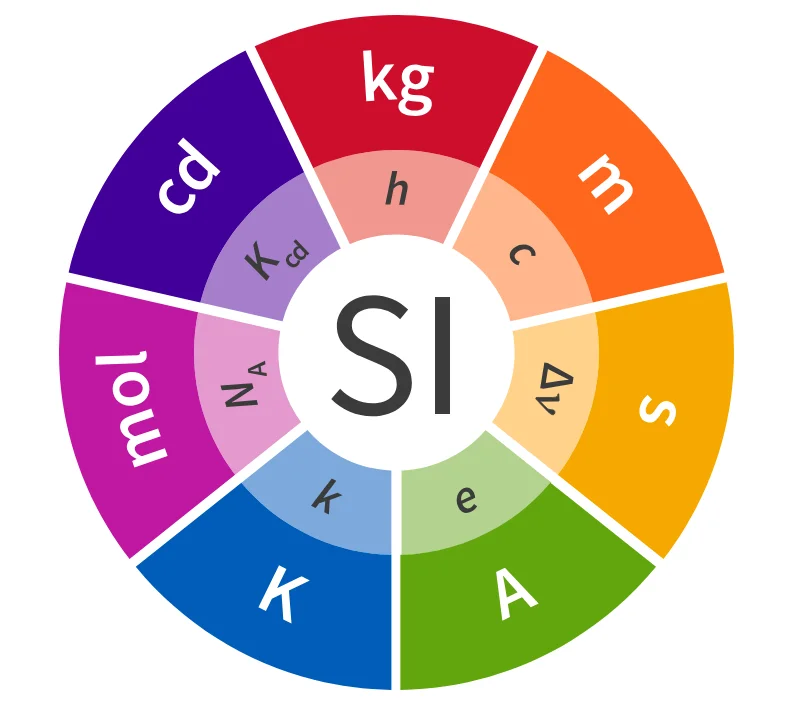
1786730771773.webp


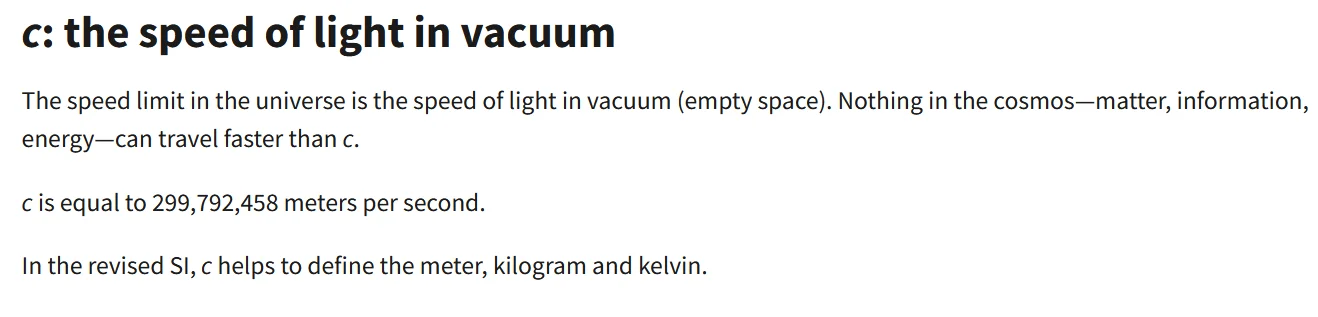
This is how they describe c:

1786730885837.webp


And this is their list of the seven "base SI units"
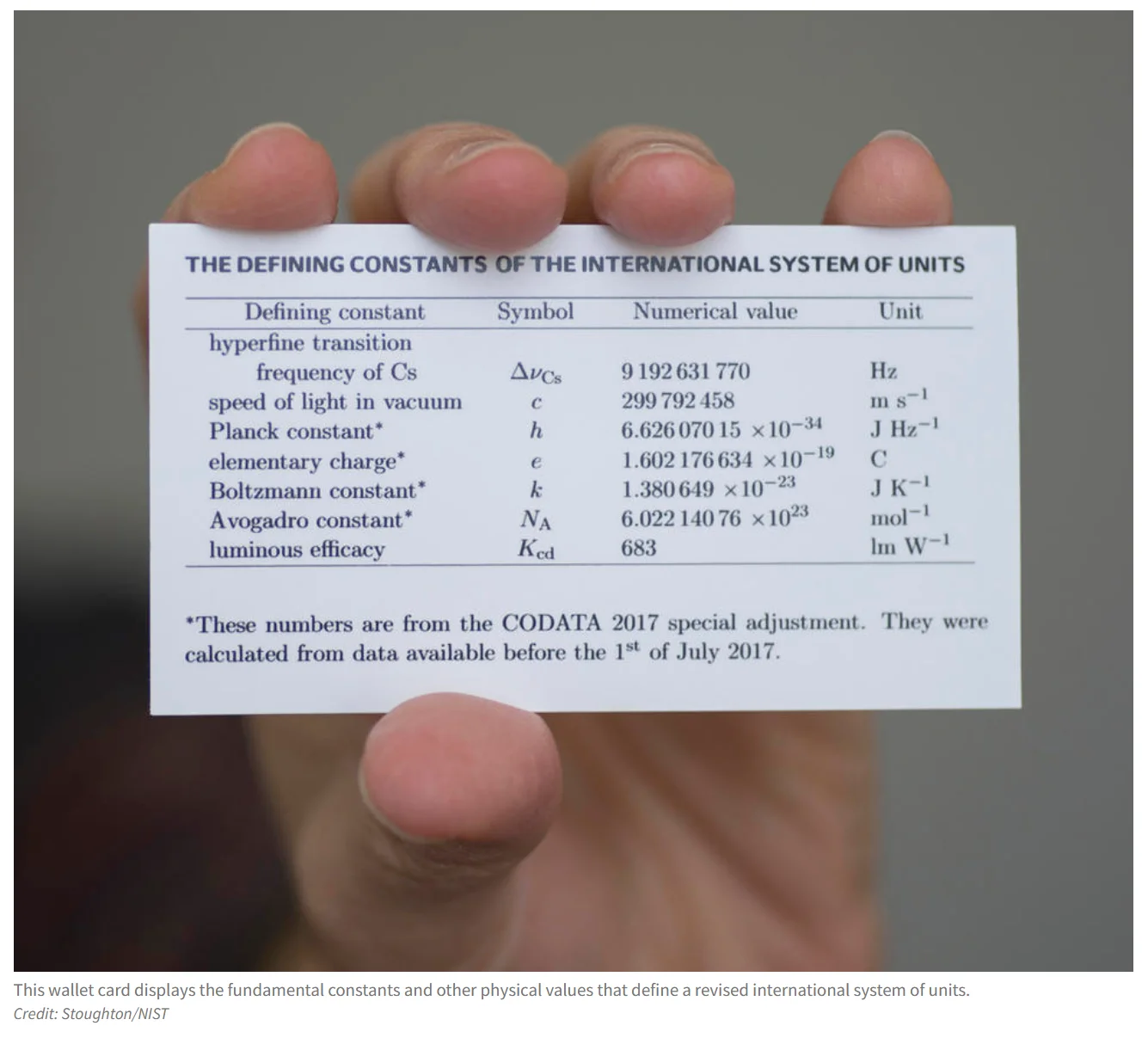
1786731008053.webp


Perhaps they were being sloppy with their choice of words, but in the figure caption they describe these seven base SI units as "fundamental constants" and provide dimensions for each. They give c in terms of m/s.

To be fair I also noticed that the date at the bottom of the webpage was Oct 12, 2018 (the year before the 2019 update went into effect), but next to that it also said that the page was updated May 7, 2026 (which was just a few months ago).

1786731501467.webp


So, it's a little disconcerting (and confusing!) that the 'measurement people' have this information on their site.
 
Astronomy news on Phys.org
GRQFT said:
So, presumably we can obtain a value for c from GR. Do you happen to know the relevant equation?
The value of the invariant speed is just 1 (in natural units). So the equation is ##c=1##.

The important thing that you get from spacetime is not the value of the invariant speed. The important thing is the fact that it is finite.
 
Sagittarius A-Star said:
In SR the invariant speed is finite.

The value of ##c## is defined by the SI definition of "1 meter".
https://en.wikipedia.org/wiki/Metre

And how does that relate to the geometry of spacetime?


Sagittarius A-Star said:
##0={E \over c^2} \sqrt{1 - v^2/c^2} \Rightarrow v=c##

Which requires a measurement of the E (hv) of a photon.
 
GRQFT said:
So, presumably we can obtain a value for c from GR. Do you happen to know the relevant equation?
You don't need curved spacetime (GR), only the flat Minkowski spacetime of SR. The relevant equation is simply ##c=1## in natural units. For example, think of astronomy: the distance to even nearby stars is huge by human standards, so astronomers (naturally!) measure distance in light-years. Their natural units are thus time in years, distance in light-years ##\Rightarrow c=1## light-year per year ##=1\,##. Any other value just originates from the human historical tendency to measure space and time in different units.
(Oops, Dale beat me to it!)
 
Reply
  • Like
Likes   Reactions: Dale
Dale said:
renormalize said:
You don't need curved spacetime (GR), only flat Minkowski spacetime of SR. The relevant equation is simply ##c=1## in natural units.

My understanding of natural units is that these "...systems simplify the form of each equation, [though] it is still necessary to keep track of the non-collapsed dimensions of each quantity or expression in order to reinsert physical constants (such dimensions uniquely determine the full formula)." Source: Natural units

Is this incorrect?
 
GRQFT said:
And how does that relate to the geometry of spacetime?
In spacetime geometry, the following interval is invariant:
##\Delta s^2 = -(c\Delta t)^2 + \Delta x^2 + \Delta y^2 + \Delta z^2##
This can be derived from the two SR postulates or from the first postulate and group properties of the coordinate transformation plus an experiment, which excludes the Galilei tramsformation as physically relevant.
https://arxiv.org/abs/physics/0302045

GRQFT said:
Which requires a measurement of the E (hv) of a photon.
Why? I don't think so.
 
Sagittarius A-Star said:
In spacetime geometry, the following interval is invariant:
##\Delta s^2 = -(c\Delta t)^2 + \Delta x^2 + \Delta y^2 + \Delta z^2##
This can be derived from the two SR postulates or from the first postulate and group properties of the coordinate transformation plus an experiment, which excludes the Galilei tramsformation as physically relevant.
https://arxiv.org/abs/physics/0302045
And so if I wanted to calculate the value of c using the spacetime interval (above), I would have to make three spatial measurements and one temporal measurement?

Sagittarius A-Star said:
Why? I don't think so.
Again, if I want to obtain a numerical value for c using the equation you supplied (which contains the variables E and v), I would have to know them in order to obtain c. Without them the equation is mathematically undetermined (and, as such, has an infinite number of solutions).
 
GRQFT said:
And so if I wanted to calculate the value of c using the spacetime interval (above), I would have to make three spatial measurements and one temporal measurement?
No, ##c## is defined by the SI unit system. No measurements are needed.

GRQFT said:
Again, if I want to obtain a numerical value for c using the equation you supplied (which contains the variables E and v), I would have to know them in order to obtain c. Without them the equation is mathematically undetermined (and, as such, has an infinite number of solutions).
No. If the square-root in posting #30 becomes zero, the energy ##E>0## of the photon is irrelevant to determine ##c##.
 
Sagittarius A-Star said:
This can be derived from the two SR postulates or from the first postulate and group properties of the coordinate transformation plus an experiment, which excludes the Galilei tramsformation as physically relevant.
https://arxiv.org/abs/physics/0302045
Okay, I very quickly skimmed the article you referenced, so maybe I missed the point relevant to the current discussion, but are you saying that we can drop Einstein's postulate that c will always have the same measured value and still arrive at SR, and that, in turn, means that c is somehow less fundamental then the way we've been thinking about it since 1905?
 
This thread seems to over-complicating things. The speed of light is invariant. That is determined by experiment. At least to the point where we are confident enough to assume it's true.

The speed of light and the definition of the second are used to define the metre. So, we no longer measure the speed of light by experiment. We measure the metre by experiment. The speed of light in metre per second is postulated.

In the past, the metre was otherwise defined and the speed of light measured by experiment.
 
Reply
  • Like
Likes   Reactions: Dale, Matterwave and AlexB23
Sagittarius A-Star said:
No, ##c## is defined by the SI unit system. No measurements are needed.
Is it not tied to a measurement of the time it takes to travel a meter?

1786735088364.webp


Source: Speed of light
 
GRQFT said:
Okay, I very quickly skimmed the article you referenced, so maybe I missed the point relevant to the current discussion, but are you saying that we can drop Einstein's postulate that c will always have the same measured value and still arrive at SR, and that, in turn, means that c is somehow less fundamental then the way we've been thinking about it since 1905?
Transformartion equation (27) in the article can be derived without the 2nd postulate.
  • K<0 : can be excluded (causality would be not invariant)
  • K=0 : makes it the Galilean transformation
  • K>0 : makes it the Lorentz transformation
An experiment is needed to decide between Galilean- or Lorentz-transformation.
 
Reply
  • Like
Likes   Reactions: Dale
Sagittarius A-Star said:
Transformartion equation (27) in the article can be derived without the 2nd postulate.
  • K<0 : can be excluded (causality would be not invariant)
  • K=0 : makes it the Galilean transformation
  • K>0 : makes it the Lorentz transformation
An experiment is needed to decide between Galilean- or Lorentz-transformation.
And what type of experiment would we do to make that determination?
 
GRQFT said:
Sorry, I don't see the relevance

There is no time dilation and twin paradox when using Galilean transformation.
 
Reply
  • Like
Likes   Reactions: bhobba and Dale
GRQFT said:
Sorry, I don't see the relevance
Sorry, I hit the return key before I finished typing.
 
weirdoguy said:
There is no time dilation and twin paradox when using Galilean transformation.
Agreed.
 
Okay, I think this is a good point for me to stop and say thank you to all who have contributed to this discussion.

Cheers...
 
Reply
  • Like
Likes   Reactions: weirdoguy and Sagittarius A-Star
GRQFT said:
And what type of experiment would we do to make that determination?
Accelerate a charged particle to high energy. If its speed goes up according to ##E = \frac 1 2 m v^2##, and eventually exceeds the speed of light, then we have a Galilean universe. If the speed of light cannot be reached and the energy obeys ##E = \gamma mc^2##, then we have a relativistic universe.
 
Reply
  • Like
Likes   Reactions: GRQFT
Since the speed of light ## c ## follows directly from Maxwell’s wave equations and is invariant across reference frames, Einstein was among the first to recognize the apparent paradox and resolve it through Special Relativity (SR).
 
Reply
  • Like
Likes   Reactions: GRQFT
GRQFT said:
Is it not tied to a measurement of the time it takes to travel a meter?
This would be the measurement of a distance.
 
GRQFT said:
“in order to reinsert physical constants” … Is this incorrect?
I am not sure why you would want to reinsert physical constants. But if you wished to do so then yes that is correct. It is not necessary to do so in order to do physics, neither theoretically nor even experimentally.

GRQFT said:
Is it not tied to a measurement of the time it takes to travel a meter?
No, the meter is tied to a measurement of the distance light travels in a second.

GRQFT said:
c is somehow less fundamental then the way we've been thinking about it since 1905?
I think that the change between now and 1905 is more an over reliance on SI units. In Einstein’s day students understood Heaviside units, Gaussian units, and the SI units, and other conventional units. They understood that some constants (like ##\epsilon_0##) appear or disappear depending on the units. They may not have understood that ##c## was also such a constant. But the idea that such constants exist would have been more generally understood than it is today.

Today students are so immersed in the SI units that they mistakenly believe that the only form of physical equations is the SI form, and that the SI dimensions and constants are part of nature rather than a convention. Scientists that had worked in both Gaussian and SI units would know otherwise from direct experience.
 
Last edited:
Reply
  • Like
Likes   Reactions: bhobba and GRQFT
GRQFT said:
And so how would we calculate c by this approach?

In the classical limit, you get Maxwell's equations that imply c is the invariant speed of light.

Thanks
Bill
 
bhobba said:
The Casimir Effect is related to Van der Waals forces:
https://www.nature.com/nature-index...van-der-waals-interactions-in-quantum-systems

Thanks
Bill
In the paper you reference, it says:

Casimir effect: Force between macroscopic bodies due to alteration of vacuum fluctuations by boundary conditions.

I'm confused why you would cite that one to support your claim that "The whole issue of virtual particles and vacuum fluctuations being real is complicated, with many experts (including me, not that I am an expert) thinking they are mathematical fictions."
 
GRQFT said:
Why is it not 5% faster or 20% slower?

Many constants in physics are known to exist, but their values must be determined experimentally. The constant c in the Lorentz Transformations is one of them. To see why, you need to study a derivation of the Lorentz transformations from the Principle of Relativity (POR) alone:

https://physics.umd.edu/~yakovenk/teaching/Lorentz.pdf

There are many ways of determining that value, but my favourite is that you can actually derive Maxwell's equations from Coulomb's law and the Lorentz Transformations:

https://www.amazon.com.au/Understanding-Special-Relativity-Maxwells-Equations/dp/1516864743

This leads to many ways of experimentally establishing the value of c in the Lorentz Transformations as the speed of light.

Also, you start to see a glimpse of the power of symmetry in physics.

Thanks
Bill