Kim Gi Hyuk
Gold Member
- 18
- 0
- TL;DR
- Seeking a named physical quantity with dimension [ML⁻³T⁻²].
Two independent paths from Maxwell's equations (ρ²/ε₀ and μ₀J²)
both yield this dimension, suggesting it may be the apex of an
electromagnetic dimensional hierarchy. Is this quantity known in
established physics?
Background.
I have been building a systematic dimensional map of electromagnetic quantities, organized by their MLTIQNJ exponents. The map places mechanical quantities along a central vertical axis, with electric quantities to the left and magnetic quantities to the right — connected by structured dimensional steps (×d, ×E, ×H, etc.). The left-right symmetry reflects the duality between electric and magnetic sources.
The quantity χ.
When filling in all cells of the map using dimensional consistency with neighboring quantities, the top-center cell — the apex of the mechanical core axis — must have dimension:[χ] = M¹L⁻³T⁻²I⁰.
Two independent paths from Maxwell's equations both lead to this dimension:
- From Gauss's law (electric source): ρ²/ε₀ ~ [ML⁻³T⁻²]
- From Ampère's law (magnetic source): μ₀J² ~ [ML⁻³T⁻²]
where ρ is charge density [IL⁻³T] and J is current density [IL⁻²].
Note that (ρ, J) form the natural pair of electromagnetic source quantities — the four-current in relativistic notation.
My Questions
1. Does a named physical quantity with dimension [ML⁻³T⁻²] exist in established physics?
2. Is the structural relation ρ²/ε₀ ~ μ₀J² physically significant? For instance, does it appear in plasma physics, radiation reaction theory, or higher-dimensional theories such as Kaluza–Klein or Brane World models?
3. Both ρ and J — quantities with current index I≠0 — give rise, through ε₀ and μ₀, to a purely mechanical quantity χ with I⁰. Is there a known principle explaining why the apex of an electromagnetic dimensional hierarchy should be charge-free?
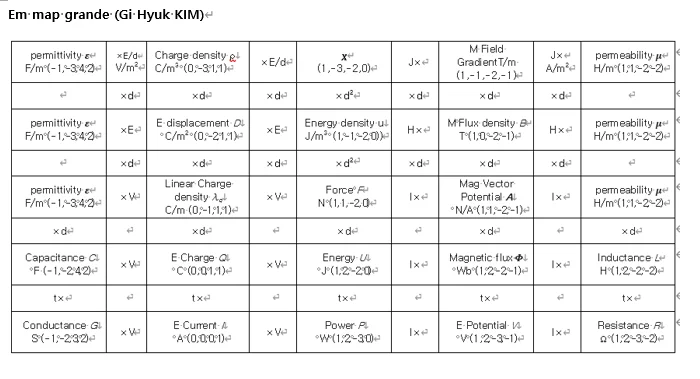
I have been building a systematic dimensional map of electromagnetic quantities, organized by their MLTIQNJ exponents. The map places mechanical quantities along a central vertical axis, with electric quantities to the left and magnetic quantities to the right — connected by structured dimensional steps (×d, ×E, ×H, etc.). The left-right symmetry reflects the duality between electric and magnetic sources.
The quantity χ.
When filling in all cells of the map using dimensional consistency with neighboring quantities, the top-center cell — the apex of the mechanical core axis — must have dimension:[χ] = M¹L⁻³T⁻²I⁰.
Two independent paths from Maxwell's equations both lead to this dimension:
- From Gauss's law (electric source): ρ²/ε₀ ~ [ML⁻³T⁻²]
- From Ampère's law (magnetic source): μ₀J² ~ [ML⁻³T⁻²]
where ρ is charge density [IL⁻³T] and J is current density [IL⁻²].
Note that (ρ, J) form the natural pair of electromagnetic source quantities — the four-current in relativistic notation.
My Questions
1. Does a named physical quantity with dimension [ML⁻³T⁻²] exist in established physics?
2. Is the structural relation ρ²/ε₀ ~ μ₀J² physically significant? For instance, does it appear in plasma physics, radiation reaction theory, or higher-dimensional theories such as Kaluza–Klein or Brane World models?
3. Both ρ and J — quantities with current index I≠0 — give rise, through ε₀ and μ₀, to a purely mechanical quantity χ with I⁰. Is there a known principle explaining why the apex of an electromagnetic dimensional hierarchy should be charge-free?
Last edited by a moderator: