What physical quantity has dimension [ML⁻³T⁻²] in electromagnetism?

Kim Gi Hyuk
Gold Member
Messages
11
Reaction score
0
TL;DR
Seeking a named physical quantity with dimension [ML⁻³T⁻²].
Two independent paths from Maxwell's equations (ρ²/ε₀ and μ₀J²)
both yield this dimension, suggesting it may be the apex of an
electromagnetic dimensional hierarchy. Is this quantity known in
established physics?
Background.
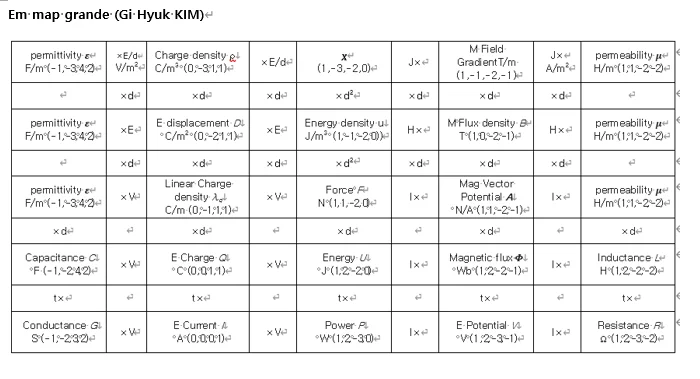
I have been building a systematic dimensional map of electromagnetic quantities, organized by their MLTIQNJ exponents. The map places mechanical quantities along a central vertical axis, with electric quantities to the left and magnetic quantities to the right — connected by structured dimensional steps (×d, ×E, ×H, etc.). The left-right symmetry reflects the duality between electric and magnetic sources.

The quantity χ.
When filling in all cells of the map using dimensional consistency with neighboring quantities, the top-center cell — the apex of the mechanical core axis — must have dimension:[χ] = M¹L⁻³T⁻²I⁰.

Two independent paths from Maxwell's equations both lead to this dimension:
- From Gauss's law (electric source): ρ²/ε₀ ~ [ML⁻³T⁻²]
- From Ampère's law (magnetic source): μ₀J² ~ [ML⁻³T⁻²]
where ρ is charge density [IL⁻³T] and J is current density [IL⁻²].

Note that (ρ, J) form the natural pair of electromagnetic source quantities — the four-current in relativistic notation.

My Questions
1. Does a named physical quantity with dimension [ML⁻³T⁻²] exist in established physics?
2. Is the structural relation ρ²/ε₀ ~ μ₀J² physically significant? For instance, does it appear in plasma physics, radiation reaction theory, or higher-dimensional theories such as Kaluza–Klein or Brane World models?
3. Both ρ and J — quantities with current index I≠0 — give rise, through ε₀ and μ₀, to a purely mechanical quantity χ with I⁰. Is there a known principle explaining why the apex of an electromagnetic dimensional hierarchy should be charge-free?
em map grande(Gi Hyuk KIM).webp
 
Last edited by a moderator:
Physics news on Phys.org
There isn’t any particularly deep significance for the dimensions of a particular quantity outside of the formulas where it appears and the system of units you use. Since you don’t specify either it isn’t much that can be said.
 
  • Like
Likes   Reactions: WernerQH and Kim Gi Hyuk
Kim Gi Hyuk said:
1. Does a named physical quantity with dimension [ML⁻³T⁻²] exist in established physics?
No.
That is the acceleration of the mass density.
 
  • Haha
  • Like
Likes   Reactions: Kim Gi Hyuk and berkeman
There is some arbitrariness about dimensions. The Gaussian system has only three, but it is a mix of the electrostatic (esu) and electromagnetic (emu) systems, which have conflicting dimensions for the quantity of electric charge. By convention, charge was chosen to be measured in ## \rm dyn^{1/2} cm ## (esu) in the Gaussian system, whereas ## \rm dyn^{1/2} s ## (emu) was used in the practical system that evolved into the SI. It is rather unsettling to have different dimensions for a single physical quantity, depending on how it is measured! (As a force between two charges at rest, or between two electric currents.) Different units for charges at rest and charges in motion!

The dimensions differ by a velocity, and for the units we have the correspondence $$ \rm
1\ Biot \cdot second = 1\ dyn^{1/2} s \leftrightarrow 3 \times 10^{10} \ dyn^{1/2} cm = 3 \times 10^{10} \ Franklin
$$ which really means that 1 second is the same as 30 billion centimetres, if "charge" is to have only one reasonable dimension. Of course the speed of light is a fundamental constant, and the metre is now defined in terms of the second. Relativity has taught us that space and time are unified, and the distinction between dimensions of length and time is arbitrary. As for the "correct" dimension of charge, the existence of the fine-structure constant indicates that it should be dimensionless.

I found this an interesting read: Babel of Units. The Evolution of Units Systems in Classical Electromagnetism
 
  • Informative
Likes   Reactions: Bystander
Dale said:
There isn’t any particularly deep significance for the dimensions of a particular quantity outside of the formulas where it appears and the system of units you use. Since you don’t specify either it isn’t much that can be said.

Baluncore said:
No.
That is the acceleration of the mass density.
You're right — I should have specified SI units from the start. Apologies for the ambiguity.

Exactly — and that kind of identification is the core of this work. My project is to systematically map all physical quantities by dimensional structure using MLTIQNJ base dimensions (extending MLT to include I, Q, N, J). The goal is a reference framework — analogous to a periodic table — where quantities sharing the same dimension are grouped together, making such relationships explicit and visible across domains.

Happy to elaborate if there's interest.
 
I wrote some code some time ago that while computing numbers, also tracked dimensions. It was able to identify the units and flag errors. This was the table I used to identify units and terms.
Code:
 Length,  m, metre
 | Mass,    kg
 | | Time,    s, second
 | | | Current, A, ampere
 | | | | Temperature, K, kelvin, celcius
 | | | | | Light,  cd, candela
 | | | | | | Substance, mole
 | | | | | | | Angle,     rad, radian, degree
 | | | | | | | | Information, bit
 | | | | | | | | | Money,    $, currency
 | | | | | | | | | | Divisor, common to all dimensions
 | | | | | | | | | | |
 1 0 0 0 0 0 0 0 0 0 1    m  metre  Length
-1 0 0 0 0 0 0 0 0 0 1        Wave number
 0 1 0 0 0 0 0 0 0 0 1    kg  kilogram  Mass
 0 0 1 0 0 0 0 0 0 0 1    s  second  Time
 0 0 0 1 0 0 0 0 0 0 1    A  ampere  Electric current
 0 0 0 0 1 0 0 0 0 0 1    K  kelvin  Temperature
 0 0 0 0 0 1 0 0 0 0 1    Cd  candela  Luminous intensity
 0 0 0 0 0 0 1 0 0 0 1    mol  mole  Substance
 0 0 0 0 0 0 0 1 0 0 1    rad  radian  Angle
 0 0 0 0 0 0 0 0 1 0 1    b  bit  Information
 0 0 0 0 0 0 0 0 0 1 1    $  USDollar  Money
 0 0-1 0 0 0 0 1 0 0 1    Hz  hertz  Frequency
 1 1-2 0 0 0 0 0 0 0 1    N  newton  Force
-1 1-2 0 0 0 0 0 0 0 1    pa  pascal  Pressure, Stress
 2 1-2 0 0 0 0 0 0 0 1    J  joule  Energy, Work, Torque, Moment, Couple
 2 1-3 0 0 0 0 0 0 0 1    W  watt  Power, Energy flux
 0 0 1 1 0 0 0 0 0 0 1    C  coulomb  Charge
 2 1-3-1 0 0 0 0 0 0 1    V  volt  Voltage
-2-1 4 2 0 0 0 0 0 0 1    F  farad  Capacitance
 2 1-3-2 0 0 0 0 0 0 1    ohm  ohm  Resistance
-2-1 3 2 0 0 0 0 0 0 1    S  siemens  Conductance
 2 1-2-1 0 0 0 0 0 0 1    wb  weber  Magnetic flux
 0 1-2-1 0 0 0 0 0 0 1    T  tesla  Magnetic flux density
 2 1-2-2 0 0 0 0 0 0 1    H  henry  Inductance
 0 0 0 0 0 1 0 2 0 0 1      lumen
-2 0 0 0 0 1 0 2 0 0 1      lux  Luminance
 2 0 0 0 0 0 0 0 0 0 1        Area
 3 0 0 0 0 0 0 0 0 0 1        Volume
 1 0-1 0 0 0 0 0 0 0 1        Velocity, Speed
 0 0-1 0 0 0 0 1 0 0 1        Angular velocity
 0 0-2 0 0 0 0 1 0 0 1        Angular acceleration
 2 1-2 0-1 0 0 0 0 0 1        Entropy
 2 0-2 0-1 0 0 0 0 0 1        Specific heat
 1 1-3 0-1 0 0 0 0 0 1        Thermal conductivity
-1 1-1 0 0 0 0 0 0 0 1    pl  poiseuille  Dynamic viscosity
 2 0-1 0 0 0 0 0 0 0 1    sk  stokes  Kinematic viscosity
 1 0-2 0 0 0 0 0 0 0 1        Acceleration
-3 1 0 0 0 0 0 0 0 0 1        Density
 1 1-1 0 0 0 0 0 0 0 1        Momentum, Impulse
 2 1 0 0 0 0 0 0 0 0 1        Moment of inertia
 2 1-1 0 0 0 0 1 0 0 1        Angular moment
 1 0 0 0 0 0-1 0 0 0 1        Molecular weight
 3 0-1 0 0 0 0 0 0 0 1        Volume flow
 0 1-1 0 0 0 0 0 0 0 1        Mass flow
 0 0-1 0 0 0 0 0 1 0 1        Information flow
-2 0 0 1 0 0 0 0 0 0 1        Current density
-2 0 1 1 0 0 0 0 0 0 1        Electric polarization, Surface charge density
-3 0 1 1 0 0 0 0 0 0 1        Volume charge density
 1 1-3-1 0 0 0 0 0 0 1        Electric field strength
 1 0 1 1 0 0 0 0 0 0 1        Electric dipole moment
 3 1-3-2 0 0 0 0 0 0 1        Resistivity
-1 0 1 0 0 0 0 0 0 0 1        Electrical conductivity
-3-1 4 2 0 0 0 0 0 0 1        Permittivity
 1 1-2-2 0 0 0 0 0 0 1        Permeability
-1 0 0 1 0 0 0 0 0 0 1        Magnetic field strength
 2 0 0 1 0 0 0 0 0 0 1        Magnetic dipole moment, pole density
 1 0 0 1 0 0 0 0 0 0 1        Magnetic pole strength
 0 0 0 0 0 0 0 0 0 0 1        Dimensionless
 
Thank you, WernerQH — this is exactly the kind of discussion I was hoping for.

The point about E and B having the same dimension in the Gaussian system is particularly striking. In SI-based frameworks, they appear dimensionally distinct, yet the underlying physics treats them as components of a unified electromagnetic field. This asymmetry has always felt like an unresolved tension to me.

I'll read the 'Babel of Units' paper over the weekend. The question of how dimensional structure changes across unit systems — and what that implies for the definition of physical quantities themselves — is something I'd like to explore more deeply. It may have direct relevance to the dimensional mapping framework I'm developing.

Looking forward to continuing this conversation.
 
Kim Gi Hyuk said:
You're right — I should have specified SI units from the start. Apologies for the ambiguity.
That is good, but you still have not said which equations you are using. The dimensionality of a quantity only has meaning once both the system of units and the equation has been specified. You have finally specified the units, but despite pointing out the need for both in post 2 it is now post 8 and the equations you are using are still missing!

This makes a difference. Consider the SI dimensions ##M^{ 1} L^{2 } T^{ -2}##. In the equation ##E=mc^2## it is the energy of a body at rest. In ##KE=\frac{1}{2}mv^2## it is the kinetic energy of a moving body. And in ##\vec \tau=\vec r \times \vec F## it is the torque. You can talk about equivalence of the first two, but even though they have the same dimensions, they are physically distinct from the third.

Dimensions do not have any inherent physical significance. They only have meaning within a specific unit system and physical equation.

Kim Gi Hyuk said:
The question of how dimensional structure changes across unit systems — and what that implies for the definition of physical quantities themselves — is something I'd like to explore more deeply.
You may want to study EM in CGS systems. In those systems EM units are all purely mechanical.

You may also be interested in particle physics units where everything is tied to ##\mathrm{eV}##.

There are also many people that use personal unit systems that are numerically equal to SI, but with some personal alteration. Like choosing that radians are a base unit with dimensions of angle, or where moles are dimensionless.

In relativity we often use units where ##c=1##, not just numerically but also dimensionally. So you might measure a person’s height in nanoseconds or the duration of the Kessel run in parsecs.

Probably the most extreme example is geometrized units, where the only fundamental dimension is length. So mass, time, and charge, each have dimensions of length.
 

Similar threads

  • · Replies 3 ·
Replies
3
Views
2K
  • · Replies 1 ·
Replies
1
Views
1K
  • · Replies 1 ·
Replies
1
Views
1K
  • · Replies 1 ·
Replies
1
Views
2K
  • · Replies 11 ·
Replies
11
Views
3K
  • · Replies 1 ·
Replies
1
Views
2K
  • · Replies 4 ·
Replies
4
Views
2K
  • · Replies 18 ·
Replies
18
Views
3K
  • · Replies 4 ·
Replies
4
Views
5K
  • · Replies 1 ·
Replies
1
Views
6K