What Potential Difference Between Plates Causes a 30° Thread Angle?

Click For Summary

Homework Help Overview

The problem involves a small charged sphere suspended between two parallel plates and seeks to determine the potential difference required to achieve a specific angle of the thread with the vertical. The subject area includes electrostatics and forces acting on charged bodies.

Discussion Character

  • Exploratory, Conceptual clarification, Mathematical reasoning, Problem interpretation

Approaches and Questions Raised

  • Participants discuss the forces acting on the sphere and the relationship between electric field, potential difference, and distance. There are attempts to derive expressions for voltage and questions about the correct trigonometric relationships to use.

Discussion Status

Multiple interpretations of the problem are being explored, with participants offering guidance on resolving forces and setting up equations. Some participants express uncertainty about their calculations and seek clarification on the relationships between the forces involved.

Contextual Notes

Participants note the need to consider the equilibrium of forces acting on the sphere and the importance of correctly identifying the charge distribution on the plates. There is mention of the potential confusion regarding the use of trigonometric functions in the context of the problem.

ovoleg
Messages
93
Reaction score
0
Can anyone help me with a hint of some sort? I am lost...

A small sphere with mass 1.50 g hangs by a thread between two parallel vertical plates 5.00 cm apart. The plates are insulating and have uniform surface charge densities + and -. The charge on the sphere is q = 8.90 10-6 C. What potential difference between the plates will cause the thread to assume an angle of 30.0° with the vertical
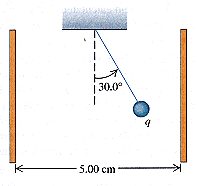
24_37.gif
 
Last edited:
Physics news on Phys.org
I know the field between two charged plates is E=sigma/epsilon_0...

The way I think of it is that I need to find the forces acting on it and then have that be my E value and then integrate E through distance 5cm?

This is what I tried but I did not get 47.7V

kq*cos30*.015kg*.05=51.95V
 
a) What is the definition of the electric field in terms of voltage (potential difference) and distance ? There is a simple formula, check your text or notes.

b) What is the relationship between the force on a charged body, the quantity of charge on that body and the electric field strength the body is subjected to ?

c) Draw a force diagram. What are the forces acting on the ball, and how do they resolve horizontally and vertically ?

d) Put it all together (in symbols), rearrange to form an expression for V, the voltage, then plug in values to get the answer.
 
Curious3141 said:
a) What is the definition of the electric field in terms of voltage (potential difference) and distance ? There is a simple formula, check your text or notes.

b) What is the relationship between the force on a charged body, the quantity of charge on that body and the electric field strength the body is subjected to ?

c) Draw a force diagram. What are the forces acting on the ball, and how do they resolve horizontally and vertically ?

d) Put it all together (in symbols), rearrange to form an expression for V, the voltage, then plug in values to get the answer.

a) E=Vab/d
b) E = F/q

c)F=(mg)*cos(30)?

d) Vab=(mg)*cos(30)*d/q?

I get 71.52007V

:(

Please help :) I've been trying for the past few hours
 
Last edited:
Should be tan(30) right? Draw the force diagram again. Other than that, I think you've got it.
 
durt said:
Should be tan(30) right? Draw the force diagram again. Other than that, I think you've got it.
'
THANKS!
 
ovoleg said:
a) E=Vab/d
b) E = F/q

Those two are fine. :smile:


c)F=(mg)*cos(30)?

No. OK, the sphere is in equilibrium right ? So there is no net force on i, all the forces balance. What are these forces ?

Let's list them :

1) Weight = mg, acts vertically downward.
2) Tension in the suspending string, call it T, acts upward in the direction of the string (at the 30 degree angle it is hanging at).
3) Electrostatic force, call it F = qE = qV/d, where q is the charge and E the electric field strength, V is the voltage and d is the distance between the plates. Acts horizontally to the right.

The easiest thing to do now is to resolve the forces horizontally and vertically and set up equations.

Basic concept : Vertical component of tension exactly balances the weight.
Horizontal component of tension exactly balances the electrostatic force.

You can get two equations with two unknowns, T and V. You need to solve for V so eliminate T. Now get an expression for V.

d) Vab=(mg)*cos(30)*d/q?

Not correct, I'm afraid. Hopefully, you can get it now. Don't forget to specify which plate is positively charged, left or right. Remember the ball is positively charged, according to the question.
 
durt said:
Should be tan(30) right? Draw the force diagram again. Other than that, I think you've got it.

Hold on, I think it's important he gets this conceptually instead of just trying out different trig ratios.
 

Similar threads

  • · Replies 6 ·
Replies
6
Views
2K
  • · Replies 5 ·
Replies
5
Views
6K
  • · Replies 4 ·
Replies
4
Views
2K
  • · Replies 3 ·
Replies
3
Views
7K
  • · Replies 4 ·
Replies
4
Views
6K
Replies
5
Views
3K
  • · Replies 7 ·
Replies
7
Views
5K
Replies
2
Views
2K
  • · Replies 2 ·
Replies
2
Views
2K
Replies
2
Views
4K