When Calculating Torque, When to Use Cos and Sin?

  • Thread starter Thread starter SpringWater
  • Start date Start date
  • Tags Tags
    Cos Sin Torque
Click For Summary
SUMMARY

This discussion focuses on the application of trigonometric functions in torque calculations, specifically when to use cosine and sine. The user queries why cosine is used in the seesaw example while sine is applied in another scenario. The key takeaway is that the angle θ is crucial in determining the correct function; when the seesaw is parallel to the ground, the angle is 90 degrees, maximizing torque. The torque can be calculated using the formula T = r X F = rF sin(θ), where θ is the angle between the force and the position vector.

PREREQUISITES
  • Understanding of torque and its physical significance
  • Familiarity with trigonometric functions, specifically sine and cosine
  • Knowledge of vector operations, particularly cross products
  • Basic principles of mechanics, including forces and moments
NEXT STEPS
  • Study the derivation and application of the torque formula T = rF sin(θ)
  • Learn about the relationship between angles and torque in rotational dynamics
  • Explore vector decomposition techniques for resolving forces into components
  • Investigate the effects of angle selection on torque calculations in various mechanical systems
USEFUL FOR

Students and professionals in physics, mechanical engineering, and anyone involved in the study of rotational mechanics and torque calculations.

SpringWater
Messages
27
Reaction score
0
I have a issue with determining when to use cos and sin when calculating torque;

For example. Referring to the attached picture. The SEESAW asks evaluate the torque of m2 (m2>>m1).

For second part evaluate the torque...

MY question:

WHY in the first part (SEESAW) do they use cos and why in the second part do they use sin? How do you determine; when to use cos or sin?
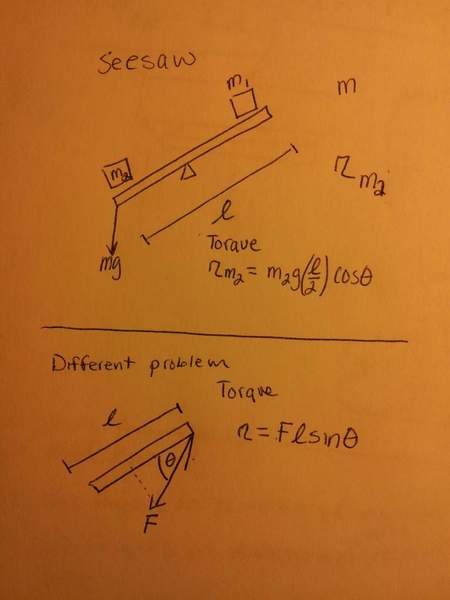
20121205_125348-1.jpg
 
Physics news on Phys.org
The selection of theta is what is causing the confusion here. Theta lies in between the vectors r and F.
In the case of seesaw the radial vector is pointing from the center towards any of the mass and the corresponding force is pointing downwards or upwards. so in that position the angle should've been an acute angle. when the seesaw becomes parallel with the ground, the angle is 90degree causing a maximum torque.
this is the actual and only correct angle
But instead of selecting that angle, we can choose others but a trigonometric convertion is to be made. like sin(90-x)=cosx

let θ+∅=90degrees:

you chose the angle between perpendicular line from ground and seesaw's perpendicular axis. which is zero when the seesaw is in parallel state and swipes an angle each time it oscillates to both sides. this is infact the 90-∅ of the angle we need (∅)
the cross product being sine ∅ now becomes sine ∅= cos 90-∅ = cos θ
 
SpringWater said:
I have a issue with determining when to use cos and sin when calculating torque;

For example. Referring to the attached picture. The SEESAW asks evaluate the torque of m2 (m2>>m1).

For second part evaluate the torque...

MY question:

WHY in the first part (SEESAW) do they use cos and why in the second part do they use sin? How do you determine; when to use cos or sin?

View attachment 53653
There are several ways to calculate the torque of a force about a point. You can use T =r X F = rF sintheta, where r is the magnitude of the position vector and theta is the included angle between the force and position vector.

Or you can use T = force times perpencicular distance from line of action of the force to the pivot point.

Or you can resolve the force into its components parallel and perpendicular to the position vector and use T = (F_perp)(r).

Watch plus/minus signs.

All roads lead to Rome.
 

Similar threads

  • · Replies 11 ·
Replies
11
Views
2K
Replies
1
Views
1K
Replies
8
Views
2K
Replies
2
Views
2K
Replies
25
Views
4K
  • · Replies 15 ·
Replies
15
Views
2K
  • · Replies 7 ·
Replies
7
Views
2K
  • · Replies 3 ·
Replies
3
Views
1K
  • · Replies 24 ·
Replies
24
Views
2K