When is Ampere's Law applicable in different scenarios?

  • Context: Undergrad 
  • Thread starter Thread starter BlackMelon
  • Start date Start date
  • Tags Tags
    Ampere Loop Solenoid
Join the discussion
Ask a follow-up here, or get your own question answered by working scientists, mathematicians and engineers — people, not an autocomplete.
Real named experts · corrections over time · the nuance an AI answer skips
3 replies · 2K views
BlackMelon
Messages
43
Reaction score
7
Hi All,

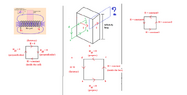
In the attachment, I have 3 scenarios in question.
The first one is just a solenoid from http://hyperphysics.phy-astr.gsu.edu/.

The second one is a hollow cuboid, which is infinitely long. I am using the same analogy as the solenoid. Would I be able to set the same Amperian loop?

For the third one, I do not have the circuits. If the magnetic field of each side of the loop is constant, but all the fields are not equal, would I be able to apply the Ampere's law?

Edited: In the scenario 2, why applying both green and blue loop at the same time (which results in the magnetic field twice of that of the green loop alone) is wrong?

Best Regards
 

Attachments
  • AmpereLaw.png
    AmpereLaw.png
    20.8 KB · Views: 107
Last edited:
Physics news on Phys.org
BlackMelon said:
Hi All,

In the attachment, I have 3 scenarios in question.
The first one is just a solenoid from http://hyperphysics.phy-astr.gsu.edu/.

The second one is a hollow cuboid, which is infinitely long. I am using the same analogy as the solenoid. Would I be able to set the same Amperian loop?

For the third one, I do not have the circuits. If the magnetic field of each side of the loop is constant, but all the fields are not equal, would I be able to apply the Ampere's law?

Edited: In the scenario 2, why applying both green and blue loop at the same time (which results in the magnetic field twice of that of the green loop alone) is wrong?

Best Regards
What do you mean by "would I be able to apply the Ampere's law?". My flippant answer is that Ampere's Law is always true and can always be applied*. You can use any loop you choose. Which means that I'm not understanding your question.

*Within the limits of classical physics, of course.
 
Reply
  • Like
Likes   Reactions: Gavran and davenn
Hi Dave

Please refer to the current loop in the following link:
http://bit.ly/3B5buxz
The Ampere's Law and the Biot Savart Law mismatch in this case. The reason is that the magnetic field along the Amperian loop is not constant.

Yet, we see from Hyperphysics site: bit.ly/4d7PAaj that if the mag field is constant at one side of the rectangular loop and zero at the other sides, we can apply the Ampere's law.

So, I am curious if the field of all sides are constant but not equal, would I be able to apply the Ampere's law.
 
As @DaveE said, Ampere's law is always valid and you can draw any loop you choose. Sometimes the symmetry of the problem is such that you can draw the loop in a way that makes it easy to solve the problem. But in most cases you draw the loop and you don't know how the magnetic field varies spatially, so Ampere's law really isn't much help.
 
Reply
  • Like
Likes   Reactions: DaveE and davenn