When to use the Jacobian in spherical coordinates?

Join the discussion
Registration is free. Ask a follow-up in this thread, or start your own.
2 replies · 3K views · last reply
Amaelle
Messages
318
Reaction score
55
Homework Statement
look at the image
Relevant Equations
jacobian is r^2 sinv
Greetings!
Printed problem b): integral of x dσ over Σ, where Σ is the intersection of the surface x² + y² + z² = 1 with the first octant.


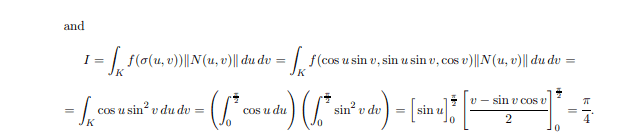
here is the solution which I undertand very well:
Typed math solution: parametrization of the unit sphere octant in spherical coordinates, x = cos u sin v, y = sin u sin v, z = cos v, with the surface normal cross product and its norm sin v, followed by the integral setup.

Typeset calculus derivation: I = integral over K of f(sigma(u,v)) times norm of N(u,v) du dv equals integral over K of f(cos u sin v, sin u sin v, cos v) times norm of N du dv, then integral of cos u sin^2 v du dv evaluated as product of integrals, giving pi/4.


my question is:
if we go the spherical coordinates shouldn't we use the jacobian r^2*sinv?

thank you!
 
Attachments
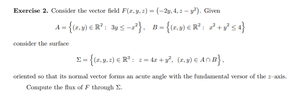
  • Typed exercise: vector field F(x, y, z) = (-2y, 4, z - y^2); sets A and B defined by inequalities; surface Sigma = {z = 4x + y^2, (x, y) in A intersect B}, oriented with acute angle to the z-axis; compute flux of F through Sigma.
    1639410956821.png
    10.7 KB · Views: 242
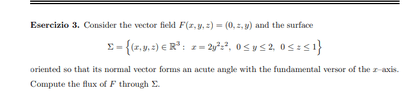
  • Printed exercise 3: vector field F(x, y, z) = (0, z, y) and surface Σ = {(x, y, z) in R^3 : x = 2y^2 z^2, 0 ≤ y ≤ 2, 0 ≤ z ≤ 1}, oriented with normal forming an acute angle with the x-axis; compute the flux of F through Σ.
    1639411043905.png
    8.3 KB · Views: 218
Physics news on Phys.org
It's sort of already baked in. The surface element comes from a little parallelogram with sides ##d\boldsymbol{l}_u = \frac{\partial \boldsymbol{\sigma}}{\partial u} du## and ##d\boldsymbol{l}_v = \frac{\partial \boldsymbol{\sigma}}{\partial v} dv## and therefore area
\begin{align*}
dS = |d\boldsymbol{l}_u \times d\boldsymbol{l}_v| = \left| \frac{\partial \boldsymbol{\sigma}}{\partial u} \times \frac{\partial \boldsymbol{\sigma}}{\partial v} \right| du dv
\end{align*}The part ##\frac{\partial \boldsymbol{\sigma}}{\partial u} \times \frac{\partial \boldsymbol{\sigma}}{\partial v}## is what your solutions denoted by the vector ##\mathbf{N}##.
 
Last edited: