Where Can I Find Replacement Pinion Gears for My Microscope?

  • Thread starter Thread starter Petes
  • Start date Start date
  • Tags Tags
    Gear Gears
Click For Summary

Discussion Overview

The discussion revolves around finding replacement pinion gears for a microscope, specifically a broken helical pinion gear. Participants explore options for sourcing replacements, including standard sizes, 3D printing, and alternative methods for creating or adapting gears. The conversation includes technical details about the gear's dimensions and its role in the microscope's focusing mechanism.

Discussion Character

  • Exploratory
  • Technical explanation
  • Debate/contested
  • Experimental/applied

Main Points Raised

  • One participant inquires about standard sizes for pinion gears and expresses difficulty in finding replacements online.
  • Another suggests the gear may be a "screw gear" rather than a pinion gear, despite its function as one.
  • Participants discuss the possibility of using modeling clay to create a mold for casting a new gear.
  • Several participants request additional details about the microscope's make and model, as well as images of the gear and its surrounding structure.
  • One participant identifies the brand as HOC and later clarifies it is a vintage Japanese Y.K.S HOC microscope, expressing doubt about finding spare parts.
  • There are suggestions for using a brass cylinder to create a new gear, including techniques for shaping the teeth and ensuring proper fit.
  • Some participants discuss the possibility of reattaching the broken gear with super glue, while one mentions that previous attempts have failed.
  • Another participant offers a metal gear from their collection but notes it is not suitable due to being right-handed when a left-handed gear is needed.
  • One participant advises against making a one-off gear due to potential costs and suggests looking for similar models that may be available cheaply.

Areas of Agreement / Disagreement

Participants express various opinions on the best approach to finding or creating a replacement gear, with no consensus reached on a definitive solution. Some ideas are supported by multiple participants, while others remain contested.

Contextual Notes

Participants mention limitations related to the availability of specific gear types and the challenges of creating a custom gear, including material choices and the feasibility of 3D printing.

Who May Find This Useful

Individuals interested in microscope repairs, hobbyists in mechanical engineering, and those exploring DIY solutions for small mechanical parts may find this discussion relevant.

Petes
Messages
10
Reaction score
0
TL;DR
How do you guys find the gears you need?
So I have a broken plastic pinion gear that belongs to my microscope and I'm wondering if there are standard sizes or how am I supposed to get a replacement? How do you guys find the gears you need? Seems like a pretty hard thing to find online.

It's an helical pinion gear. I have the dimensions but it's a small piece and I don't know if it's possible to 3D print something like that.

Just in case here are the dimensions, sorry for the bad quality drawing:
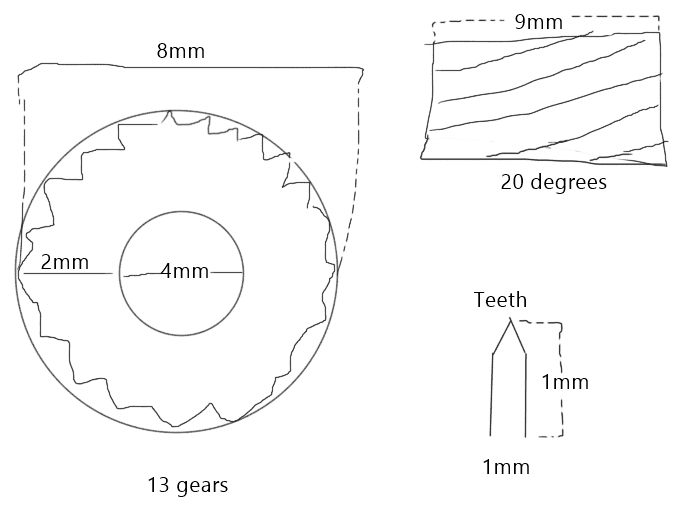
helical pinion gear.png
 

Attachments

  • helical pinion gear.png
    helical pinion gear.png
    11.2 KB · Views: 337
Last edited:
Engineering news on Phys.org
I think what you are looking for is a "screw gear", not a pinion gear (although it acts as a pinion gear).
 
  • Like
Likes   Reactions: Petes
Spares may be available. What is the make and model of the microscope?

Is it part of the focus mechanism? Does it drive a rack?

It may be possible to use modelling clay to make a copy. Use the rack as a master to copy the tooth profile. Then make a mould from the clay and cast your replacement pinion from epoxy.
 
Can you provide photos of the gear and its surrounding structure. Please show different views of the gear and the structure where it is located. I have a lot of old microscope parts and might be able to find one for you. Also, please provide the scope's make and model.
 
Thanks for the answers. The brand looks like HOC, I included a picture. I don't know about the model. The gear drives the rack.

20190921_183233x.jpg


Rack and gear:

20190921_012519.jpg


The gear goes into a 4mm metal shaft:

20190921_013918x.jpg
 
Is this for the focusing rack or the stage table cross fed?
Can you provide an overall image of the adjoining structures?
 
It's for a rack that moves up and down in order to focus.

This is the entire mechanism

20190921_190842x.jpg


The metal shaft goes into this hole in the microscope (the one between two screws) and at the top you can see where the rack goes:

20190921_190900x.jpg
 
Last edited:
Can you see how the plastic gear was afixed to the shaft?
 
  • #10
Baluncore said:
Maybe the; Holland Optical Company (HOC). Now has a different logo?
https://www.hocsite.com/

I figured out the brand, It's a Japanese Y.K.S HOC microscope It's "vintage" and I doubt I'll find a spare part. So I guess I'll have to figure out how to get one done for me or adapt something else. The gear looks so simple, I thought I could simply google for one.
 
  • #11
AZFIREBALL said:
Can you see how the plastic gear was afixed to the shaft?
Only pressure, it's a 4mm hole
 
  • #12
What do you mean by pressure?
 
  • #13
AZFIREBALL said:
What do you mean by pressure?
The gear is pushed in, friction, I guess it's nylon or some plastic that can expand a bit
 
  • #14
boston gear may have what you need
 
  • #15
So you think the gear was just pressed onto the shaft? There are no set screws, shaft keys or square bosses to prevent the gear from rotating relative to the shaft? Mmmmm. Plastics do not do well under long term constant stress, due to their creep characteristics.
 
  • Like
Likes   Reactions: Petes
  • #16
AZFIREBALL said:
So you think the gear was just pressed onto the shaft? There are no set screws, shaft keys or square bosses to prevent the gear from rotating relative to the shaft? Mmmmm. Plastics do not do well under long term constant stress, due to their creep characteristics.
Yeah, they just pressed it, probably explains why it broke off.
 
  • #17
Because it is a helical gear it will run smoothly in that application even if it is not perfect.
You might turn up a brass cylinder in a lathe.
Drill the hole undersize, then press it onto the shaft.
Mark the tooth ridge lines on the surface of the cylinder.
File or dremel the teeth to approximate shape.
Roll the gear on the rack to identify high spots that need more work.
Reassemble with grease on the rack.
 
  • Like
Likes   Reactions: gmax137 and Petes
  • #18
Try sticking the broken gear back with super glue?
 
  • #19
vxiaoyu18 said:
Try sticking the broken gear back with super glue?

Unfortunately I did it already and it broke off again, now it has so much glue that I can't glue it back into its original shape.
 
  • #20
A tip from a supplier of super glue says warm water will eventually loosen it, and if the base material allows it, Acetone works. Other sites list a range of organic solvents but many of them are quite aggresive (dangerous).

https://www.permabond.com/2019/07/22/how-to-remove-cyanoacrylate-adhesive/

(above found with:
https://www.google.com/search?&q=solvent+for+cyanoacrylate+glue)
 
  • Like
Likes   Reactions: Petes
  • #21
Here is the best I could find in my junk box. It is a metal gear, not plastic. Do you think you could use https://www.physicsforums.com/attachments/250026https://www.physicsforums.com/attachments/250027https://www.physicsforums.com/attachments/250028https://www.physicsforums.com/attachments/250029it? If you want it I will send it to you for the cost of postage. Let me know.
 
  • Like
Likes   Reactions: vxiaoyu18
  • #22
I see my post does not show the images. I found this one. If you want it let me know.
IMG_2471.JPG
IMG_2473.JPG
 
  • #23
AZFIREBALL said:
I see my post does not show the images. I found this one. If you want it let me know.
View attachment 250128View attachment 250129
Thanks for all but it won't work, that's a right handed gear and I need a left handed one, I also preffer it to be plastic so it doesn't grind the plastic rack mechanism. I think I'll try to find someone who can make one for me but thanks again.
 
  • #24
Making a one-off gear is expensive unless you have a hobbyist friend* or neighbor who does that sort of thing for fun. I would poke around online looking for similar models in cheap (broken) condition. Unless you need it fixed in a hurry.

I like the suggestion by @Baluncore above, it's worth a try -- maybe with some plastic if you don't want to use brass.

* yes this is a pun
 

Similar threads

Replies
1
Views
2K
  • · Replies 7 ·
Replies
7
Views
3K
Replies
2
Views
7K
  • · Replies 6 ·
Replies
6
Views
2K
  • · Replies 1 ·
Replies
1
Views
2K
Replies
2
Views
4K
  • · Replies 5 ·
Replies
5
Views
4K
  • · Replies 1 ·
Replies
1
Views
6K
Replies
4
Views
6K
  • · Replies 11 ·
Replies
11
Views
11K