Where does the energy go when charges are shared between capacitors?

  • Context: Undergrad 
  • Thread starter Thread starter saltine
  • Start date Start date
  • Tags Tags
    Charges Conservation
Click For Summary

Discussion Overview

The discussion revolves around the energy loss that occurs when charges are shared between two identical capacitors. Participants explore the theoretical implications of this energy transfer, comparing it to physical analogies such as water tanks, and consider the forms of energy loss involved, including thermal energy and electromagnetic radiation.

Discussion Character

  • Exploratory
  • Technical explanation
  • Debate/contested
  • Mathematical reasoning

Main Points Raised

  • Some participants propose that when charges are shared between two identical capacitors, the energy is halved, leading to questions about where the lost energy goes.
  • One participant suggests that the energy is lost to thermal energy due to resistive heat generation and implies that the system's irreversible nature contributes to this loss.
  • Another participant discusses the power loss in a resistor when the switch to the second capacitor is closed, questioning what happens to the energy dissipated as resistance approaches zero.
  • Some participants mention that electromagnetic radiation may play a role in energy loss, although there is debate about its significance compared to resistive heating.
  • One participant notes that oscillation in energy transfer, as seen in water tank demonstrations, does not occur with just capacitors unless inductors are included in the circuit.
  • There is a discussion about the conditions under which electromagnetic radiation could become a dominant form of energy loss, with references to the need for specific configurations to achieve this.
  • Questions arise regarding the role of medium permittivity and air resistance in the induction process during charge transfer between capacitors.

Areas of Agreement / Disagreement

Participants express multiple competing views regarding the mechanisms of energy loss, including thermal energy and electromagnetic radiation. The discussion remains unresolved on the exact contributions of these factors.

Contextual Notes

Some assumptions about the system's behavior, such as the irreversibility of energy loss and the conditions for oscillation, are not fully explored. The discussion also touches on the limitations of circuit theory in accounting for electromagnetic radiation.

Who May Find This Useful

This discussion may be of interest to those studying electrical engineering, physics, or anyone curious about energy transfer mechanisms in capacitive systems.

saltine
Messages
84
Reaction score
0
When you share charges between two identical capacitors (by letting half of the charges in one capacitor to spill to the other) the over energy is halved. Where does that energy go? In what way is it lost?

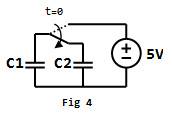
Example circuit:
3414268782_0495859696.jpg


Before t=0, capacitor C1 is fully charged. The energy that it stores can be computed by E = 0.5QV. The voltage across the capacitor is 5volt. When the circuit toggles, half of its charges would spill to C2 (which is an identical capacitor). The voltage across either capacitor will be 2.5volt. The total energy after toggling is ETotal = 2( 0.5(0.5Q)(0.5V) ) = 0.5E. Half of the energy is lost.

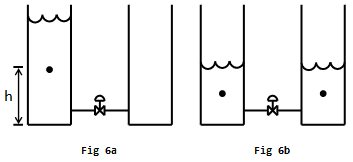
But in what form is the energy "lost?"This is a similar situation using water tanks:
3415637760_5c6dd736f9_o.png


The potential energy in Fig6a is Ea = mgh. The potential energy in Fig6b is Eb = 2( (0.5m)g(0.5h) ) = 0.5 Ea. Half of the potential energy is lost.

When an object freefall, potential energy is converted into kinetic energy. So there is no net lost of energy. But where did the energy go in the case of the water tank? Is it true that the energy is still lost through kinetic energy, because, if the water must obviously move to get to the second tank, and while it is moving, there is additional kinetic energy (aside from its temperature), which the water gets from its potential energy?

What about the case of the capacitors? Is the energy lost simply because the charges moved (they moved because the potential energy gave them kinetic energy to move down the gradient)?

Does the energy lost have anything to do with electromagnetic radiation?
 
Physics news on Phys.org
The energy is lost to thermal energy (via resistive heat generation in the first case and turbulent and frictional heat generation in the second case). I noticed you drew the water levels as equal in your Fig. 6b instead of having all the water rush to the right side (with no loss of energy) then all back to the left side (again, with no loss of energy); so at some level (maybe not explicitly), you've assumed that damping exists in the system. The same thing applies to the voltage in the capacitor problem; by assuming the voltages end up as equal, you're implying an irreversible system, which means that energy will be thermalized.

The lost energy doesn't involve radiation except inasmuch as hotter objects radiate more and at higher frequencies.
 
Put a resistor in series with C2, and calculate the power loss (integrate V(t)2/R dt from zero to infinity) when the switch to C2 is closed. Now slowly let R go to zero. What happens to the energy dissipated in R?
 
saltine said:
When you share charges between two identical capacitors (by letting half of the charges in one capacitor to spill to the other) the over energy is halved. Where does that energy go? In what way is it lost?
See this thread, especially the detailed derivation in post 9:
https://www.physicsforums.com/showthread.php?t=249154
 
I remember a demonstration of the two tank problem using a U-shape tube. The water level was clearly oscillating.

3420061570_0f821b92c3.jpg


In this figure, vR = e1 = e2. From KCL I get these equations:

[tex]\frac{1}{R}v_R + C_1\frac{dv_{C1}}{dt} = 0[/tex]
[tex]\frac{1}{R}v_R - C_2\frac{dv_{C2}}{dt} = 0[/tex]

In my case, [tex]C_1 = C_2 = C[/tex], and [tex]\frac{dv_R}{dt} = \frac{dv_{C1}}{dt} - \frac{dv_{C2}}{dt}[/tex]. So

[tex]\frac{2}{R}v_R + C(\frac{dv_R}{dt}) = 0[/tex]

[tex]v_R = e^{-\frac{2}{RC}t}+K[/tex]

Since [tex]v_R[/tex] is initially 5volt, K = 4. But this cannot be correct because as t goes to infinity, [tex]v_R[/tex] is supposed to be 0. What went wrong?Re: DaleSpam

https://www.physicsforums.com/showpost.php?p=1829464&postcount=9"

How do you get (2) in your solution?
 
Last edited by a moderator:
Why don't you just try the general solution I linked to, just to see if it works.
 
(That is because I already know that it works!)

Ok I found what was wrong. That constant from the integral was there before the natural log, so it is a multiplier to the exp.

[tex]V_R = 5 e^{-\frac{2}{RC}t}[/tex]

Power is VR^2/R = [tex]\frac{25}{R}e^{\frac{4}{RC}t}[/tex]

Total Energy dissipated by resistor is:

[tex]\int_0^{\infty} E dt = \frac{25C}{4}[/tex]

The initial energy was [tex]0.5 CV^2 = \frac{25C}{2}[/tex]. So half of the energy is lost eventuall regardless what R is.

But in this derivation, wouldn't it mean that the charge will not oscillate between the two capacitors? Because VR is just an exponential decay. But in the water tube demonstration it would oscillate.
 
That is correct, it will not oscillate with two capacitors. If you want some oscillation then you need to include an inductor. I think I may have worked out that situation later in the same thread, but I don't remember for sure.
 
  • #10
Yes, you did. Can I say that adding inductors would not cause more energy loss because in an RLC circuit, the resistor is the only way to lose energy.
 
  • #11
saltine said:
Does the energy lost have anything to do with electromagnetic radiation?
I would say that the energy is dissipated via both resistive heating (as described) as well as some amount of electromagnetic radiation due to the shifting charges.
 
  • #12
saltine said:
Can I say that adding inductors would not cause more energy loss because in an RLC circuit, the resistor is the only way to lose energy.
Correct.
 
  • #13
Doc Al said:
I would say that the energy is dissipated via both resistive heating (as described) as well as some amount of electromagnetic radiation due to the shifting charges.

Whoops, I missed the issue of radiation from moving charges in my answer above. Obviously I was too absorbed in standard circuit elements and water flow. In any case, radiated EM waves aren't solely sufficient in explaining the energy loss, as Doc Al says.
 
  • #14
How is the loss due to EM radiation account in the total energy? What would you need to change to make it the dominant form of energy loss?

When you wiggle a charge in space, its electrical field lines wiggle. In the direction perpendicular to the motion, there is electromagnetic wave.

In the case of the capacitors, the charges only flow from C1 to C2 once. So there won't be an actual wave. It would be more like a shift?
 
  • #15
Mapes said:
Whoops, I missed the issue of radiation from moving charges in my answer above. Obviously I was too absorbed in standard circuit elements
I should emphasize that my analysis also was strictly based on circuit theory and explicitly does not consider the radiation of any energy.

Saltine, if you want radiation to be the dominant source of energy loss than you should get a good book on antenna design. Unfortunately I will not be of much help for that nor will those equations I derived previously.
 
  • #16
Hi just a quick question on this, when we talk of induction playing a part in the transfer of charges from Capacitor A to B, don't we take air resistance and medium permittivity into account
 

Similar threads

  • · Replies 3 ·
Replies
3
Views
2K
  • · Replies 6 ·
Replies
6
Views
13K
  • · Replies 24 ·
Replies
24
Views
5K
  • · Replies 1 ·
Replies
1
Views
2K
  • · Replies 22 ·
Replies
22
Views
6K
  • · Replies 4 ·
Replies
4
Views
15K
  • · Replies 4 ·
Replies
4
Views
3K
  • · Replies 2 ·
Replies
2
Views
7K
  • · Replies 2 ·
Replies
2
Views
1K
Replies
8
Views
3K