Where does this term come from? (pulling a wire loop through a B-field)

Click For Summary
SUMMARY

The discussion centers on the derivation of the sin(θ) term in the context of electromagnetic theory as presented in Griffiths' 4th edition textbook. The sin(θ) term arises from the dot product between the force acting on a charge and the differential length element of the loop, where θ is the angle between the drift velocity of the charge and the total velocity. When the coil is oriented parallel to the B-field, no magnetic flux pierces the loop, confirming that θ represents the angle of the loop with respect to the B-field direction. The relationship is established through the definition of the dot product, leading to the conclusion that the force component contributing to the work done is proportional to sin(θ).

PREREQUISITES
  • Understanding of electromagnetic theory, specifically concepts from Griffiths' "Introduction to Electrodynamics".
  • Familiarity with vector calculus and the dot product operation.
  • Knowledge of magnetic flux and its relation to current loops in magnetic fields.
  • Basic understanding of forces acting on charges in a conductor.
NEXT STEPS
  • Study the derivation of magnetic flux through a loop in a magnetic field.
  • Learn about the application of the dot product in physics, particularly in electromagnetism.
  • Explore the implications of coil orientation on magnetic flux and induced electromotive force (EMF).
  • Investigate the relationship between drift velocity and total velocity in charged particles within conductors.
USEFUL FOR

Students and professionals in physics, particularly those studying electromagnetism, electrical engineering, or anyone seeking a deeper understanding of the mathematical foundations of electromagnetic phenomena.

snatchingthepi
Messages
145
Reaction score
37
Homework Statement
Pulling a hoop through a uniform B-field
Relevant Equations
emf = loopintegral (f_pull dot dl)
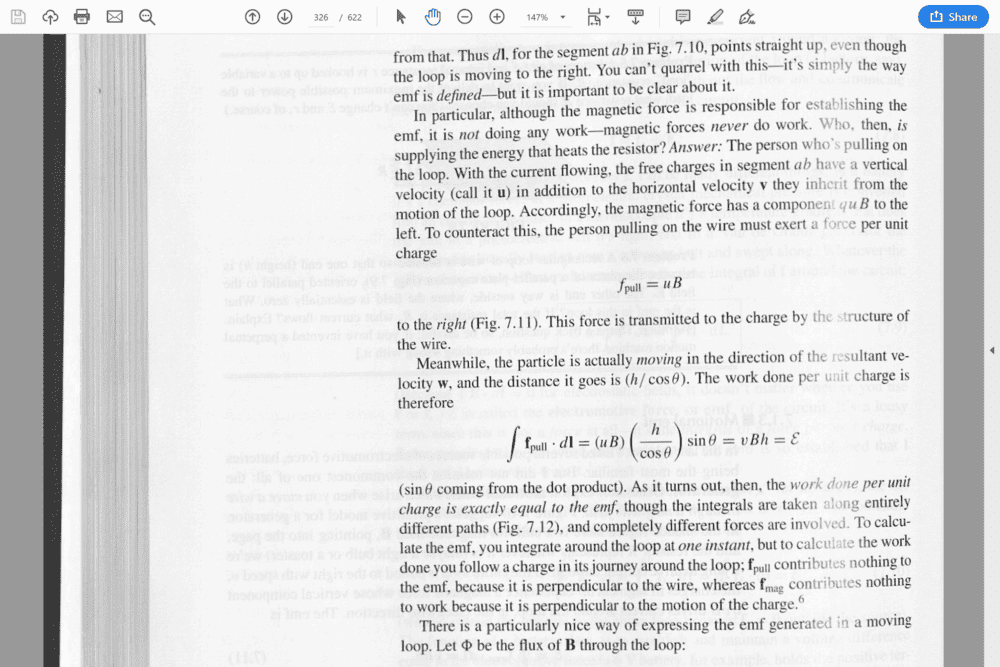
I can't for whatever reason figure out where the sin(theta) term is coming from in the attached picture of page 306 of Griffiths' 4th edition EM text. The paragraph says it comes from the dot product, but I just don't see where it's coming from.
2019-09-10.png
 
Physics news on Phys.org
Can you also scan the figure that this is referring to? Theta must be the angle of the loop with respect to the B-field direction?
 
berkeman said:
Can you also scan the figure that this is referring to? Theta must be the angle of the loop with respect to the B-field direction?

Yes here it is.
 

Attachments

  • 2019-09-10 (1).png
    2019-09-10 (1).png
    102.3 KB · Views: 252
  • 2019-09-10 (2).png
    2019-09-10 (2).png
    121.4 KB · Views: 250
So the dot product enters in because if the coil is oriented parallel to the B-field, then none of the flux pierces the plane of the loop. Does that make sense?
 
  • Like
Likes snatchingthepi
yes it all fits now, ##\theta## is the angle between ##\vec{u}## (the drift velocity of a charge inside the conductor) and the total velocity of the charge ##\vec{w}##. The element ##\vec{dl}## of the integral is in the direction of the total velocity ##\vec{w}## (it is ##\vec{dl}=\vec{w}dt##), because as Griffith says to find the work of ##F_p## we have to follow a charge at its journey around the loop, and this journey is done with the total velocity ##\vec{w}##. Thus the angle between ##\vec{dl}## and ##\vec{F_p}## is the angle between ##\vec{w}## and ##\vec{F_p}## which is ##\frac{\pi}{2}-\theta## .Thus and by definition of dot product ##\vec{F_p}\cdot \vec{dl}=F_pdl\cos(\vec{F_p},\vec{dl})=F_pdl\cos(\frac{\pi}{2}-\theta)=F_pdl\sin\theta##
 
Last edited:
  • Like
Likes snatchingthepi
Thank you all!
 
  • Like
Likes berkeman and Delta2

Similar threads

Replies
1
Views
1K
  • · Replies 6 ·
Replies
6
Views
2K
Replies
8
Views
2K
  • · Replies 2 ·
Replies
2
Views
5K
  • · Replies 2 ·
Replies
2
Views
2K
  • · Replies 1 ·
Replies
1
Views
1K
Replies
16
Views
3K
Replies
4
Views
2K
Replies
16
Views
2K
Replies
4
Views
2K