Where is a particle most likely to be? (Griffiths Quantum Mechanics)

Click For Summary
SUMMARY

The discussion focuses on the properties of wave functions in quantum mechanics, specifically addressing their differentiability and implications for determining the probability density function (PDF) of a particle's position. It is established that while wave functions are ideally differentiable, they only need to be square integrable to represent a physically realizable state. To find the coordinate where a particle is most likely to be, one should calculate the maximum of the modulus squared of the wave function, |ψ|², using calculus techniques. The derivative of |ψ| does not yield the same result as |ψ|² for finding absolute maxima.

PREREQUISITES
  • Understanding of wave functions in quantum mechanics
  • Familiarity with probability density functions (PDFs)
  • Basic calculus, including differentiation
  • Knowledge of the Schrödinger Equation
NEXT STEPS
  • Study the properties of wave functions in quantum mechanics
  • Learn about probability density functions and their applications
  • Explore calculus techniques for finding maxima and minima
  • Investigate the implications of differentiability in quantum mechanics
USEFUL FOR

Students and professionals in physics, particularly those studying quantum mechanics, as well as anyone interested in the mathematical foundations of wave functions and probability distributions.

blackbeans
Messages
3
Reaction score
0
Homework Statement
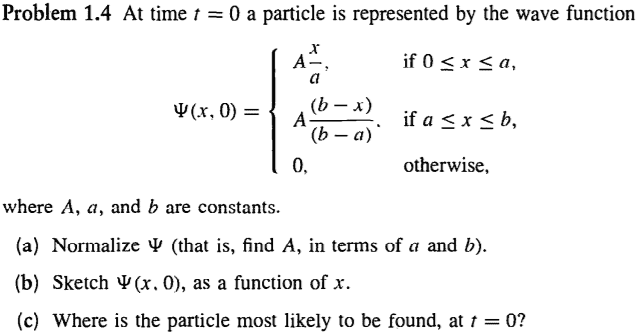
Hi there, it seems more convenient to post a picture of the problem in question. More specifically, problem 1(c).
Relevant Equations
the schrodinger equation.
The wave function described seems impossible. Wave functions have to be differentiable at all points, right? Otherwise they don't represent a physically realizable state. The wave function in the example isn't differentiable at x=A, the maximum point. Also, for problem (c), I know it's visually simple to see the answer, but for a more general case, how would i find the coordinate where the "particle is most likely to be"? Would I take the derivative of |psi|^2 or |psi| to find the absolute maxima? Do they provide the same result? Is there a simpler method?
Screenshot (47).png
 
Physics news on Phys.org
Theoretically, wave functions need only be square integrable. You could, however, look at this sort of function an idealised approximation to a function that would have a differentiable maximum.

As you state, the modulus squared of the wave function represents the PDF of the particle's position. You calculate the maximum as you would for any function, using calculus or otherwise.
 
  • Like
Likes   Reactions: blackbeans
I see. I just assumed that the wave function had to be differentiable everywhere, since its derivative shows up in the Schrödinger Eq. Thank you!
 
blackbeans said:
I see. I just assumed that the wave function had to be differentiable everywhere, since its derivative shows up in the Schrödinger Eq. Thank you!
Technically it's better if it is differentiable. But differentiable almost everywhere is probably good enough
 

Similar threads

  • · Replies 9 ·
Replies
9
Views
1K
  • · Replies 7 ·
Replies
7
Views
3K
  • · Replies 9 ·
Replies
9
Views
2K
  • · Replies 8 ·
Replies
8
Views
2K
  • · Replies 12 ·
Replies
12
Views
924
  • · Replies 6 ·
Replies
6
Views
3K
Replies
3
Views
2K
  • · Replies 2 ·
Replies
2
Views
3K
  • · Replies 34 ·
2
Replies
34
Views
2K
  • · Replies 3 ·
Replies
3
Views
653