Where is a particle most likely to be? (Griffiths Quantum Mechanics)

Click For Summary

Homework Help Overview

The discussion revolves around the properties of wave functions in quantum mechanics, specifically addressing their differentiability and implications for determining the probability density function (PDF) of a particle's position. The original poster questions the conditions under which a wave function can be considered physically realizable and how to find the most probable position of a particle.

Discussion Character

  • Conceptual clarification, Assumption checking, Mathematical reasoning

Approaches and Questions Raised

  • Participants explore the differentiability of wave functions and its relevance to physical realizability. Questions arise regarding the method to determine the maximum probability density, including whether to differentiate |psi|^2 or |psi|, and the implications of each approach.

Discussion Status

The conversation is ongoing, with some participants providing clarifications about the requirements for wave functions and discussing the mathematical approaches to finding maxima. There is an acknowledgment of differing interpretations regarding differentiability and its significance in the context of quantum mechanics.

Contextual Notes

Participants note that while differentiability is generally preferred, there may be cases where a wave function is not differentiable at certain points, raising questions about the implications for physical states and calculations.

blackbeans
Messages
3
Reaction score
0
Homework Statement
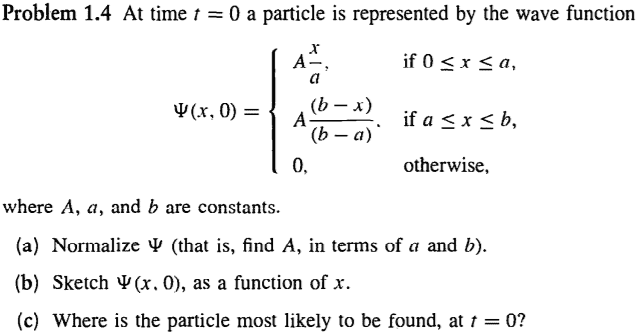
Hi there, it seems more convenient to post a picture of the problem in question. More specifically, problem 1(c).
Relevant Equations
the schrodinger equation.
The wave function described seems impossible. Wave functions have to be differentiable at all points, right? Otherwise they don't represent a physically realizable state. The wave function in the example isn't differentiable at x=A, the maximum point. Also, for problem (c), I know it's visually simple to see the answer, but for a more general case, how would i find the coordinate where the "particle is most likely to be"? Would I take the derivative of |psi|^2 or |psi| to find the absolute maxima? Do they provide the same result? Is there a simpler method?
Screenshot (47).png
 
Physics news on Phys.org
Theoretically, wave functions need only be square integrable. You could, however, look at this sort of function an idealised approximation to a function that would have a differentiable maximum.

As you state, the modulus squared of the wave function represents the PDF of the particle's position. You calculate the maximum as you would for any function, using calculus or otherwise.
 
  • Like
Likes   Reactions: blackbeans
I see. I just assumed that the wave function had to be differentiable everywhere, since its derivative shows up in the Schrödinger Eq. Thank you!
 
blackbeans said:
I see. I just assumed that the wave function had to be differentiable everywhere, since its derivative shows up in the Schrödinger Eq. Thank you!
Technically it's better if it is differentiable. But differentiable almost everywhere is probably good enough
 

Similar threads

  • · Replies 9 ·
Replies
9
Views
2K
  • · Replies 7 ·
Replies
7
Views
3K
  • · Replies 9 ·
Replies
9
Views
2K
  • · Replies 8 ·
Replies
8
Views
2K
  • · Replies 12 ·
Replies
12
Views
2K
  • · Replies 6 ·
Replies
6
Views
3K
Replies
3
Views
2K
  • · Replies 2 ·
Replies
2
Views
3K
  • · Replies 34 ·
2
Replies
34
Views
3K
  • · Replies 3 ·
Replies
3
Views
1K