Where on Earth (75% of the time in the dark)

  • Context: Undergrad 
  • Thread starter Thread starter rede96
  • Start date Start date
  • Tags Tags
    Earth Time
Click For Summary

Discussion Overview

The discussion revolves around determining the latitude on Earth where a person would spend 75% of their time in darkness due to the Earth's rotation and the angle of sunlight. Participants explore the mathematical relationships and calculations necessary to derive the relevant dimensions and angles involved in this scenario.

Discussion Character

  • Exploratory
  • Mathematical reasoning

Main Points Raised

  • One participant seeks assistance in calculating the diameter (d2) and height (h2) related to the shadow cast by the sun at a 60-degree angle to the Earth's axis.
  • Another participant inquires about the level of trigonometry knowledge to tailor their response effectively.
  • A participant describes a method involving the circumference of a circle to determine the proportions of light and dark, indicating a need for the calculation of d2.
  • A later post presents equations for h2 and d2, expressing a desire for help in simplifying these equations.

Areas of Agreement / Disagreement

Participants do not reach a consensus on the calculations or methods, and multiple approaches and equations are presented without resolution.

Contextual Notes

Participants express uncertainty regarding the calculations and the relationships between the variables involved, particularly in the context of the shadow's angle and the Earth's dimensions.

rede96
Messages
663
Reaction score
16
...would I have to be so I spend 75% of the time in the dark as the Earth spins?

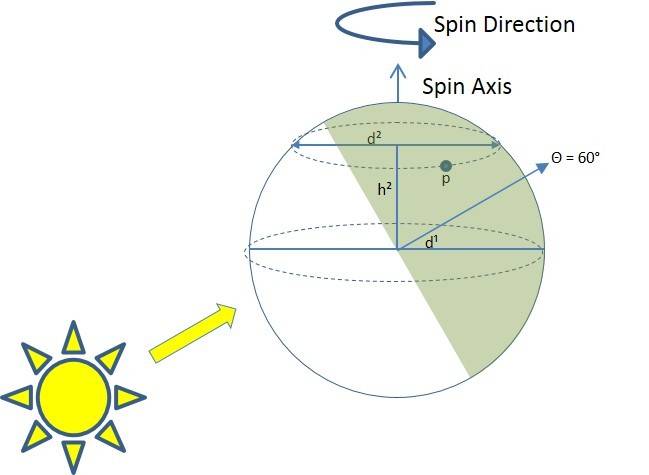
Imagine the sun shines on the Earth in such a way that it casts a shadow that is at 60 degrees to the axis of the spin of the Earth (Assume the Earth's axis is 0 degrees) as shown in my diagram below.

I am trying to work out what 'latitude' (shown as P) I have to be at so I spend 75% of my time in the dark and 25% of my time in sun light as the Earth spins about its axis. I am not looking for the actual latitude, but how to calculate d2 (diameter) and h2 (height) from below.

Can anyone help? I've been at this for ages!
Fig_A.jpg
 
Mathematics news on Phys.org
How much trigonometry have you studied?
(Knowing this will help us give you a better answer)
 
Nugatory said:
How much trigonometry have you studied?

I know the basics, SOH, CAH, TOA. So can work most simple trig problems out.
 
If I look in the downward on the 'Earth' at the circle drawn out by the chord d2, then I know that 25% of the circumference of that circle needs to be in the light and 75% in the dark, which is 270 degrees and 90 degrees respectively. So I can make a segment that splits the circumference of a circle at 0 and 90 degrees, and thus work out the chord of that segment, and the arc which the shadow casts on the earth. But to do all that I would need to know d2 and I just can't figure out how to calculate that :(
 
Last edited:
A lot of trial and error but I managed to solve this. Below are the un-simplified equations. If anyone could help simplify them that would be great :)

From the diagram above:

h2 = sin((cos(((1-(cos(θ/2)^2))*360)/2)+1)/2*θ)*(d/2)

d2 = cos((cos(((1-(cos(θ/2)^2))*360)/2)+1)/2*θ)*d/2)*2

Where θ is the angle of the shadow (60° in the example I gave) and d is the diameter of the Earth (I called it d1 in the above diagram)
 

Similar threads

Replies
10
Views
1K
Replies
38
Views
5K
  • · Replies 1 ·
Replies
1
Views
1K
  • · Replies 11 ·
Replies
11
Views
3K
Replies
13
Views
2K
  • · Replies 19 ·
Replies
19
Views
3K
  • · Replies 16 ·
Replies
16
Views
6K
  • · Replies 2 ·
Replies
2
Views
3K
  • · Replies 16 ·
Replies
16
Views
12K
  • · Replies 35 ·
2
Replies
35
Views
4K