Undergrad Which area should I use to calculate the force on a submerged surface?

Click For Summary
To calculate the force exerted by water on a wall, only the area in contact with the liquid should be considered. The pressure increases with depth, meaning it is not constant, necessitating the use of integration for accurate calculations. While the upper part of the wall is in contact with air, it may require consideration of air pressure, but this does not affect the force calculation directly. An integral over the entire wall area will yield the same result as one over the area where pressure is non-zero. Accurate force calculations must account for varying pressure due to water depth.
rbmartel
Messages
4
Reaction score
2
TL;DR
In order to find the resultant force applied to a submerged vertical wall, which area should I consider?
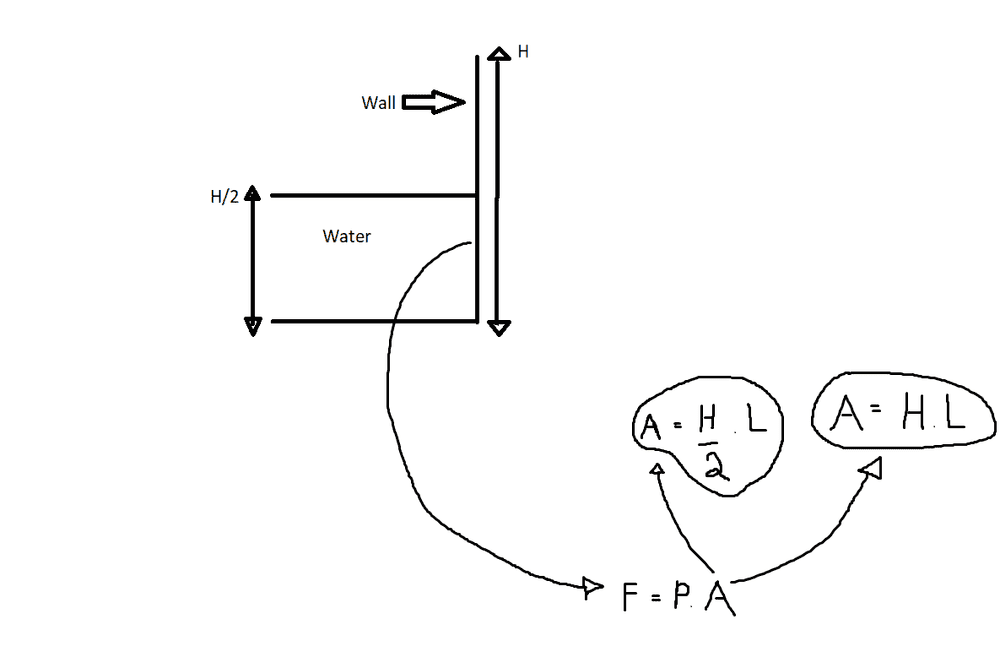
Let's say we have a tank filled with water only half way up. I want to calculate the force being applied by the liquid on one of the walls, that's F = P.A. For the area (A), should I consider the area of the entire wall (H.L), or only the area of the wall that's in contact with the liquid ((H/2).L).
I'm having a hard time trying to understand if I should or shouldn't include in the calculations the part of the wall that is not in contact with the water.
Hydro question.png
 
Physics news on Phys.org
You should take area in contact with liquid. If the upper part is in contact with air, you may have to consider air pressure on that part.
 
Last edited:
  • Like
Likes Delta2
You also need to consider that the total force is pressure times area only if the pressure is constant. Here the pressure is not constant because it increases with depth. You will have to do an integral.
 
  • Like
Likes Delta2
kuruman said:
You also need to consider that the total force is pressure times area only if the pressure is constant. Here the pressure is not constant because it increases with depth. You will have to do an integral.
And, of course, an integral taken over the whole area will yield the same result as an integral taken over the area where the pressure is non-zero.
 
Thread 'What is the pressure of trapped air inside this tube?'
As you can see from the picture, i have an uneven U-shaped tube, sealed at the short end. I fill the tube with water and i seal it. So the short side is filled with water and the long side ends up containg water and trapped air. Now the tube is sealed on both sides and i turn it in such a way that the traped air moves at the short side. Are my claims about pressure in senarios A & B correct? What is the pressure for all points in senario C? (My question is basically coming from watching...

Similar threads

  • · Replies 5 ·
Replies
5
Views
2K
  • · Replies 0 ·
Replies
0
Views
1K
  • · Replies 3 ·
Replies
3
Views
3K
  • · Replies 4 ·
Replies
4
Views
3K
  • · Replies 3 ·
Replies
3
Views
2K
  • · Replies 15 ·
Replies
15
Views
3K
  • · Replies 22 ·
Replies
22
Views
1K
  • · Replies 12 ·
Replies
12
Views
2K
  • · Replies 28 ·
Replies
28
Views
3K
  • · Replies 3 ·
Replies
3
Views
2K