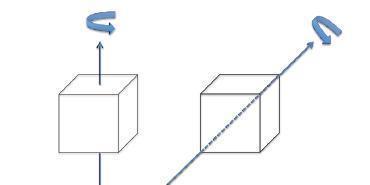
Which cube has a larger moment of inertia?

Click For Summary
SUMMARY

The discussion centers on determining which of two cubes has a larger moment of inertia. The right cube is argued to have a larger moment of inertia because its rotation does not occur around the principal axes, which minimizes the moment of inertia. The parallel axis theorem is referenced, stating that the moment of inertia about an arbitrary axis equals the moment of inertia about a parallel axis through the center of mass plus the moment of inertia about the arbitrary axis. The conclusion emphasizes that the moment of inertia is minimized around principal axes, supporting the claim that the right cube has a greater moment of inertia.

PREREQUISITES
  • Understanding of moment of inertia concepts
  • Familiarity with the parallel axis theorem
  • Knowledge of principal axes in rigid body dynamics
  • Basic integration techniques for calculating moments of inertia
NEXT STEPS
  • Study the derivation of moment of inertia for various shapes
  • Learn about the application of the parallel axis theorem in different contexts
  • Explore the significance of principal axes in rigid body motion
  • Practice integration techniques for calculating moments of inertia
USEFUL FOR

Physics students, mechanical engineers, and anyone interested in the dynamics of rigid bodies and the calculation of moments of inertia.

Cosmossos
Messages
100
Reaction score
0
To which of the two cubes has a larger moment of inertia?
attachment.php?attachmentid=23012&d=1263306125.jpg


I think it's the right one because We know that the minimal moment of inertia is throw the principal axes that goes throw the center of mass. in the right one , the rotation isn't throw the principal axes . there is also the following theorem :

The moment of inertia about an arbitrary axis is equal to the
moment of inertia about a parallel axis passing through the
center of mass plus the moment of inertia of the body about
the arbitrary axis, taken as if all of the mass M of the body
were at the center of mass.

Am I wrong?
 
Physics news on Phys.org
If I'm reading your diagram correctly, the parallel axis theorem wouldn't apply since in both cases, the axis passes through the center of mass of the cube. But if the moment of inertia is always minimized around a principal axis, that would be a valid reason for arguing that the one on the right is greater.

Personally, I might try to work it out by integration to really convince myself.
 

Similar threads

  • · Replies 15 ·
Replies
15
Views
2K
Replies
5
Views
2K
  • · Replies 3 ·
Replies
3
Views
4K
  • · Replies 2 ·
Replies
2
Views
2K
Replies
11
Views
4K
  • · Replies 5 ·
Replies
5
Views
3K
  • · Replies 6 ·
Replies
6
Views
12K
Replies
2
Views
2K
  • · Replies 40 ·
2
Replies
40
Views
6K
  • · Replies 13 ·
Replies
13
Views
3K