Which Molecule Velocity in a Gas is Greatest?

Click For Summary

Homework Help Overview

The discussion revolves around the velocities of gas molecules, specifically comparing the average velocity (AV), most probable velocity (MPV), and root mean square velocity (RMSV) within the context of kinetic theory and the Maxwell-Boltzmann distribution.

Discussion Character

  • Conceptual clarification, Assumption checking

Approaches and Questions Raised

  • Participants explore the relationships between AV, MPV, and RMSV, questioning whether AV and MPV are equivalent and discussing the implications of the Maxwell-Boltzmann distribution on these velocities.

Discussion Status

Some participants have offered insights into the ordering of the velocities, suggesting RMSV is greater than AV, which in turn is greater than MPV. Others have provided clarifications regarding the nature of the Maxwell-Boltzmann distribution and its asymmetry, indicating that the average and most probable velocities are not equal in this context.

Contextual Notes

There is a mention of the distribution being asymmetric and the implications this has on the relationship between the average and most probable velocities. Additionally, the discussion touches on the nature of molecule speeds being non-negative in the context of the Maxwell-Boltzmann distribution.

lando45
Messages
84
Reaction score
1
I am a little confused. I was talking to my teacher a couple days ago, and he asked me to put the following three into order of velocity (greatest first):

1. Average velocity of the molecules in a gas (AV)
2. Most probable velocity of the molecules in a gas (MPV)
3. RMS (root mean square) velocity of the molecules in a gas (RMSV)

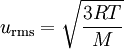
Well, I thought that AV and MPV must be the same? Because surely the MPV is based upon the AV? And then the formula used to calculate RMSV is:
b686e5b7842b561a26457bbd3e34deef.png


So I figured this is greater than the other 2? So I said to him RMSV had the greatest velocity, and then AV and MPV had equal velocities, but he told me this was incorrect. Can anyone help me out? Are they all equal?
 
Physics news on Phys.org
Rms>av>mpv
 
ah thanks, that makes good sense. i did some more research and that's the answer that made most sense to me as well. thanks.
 
lando45 said:
I am a little confused. I was talking to my teacher a couple days ago, and he asked me to put the following three into order of velocity (greatest first):

1. Average velocity of the molecules in a gas (AV)
2. Most probable velocity of the molecules in a gas (MPV)
3. RMS (root mean square) velocity of the molecules in a gas (RMSV)

Well, I thought that AV and MPV must be the same? Because surely the MPV is based upon the AV? And then the formula used to calculate RMSV is:

Just a comment. For *symmetric* probability distributions, the average value and most probable value are equal. The MB distribution is asymmetric...From a graph it is clear that the average value is larger than the most probable value (which would corespond to the peak) because the distribution is ''stretched'' farther from the peak for speeds above the most probable value.

Patrick
 
The average velocity of a gas molecule = most probable velocity = 0.

The typical Maxwell-Boltzmann distribution function is for molecule SPEEDs,
which are never negative.

It's not so much that the distribution is "stretched" toward large speeds,
as that the negatives have been "folded over to +'ve" by Pythagoras.
 

Similar threads

  • · Replies 12 ·
Replies
12
Views
2K
  • · Replies 7 ·
Replies
7
Views
3K
  • · Replies 32 ·
2
Replies
32
Views
3K
Replies
5
Views
1K
  • · Replies 3 ·
Replies
3
Views
5K
Replies
15
Views
3K
  • · Replies 1 ·
Replies
1
Views
6K
  • · Replies 2 ·
Replies
2
Views
1K
  • · Replies 23 ·
Replies
23
Views
4K
Replies
3
Views
2K