Who is Right: Backward Difference Table or Forward Difference Table?

  • Context: Undergrad 
  • Thread starter Thread starter momentum
  • Start date Start date
  • Tags Tags
    Difference Table
Click For Summary

Discussion Overview

The discussion centers around the correctness of a backward difference table versus a forward difference table, exploring the conventions and interpretations of these tables in the context of discrete calculus. Participants examine the alignment and labeling of entries in the tables and their implications for understanding the differences.

Discussion Character

  • Debate/contested
  • Technical explanation

Main Points Raised

  • One participant asserts that the backward difference table presented in their book contains an error.
  • Another participant agrees with the assertion that there is an error in the table.
  • Some participants argue that whether the table is considered a forward or backward difference table depends on the alignment of the entries and how they are labeled.
  • A participant notes that the columns are labeled in a way that conventionally refers to backward differences, suggesting that the labeling influences the interpretation of the table.
  • One participant shares their experience teaching discrete calculus, highlighting the confusion among students who are accustomed to backward differences, while the instructor emphasizes forward differences.
  • A later reply questions the unusual reading direction of the table, suggesting that it deviates from common conventions of reading tables from top to bottom.

Areas of Agreement / Disagreement

Participants express differing views on the interpretation of the difference table, with some agreeing on the presence of an error while others focus on the alignment and labeling conventions. The discussion remains unresolved regarding the definitive classification of the table as either forward or backward difference.

Contextual Notes

There are limitations regarding the assumptions made about the alignment and labeling of the tables, as well as the conventions that participants are accustomed to. The discussion does not resolve these ambiguities.

momentum
Messages
111
Reaction score
0
<Moderator's note: Please upload images for otherwise the links might get broken.>

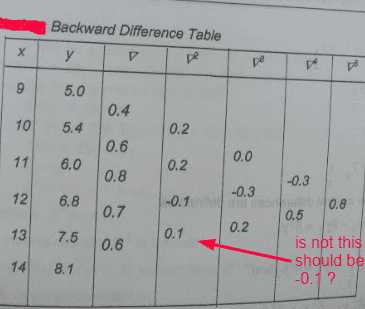
Here is the backward difference table given in my book

https://prnt.sc/n2965l
240773

But it seems this table is wrong. I have marked my comment in the screen.

Can you please tell who is right ?
 
Mathematics news on Phys.org
Yes you are correct they made an error.
 
momentum said:
<Moderator's note: Please upload images for otherwise the links might get broken.>

Here is the backward difference table given in my book

https://prnt.sc/n2965lView attachment 240773
But it seems this table is wrong. I have marked my comment in the screen.

Can you please tell who is right ?

(1) Yes, you are right.
(2) Isn't that a forward-difference table?
 
Whether it is a forward or backward difference table depends on how you allign entries. Since the table has the differences half way between the terms they subtract you can view them as forward differences (next row's entry minus this row's) by assuming the rows slant downward to the left. Letting the rows slant upward allows you to call them backward differences (this row's entry minus the previous row's).
 
jambaugh said:
Whether it is a forward or backward difference table depends on how you align entries.
And on how you label them - the columns here are labelled ## \nabla, \nabla^2 ... ## which by convention refers to backward differences i.e ## x_n - x_{n-1} ## (forward differences ## \Delta ## being ## x_{n+1} - x_n ##).
 
I ran into this with my Survey of Calc students this semester. I taught them a bit of discrete calculus because it makes things like the FTC rather obvious. But many are Econ students used to taking backward differences when I insist (so certain facts line up) that we work primarily with forward differences. So I don't mark their completed tables wrong but bless them out a bit on the comments when I return work. (Mainly about knowing which is which and being sure to follow the given instructions.)

Easy FTC proof: A sum of successive forward differences cancel all but the last minus first term. Multipy by h/h and the sum becomes a Riemann sum and the differences become difference quotients. Take the simultaneous limit and you have a definite integral of a derivative equals difference in end values.
 
pbuk said:
And on how you label them - the columns here are labelled ## \nabla, \nabla^2 ... ## which by convention refers to backward differences i.e ## x_n - x_{n-1} ## (forward differences ## \Delta ## being ## x_{n+1} - x_n ##).

Ok, I failed to look at the column labels---that is, I thought they were ##\Delta##, etc.

However, to me the table looks weird; over many decades of viewing tables, I have never seen tables that you read from bottom to top; reading from top to bottom seems to be almost a universal convention (albeit undocumented), rather like that of reading from left to right in Western languages.
 

Similar threads

  • Sticky
  • · Replies 33 ·
2
Replies
33
Views
12K
  • · Replies 7 ·
Replies
7
Views
3K
Replies
2
Views
1K
  • · Replies 37 ·
2
Replies
37
Views
3K
  • · Replies 4 ·
Replies
4
Views
3K
  • · Replies 5 ·
Replies
5
Views
4K
  • · Replies 7 ·
Replies
7
Views
3K
  • · Replies 125 ·
5
Replies
125
Views
8K
  • · Replies 6 ·
Replies
6
Views
2K
Replies
2
Views
3K