Why and how are ketones reduced?

  • Thread starter Thread starter olee
  • Start date Start date
  • Tags Tags
    Reduction
Click For Summary

Discussion Overview

The discussion revolves around the reduction of ketones, exploring the mechanisms involved, the simplifications often presented in educational materials, and the complexities of the reactions. Participants delve into theoretical aspects, practical considerations, and the role of intermediates in these chemical processes.

Discussion Character

  • Exploratory
  • Technical explanation
  • Debate/contested
  • Mathematical reasoning

Main Points Raised

  • Some participants note that the reduction of ketones is often simplified in educational contexts, particularly regarding the equilibrium nature of the reactions and the role of hydride ions from reducing agents like lithium aluminum hydride and sodium borohydride.
  • There is a discussion about the existence of a tetrahedral intermediate during the reduction process, with some participants questioning its universality and suggesting that different solvents may lead to different mechanisms.
  • One participant emphasizes that while simplified mechanisms are not entirely accurate, they can still provide useful insights into reaction barriers and stability of intermediates.
  • Another participant highlights the challenges of using valence bond theory compared to molecular orbital theory, suggesting that while VBT is easier for conceptual understanding, it may not capture the full complexity of the reactions.
  • There is an exchange regarding the practicalities of performing molecular orbital calculations, with participants sharing their experiences and the challenges associated with such computations.

Areas of Agreement / Disagreement

Participants express differing views on the validity and utility of simplified mechanisms in organic chemistry. While some acknowledge their usefulness, others challenge the completeness of these models, indicating that multiple competing views remain regarding the nature of intermediates and the theoretical frameworks used.

Contextual Notes

The discussion touches on various assumptions related to solvent effects, the nature of intermediates, and the limitations of theoretical models in accurately describing chemical processes.

Who May Find This Useful

Readers interested in organic chemistry, particularly those exploring reaction mechanisms, theoretical frameworks, and the complexities of chemical reductions may find this discussion relevant.

olee
Messages
24
Reaction score
0
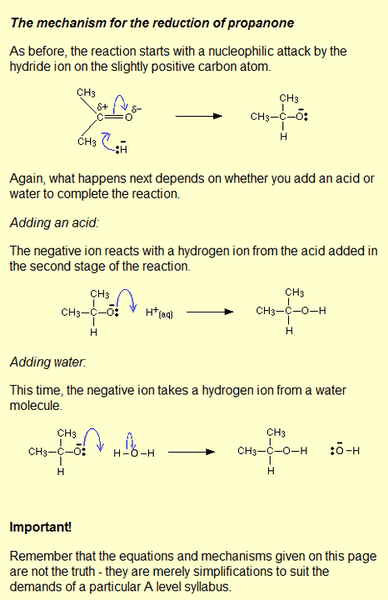
found this on this page
http://www.chemguide.co.uk/mechanisms/nucadd/reduce.html#top
wujoyw.png

can someone explain why it is simplified? and how does it really happen?
 
Chemistry news on Phys.org
This is the gist of what happens. However, there are a few ways in which it is simplified.

For one, all of those individual reactions are equilibrium processes and some are very reversible, especially the formation of the tetrahedral intermediate that results from the nucleophilic attack of hydride on the carbonyl group.

Also, the hydride ion is not floating around in solution. Hydride comes from some hydride reducing agent such as lithium aluminum hydride (LAH), sodium borohydride, sodium cyanoborohydride, etc. In the case of lithium aluminum hydride, the lithium or aluminum ion will stabilize the charge density on oxygen atom in the tetrahedral intermediate. Also, in the case of the LAH reduction, the resulting lithium alkoxide salt needs to be hydrolyzed to liberate the alcohol.

Furthermore, there is no mention of what solvents are used in these reactions. For example, the LAH reduction is typically done in ether or THF, while sodium borohydride and sodium cyanoborohydride reductions are done in aqueous solutions.

Finally, a note about water chemistry: in acidic solution, there is a high concentration of hydronium ion. There are never free protons floating around in solution, although in most introductory courses, it's perfectly acceptable to simply write "H+(aq)" as opposed to "H3O+(aq)."

Really, it could be a lot more complicated than this depending on how deep and quantitative you'd like to go! Organic Chemistry might seem like a very "fuzzy" or "squishy" branch of chemistry, but it actually depends on some cold, hard, physical laws.
 
Sounds good. Also, is there really a tetrahedral anion intermediate? I'm not sure that's actually the case in all circumstances.
You could have some kind of [BH4-CR1R2O]- intermediate. Although this probably depends a lot on the solvent.

(edit: Checked it out, seems that for sodium borohydride in a nonpolar solvent you wouldn't have an intermediate; the hydrogen is transferred to the carbon in concert with the oxygen binding to the sodium.
But I should point out that the 'simplified' picture, and mechanisms given in org chem textbooks are still useful even when not 100% correct, because knowing the stability of these hypothetical intermediates still tells you something about the reaction barrier of the real thing. Analogously, resonance structures don't really exist in-themselves, but are a useful tool in analyzing the stability.)
 
Last edited:
alxm said:
But I should point out that the 'simplified' picture, and mechanisms given in org chem textbooks are still useful even when not 100% correct, because knowing the stability of these hypothetical intermediates still tells you something about the reaction barrier of the real thing. Analogously, resonance structures don't really exist in-themselves, but are a useful tool in analyzing the stability.)

One of the tricks in every branch of science is knowing which approximations are acceptable for a particular situation. So, while any description relying on valence bond theory (VBT) is not going to be the entire "truth" of the matter, it is certainly *a lot* easier to think in terms of VBT as opposed to Molecular Orbital (MO) Theory. Seriously, have you done MO calculations on even something small like CN-? It can be done, but it's not fun to do by hand!

If you ever study physical organic chemisry, you'll learn a lot of cool things along these lines--basically, everything you're taught in a sophomore O. Chem class is pretty much a limiting example or not *quite* accurate, although it suffices for rationalizing why reactions occur. It's disconcerting to "unlearn" what you've been taught, but also exciting to get that deeper understanding.
 
DDTea said:
So, while any description relying on valence bond theory (VBT) is not going to be the entire "truth" of the matter, it is certainly *a lot* easier to think in terms of VBT as opposed to Molecular Orbital (MO) Theory.

Actually I think in MO theory terms almost exclusively. VB theory isn't so simple IMO, once you get into three-electron bonds, etc.
Seriously, have you done MO calculations on even something small like CN-?

Seriously? :-p Well, after doing quantum chemistry full-time for the past 7 years, I've done a few. The largest would be on systems of >200 atoms, if you count Kohn-Sham MOs. Otherwise, it'd depends on the level of theory.
It can be done, but it's not fun to do by hand!

By hand? I'm not sure what kind of calculation you're be talking about then. Do you mean using Hückel theory? (In which case, sure, I've done it)
If you ever study physical organic chemisry

What made you think I haven't? :smile: (My first postgrad degree was in phys chem) Did you intend to address the original poster?
(And welcome to PF by the way)
 
Haha, yes, the comment about Physical O. Chem was directed at the original poster. Actually, almost all of the post was. I was just quoting from your post, alxm, to keep some continuity in the discussion. :P

Cheers on the welcome!
 

Similar threads

  • · Replies 6 ·
Replies
6
Views
7K
  • · Replies 11 ·
Replies
11
Views
2K
  • · Replies 5 ·
Replies
5
Views
8K
  • · Replies 4 ·
Replies
4
Views
2K
  • · Replies 10 ·
Replies
10
Views
22K
  • · Replies 5 ·
Replies
5
Views
2K
Replies
5
Views
8K
  • · Replies 13 ·
Replies
13
Views
10K
  • · Replies 14 ·
Replies
14
Views
2K
  • · Replies 2 ·
Replies
2
Views
2K