Why can we choose any arbitrary point to calculate the moment?

  • Context: High School 
  • Thread starter Thread starter xyz
  • Start date Start date
  • Tags Tags
    Moment Point
Click For Summary
SUMMARY

The discussion centers on the principle that the net moment (torque) can be calculated about any arbitrary point, with the result being identical under specific conditions. It is established that while the net moment may differ based on the chosen point, the sum of torques around any point is equal only when the net force acting on the system is zero. The conversation references the equation for moment transfer, Mb = Ma + rab x F, emphasizing the importance of understanding the relationship between torque and net force in rotational equilibrium.

PREREQUISITES
  • Understanding of basic physics concepts such as torque and moment.
  • Familiarity with the principles of rotational equilibrium.
  • Knowledge of vector mathematics, particularly in relation to forces and moments.
  • Ability to interpret equations involving forces and torques, such as Mb = Ma + rab x F.
NEXT STEPS
  • Study the concept of rotational equilibrium in-depth.
  • Learn about the calculation of torque in various physical systems.
  • Explore the implications of net force being zero in mechanical systems.
  • Investigate the relationship between angular momentum and torque in physics.
USEFUL FOR

Students of physics, mechanical engineers, and anyone interested in understanding the principles of torque and rotational dynamics in physical systems.

xyz
Messages
5
Reaction score
1
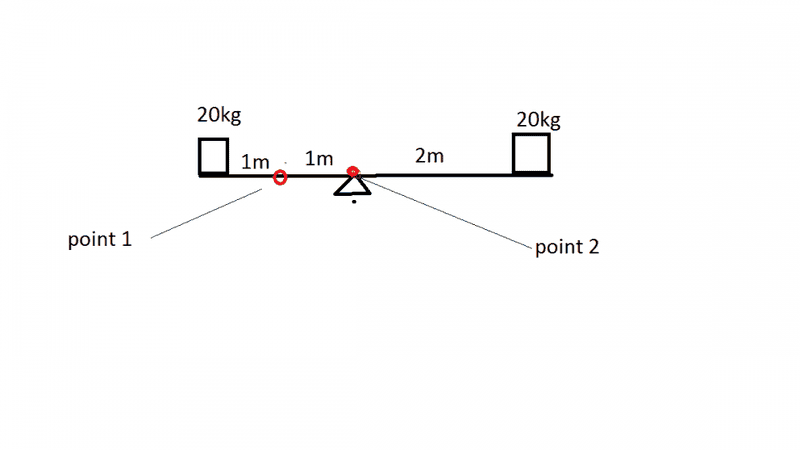
Can someone explain, what means that we can choose any arbitrary point to calculate moment and result will always be identical?

If I choose point 1 ...20kg x 1m = 20kg x 3m...seesaw right side will fall down
If I choose point 2...20kg x 2m = 20kg x 2m...seesaw stay horizontal

So this two moments are not the same...Fulcrum point in nature is always just one point,how then we can choose any point we wont??
safgdfg.png
 
Physics news on Phys.org
xyz said:
If I choose point 1 ...20kg x 1m = 20kg x 3m...seesaw right side will fall down
If I choose point 2...20kg x 2m = 20kg x 2m...seesaw stay horizontal
There are 3 forces acting on the seesaw, not just 2.
 
A.T. said:
There are 3 forces acting on the seesaw, not just 2.

I know,there is reaction force on fulcrum which is equal to total weight (40kg)..

But what does mean that we can choose any point for calculate moment?
 
xyz said:
I know,there is reaction force on fulcrum which is equal to total weight (40kg)..
So why do you ignore it in your net moment calculations?
 
xyz said:
Can someone explain, what means that we can choose any arbitrary point to calculate moment and result will always be identical?

Not clear what you mean by "result." The net moment (torque) will be different depending on the choice of point. The more general statement is that net moment about any point is proportional to the rate of change of angular momentum about that point.

Here is an earlier thread with a similar discussion: https://www.physicsforums.com/threads/rotational-equilibrium-torque-about-any-axis.440631/
 
pixel said:
The net moment (torque) will be different depending on the choice of point.
Unless it's zero, like in this case.
 
A.T. said:
Unless it's zero, like in this case.

Your comment led me to review some ancient history. If the net moment is zero about one point, it is not necessarily zero about all other points. That is only true if the net force is zero.

Here's a discussion of this: http://physics.stackexchange.com/qu...red-from-one-point-in-space-it-equals-zero-me

As shown there, in general the moment transfer from point A to point B is given by Mb = Ma + rabxF where rab is the position vector from a to b and F is the net force. So if Ma is zero and the net force is zero, then Mb is also zero.
 
pixel said:
That is only true if the net force is zero.
Good point, but that's also the case here.
 
pixel said:
Your comment led me to review some ancient history. If the net moment is zero about one point, it is not necessarily zero about all other points. That is only true if the net force is zero.

Here's a discussion of this: http://physics.stackexchange.com/qu...red-from-one-point-in-space-it-equals-zero-me

As shown there, in general the moment transfer from point A to point B is given by Mb = Ma + rabxF where rab is the position vector from a to b and F is the net force. So if Ma is zero and the net force is zero, then Mb is also zero.

Thanks pixel!
Now is clear to me...This is the key;

The sum of the torques on any point is equal, only when the sum of the forces is zero
 
  • Like
Likes   Reactions: sophiecentaur

Similar threads

  • · Replies 1 ·
Replies
1
Views
2K
  • · Replies 1 ·
Replies
1
Views
1K
  • · Replies 34 ·
2
Replies
34
Views
9K
  • · Replies 2 ·
Replies
2
Views
1K
Replies
8
Views
7K
  • · Replies 6 ·
Replies
6
Views
1K
  • · Replies 5 ·
Replies
5
Views
3K
Replies
3
Views
1K
  • · Replies 0 ·
Replies
0
Views
2K
Replies
9
Views
13K